
Part 1: A Temporary Father
Two years after my mother passed away, the silence of my childhood home became deafening. To escape the echoing walls, I began volunteering at a small hospice on the outskirts of town. I told my friends and colleagues that I wanted to give back to the community and help others in need. The truth, however, was much simpler and far more selfish: I simply could not stand returning to an empty house. At the hospice, grief was a shared, unspoken language. It was allowed to exist freely, without anyone constantly asking when I planned to “move on” or “recover.”
That quiet sanctuary was where I first crossed paths with Nathan Cole.
 Our unconventional friendship started with a simple cup of coffee and a lot of complaints.
Nathan was fifty-nine years old, seriously ill, and profoundly irritated by absolutely everything breathing or moving around him. He complained relentlessly about the weak, watery coffee, the mind-numbing daytime television, and the overly cheerful nurses who constantly called him “brave.” While the other patients’ rooms were brightly decorated with fresh flowers, framed family photographs, and a steady stream of relatives visiting with warm, homemade food, Nathan’s room was stark. He had one battered leather bag sitting in the corner and a glaring blank space on his intake form where an emergency contact should have been.
During my second volunteer shift, I decided to take a risk. I walked across the street to a local café and brought him a real cup of coffee.
“You remembered the cream,” he grumbled, eyeing the cup suspiciously before taking it.
“You complained about the lack of it for twenty solid minutes yesterday,” I replied, pulling up a chair.
He almost smiled—a rare, fleeting break in his stony facade. “Complaining doesn’t guarantee that anyone actually listens.”
“It certainly does when you make yourself impossible to ignore.”
After that day, a strange bond formed. He began explicitly requesting me for his care. I made it a habit to visit him before every shift ended, and little by little, the walls came down. Nathan shared fragmented pieces of his life story. I learned he had washed dishes for minimum wage, driven long-haul delivery trucks across the country, and eventually worked his way up to manage a local diner. Whenever I gently steered the conversation toward family or asked if he had any children, however, a shadow would cross his face, and he would abruptly change the subject.
One rainy evening, a younger man in a sharp, dark suit appeared in Nathan’s room carrying a thick folder of documents. The moment the man walked in, Nathan’s relaxed expression hardened into stone.
“This is Eric,” Nathan said flatly, not making eye contact. “He handles my paperwork.”
Eric barely acknowledged my presence, offering only a stiff nod. Nathan rigidly signed the legal documents and dismissed Eric with the cold detachment one might use for an employee, rather than someone who might be family.
A few days after the uncomfortable visit, Nathan was weaker. He reached out and grasped my hand with surprising strength.
“I have one final request,” he rasped.
“That sounds dangerous coming from you,” I teased gently.
“Pretend you’re my daughter until I’m gone.”
I froze, staring at him. He quickly filled the silence, explaining in a low voice that he had lost his daughter before she was even born and had never gotten the chance to know her.
The request struck a deep chord within me. My mother had raised me entirely alone. She never once revealed my father’s identity, shutting down my questions with a single, painful sentence: He chose fear over us. Nathan’s bizarre request probably should have disturbed me, but instead, it touched the oldest, most tender wound inside my heart.
“Well then,” I said, forcing a warm smile through my sudden tears, “hello, Dad.”
Nathan laughed out loud—a genuine sound that quickly turned into a violent coughing fit, but his eyes sparkled with gratitude.
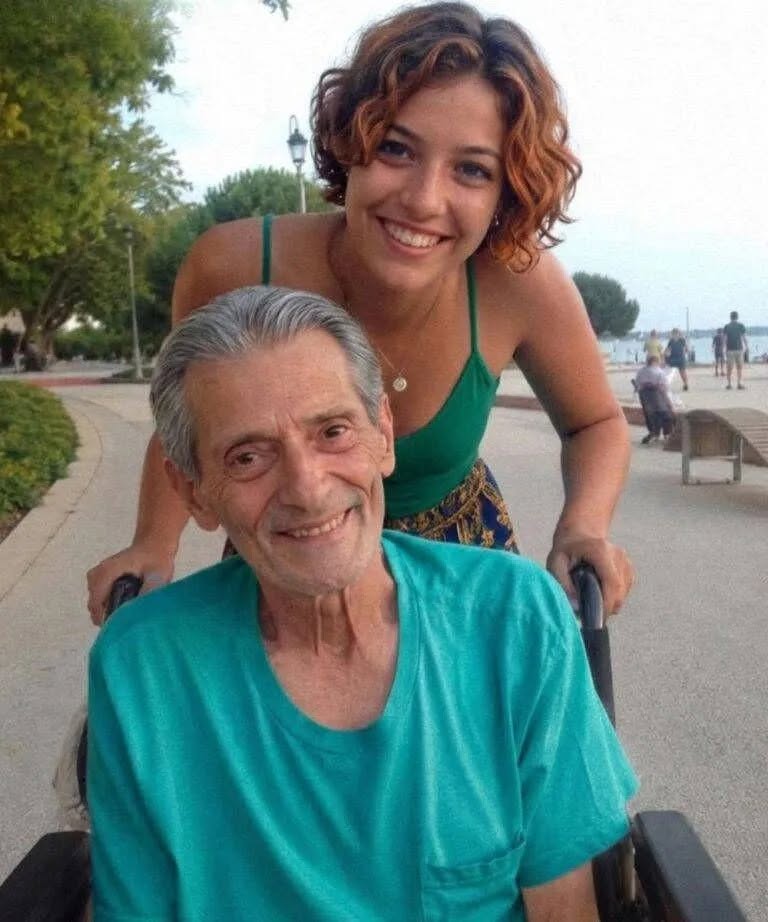
For six beautiful, heartbreaking weeks, we played the role of a temporary family. I brought him his favorite coffee, helped him cheat on his crossword puzzles, and pushed his wheelchair through the hospice garden while he meticulously criticized the color of every blooming flower. The hospice staff even approved two special outings for us.
The first was a trip to Millie’s Diner. Walking in with Nathan felt like walking in with a local celebrity. Everyone seemed to know his name. A waitress rushed over, bringing his coffee exactly how he liked it without even asking, and Nathan happily ordered two massive slices of warm apple pie.
The second trip was to the ocean. I carefully helped him across the uneven sand, and he stood barefoot near the freezing water, his eyes closed, breathing in the salt air as if trying to memorize it.
Throughout these weeks, people we encountered often assumed I was his real daughter.
“She is,” Nathan would fiercely interject before I could even open my mouth to correct them.
Every single time he said it, a profound warmth moved through my chest, immediately chased by a heavy pang of guilt. I knew we were just playing pretend, but after years of being the sole caretaker for my ailing mother and always being the one who was desperately needed, I deeply enjoyed the feeling of being chosen.
But time is unforgiving, and Nathan became weaker with terrifying speed. During my final evening visit, he could barely keep his eyes open.
“Was I convincing?” he whispered, his breathing shallow.
“As a father?”
“As someone worth remembering.”
I held his frail hand tightly between both of mine. “You were incredibly difficult.”
“That sounds honest,” he breathed.
“But I promise you… I’ll remember you.”
He passed away peacefully the following morning.
At his small funeral, the crowd was sparse but meaningful. I saw familiar faces of the hospice workers, the loyal staff from the diner, and Eric, the man in the suit, standing entirely alone near the back of the cemetery. Eric watched intently as I placed a single white flower on Nathan’s casket, but he made no move to approach me.
The very next day, my phone rang. It was Eric.
“I need you to come to my office,” he said, his voice completely devoid of emotion. “I need to tell you something Nathan should have told you himself.”
Part 2: The Truth Behind the Pretence
The wooden box contained decades of silence, secrets, and a truth that shattered my reality.
We met in Eric’s sterile, meticulously organized office. The only thing out of place was an old, intricately carved wooden box sitting dead center on the desk between us.
Eric didn’t bother with small talk. He looked me dead in the eye and dropped a bomb.
“Nathan was your biological father,” Eric said.
For several agonizing seconds, the words floated in the air, making absolutely no sense. My brain refused to process the syllables. Then, Eric slid a thick manila file across the polished wood. With trembling hands, I opened it. Inside was a legally signed acknowledgment of paternity dated months before my birth, stacks of letters my mother had stubbornly returned unopened, and a recent, undeniable DNA genealogy match.
The puzzle pieces violently clicked together. Years earlier, in a desperate bid to find a sense of belonging, I had submitted my DNA to a public database while searching for distant relatives on my mother’s side. Nathan had used that exact database to track me down. He had learned where I spent my weekends volunteering and had deliberately, calculatedly chosen to check into that specific hospice.
“He arranged everything?” I asked, my voice barely a whisper.
“Yes.”
“And you knew?”
“Yes.”
“For all six weeks I sat by his bed? You knew?”
“Yes.”
I stood up so violently that my heavy chair slammed into the wall behind me. My blood roared in my ears. Nathan had known exactly who I was every single time he looked at me, all while pathetically asking me to “pretend” to be his daughter. Eric had known, too. Together, these two men had completely stripped away my agency. They had taken away my fundamental right to decide whether I wanted to forge a relationship with the coward who had abandoned my mother to raise me alone.
Eric remained seated, though he looked visibly uncomfortable. He admitted that Nathan was terrified I would angrily refuse to ever see him if I knew his true identity.
“That was my choice to make!” I shouted.
Eric lowered his eyes, suddenly looking much older than his years. “I told myself he was a dying man. I genuinely believed that six weeks of ignorant comfort would hurt you less than the brutal truth.”
“No,” I sneered. “You decided that his comfort, his peace of mind, mattered significantly more than my consent.”
“Yes,” he admitted softly. “I was wrong.”
I sank back into my chair, exhausted. Inside the wooden box were two thick bundles of letters—one addressed in shaky handwriting to me, and one to Eric. Beneath those letters were legal documents leaving us, two perfect strangers, joint ownership of Millie’s Diner.
“Who exactly are you to Nathan?” I demanded.
Eric’s jaw tightened, the muscles ticking in his cheek.
“I’m his son.”
The revelation was another blow. Nathan had married a few years after cowardly abandoning my pregnant mother. Eric had grown up in Nathan’s house, living under his roof, but their relationship had been anything but warm.
“He paid the electric bills and showed up to my school meetings,” Eric said bitterly. “But he never once asked how I felt about anything, unless the answer directly affected my academic grades or his reputation.”
“And yet, despite all of that coldness, you still protected him. You lied for him.”
Eric looked away, staring out the office window. “When he finally sat me down and told me about you, I thought he was finally trusting me. I thought he was finally treating me like a son. But then… then you arrived at the hospice with that damn coffee, and within days, he became the loving father I had desperately wanted my entire life.”
“You resented me.”
“Yes. More than you can imagine.”
That night, sitting alone in my dark living room, I finally opened Nathan’s letter. It was a painful, raw confession. He admitted that he had profoundly failed both of us, albeit in completely different ways. He had abandoned me completely, leaving a void in my life, while physically raising Eric in a home utterly devoid of affection.
He confessed that he had orchestrated our “accidental” meeting because he wanted to discover whether I could grow to care about him as a person before I learned about the monstrous thing he had done in the past.
The realization made my stomach churn. When Nathan had asked me on his deathbed whether he had been convincing, he hadn’t been asking if he was good at pretending to be my father. He had been asking if he was good at pretending not to be.
His deep regret had somehow morphed into one final, selfish demand. He wanted absolute forgiveness without ever giving me the fair chance to question him, to scream at him, to reject him, or to look him in the eye and tell him exactly how his cowardly absence had shaped every facet of my life.
Nathan’s final, desperate hope—written in the closing lines of the letter—was that Eric and I would somehow magically bond and give each other the loving family he had selfishly denied us both.
I called Eric first thing the next morning.
“We are not required to become a family just because Nathan wanted a neat, clean ending for his own conscience,” I stated firmly.
“I completely agree,” Eric replied.
“And for the record, I’m not forgiving you for lying to me.”
“I understand.”
For the next long, agonizing month, we communicated strictly through separate lawyers. Millie’s Diner was locked in legal limbo; it could not be sold without both of our signatures. The prime real estate the building sat on was incredibly valuable, but the restaurant business itself was struggling heavily. Eric, ever the pragmatic businessman, wanted to sell the property immediately, pay off the mounting debts, and cleanly divide whatever cash remained.
At first, still blindingly angry, I readily agreed.
Then, we had to visit the diner for an appraisal.
Part 3: The Family We Chose Ourselves
Millie’s Diner wasn’t just a business; it was a sanctuary full of memories and loyal friends.
The moment we walked through the glass doors, the smell of roasted coffee and baking pie hit me. A silver-haired waitress named Rosa, whom I remembered from my outing with Nathan, recognized me immediately. Her face lit up.
“Oh, honey! You came here with Nathan a while back,” she smiled warmly.
She bypassed the empty tables at the front and led us straight to the secluded corner booth where he and I had eaten apple pie together. We sat down, and Rosa lingered for a moment, wiping down the already spotless table.
“You know, Nathan actually began his time here as a teenage dishwasher,” she explained, a nostalgic gleam in her eye. “He worked his fingers to the bone. Years later, he scraped together enough to buy the whole building.”
Then, she leaned in and told me something that made my breath hitch.
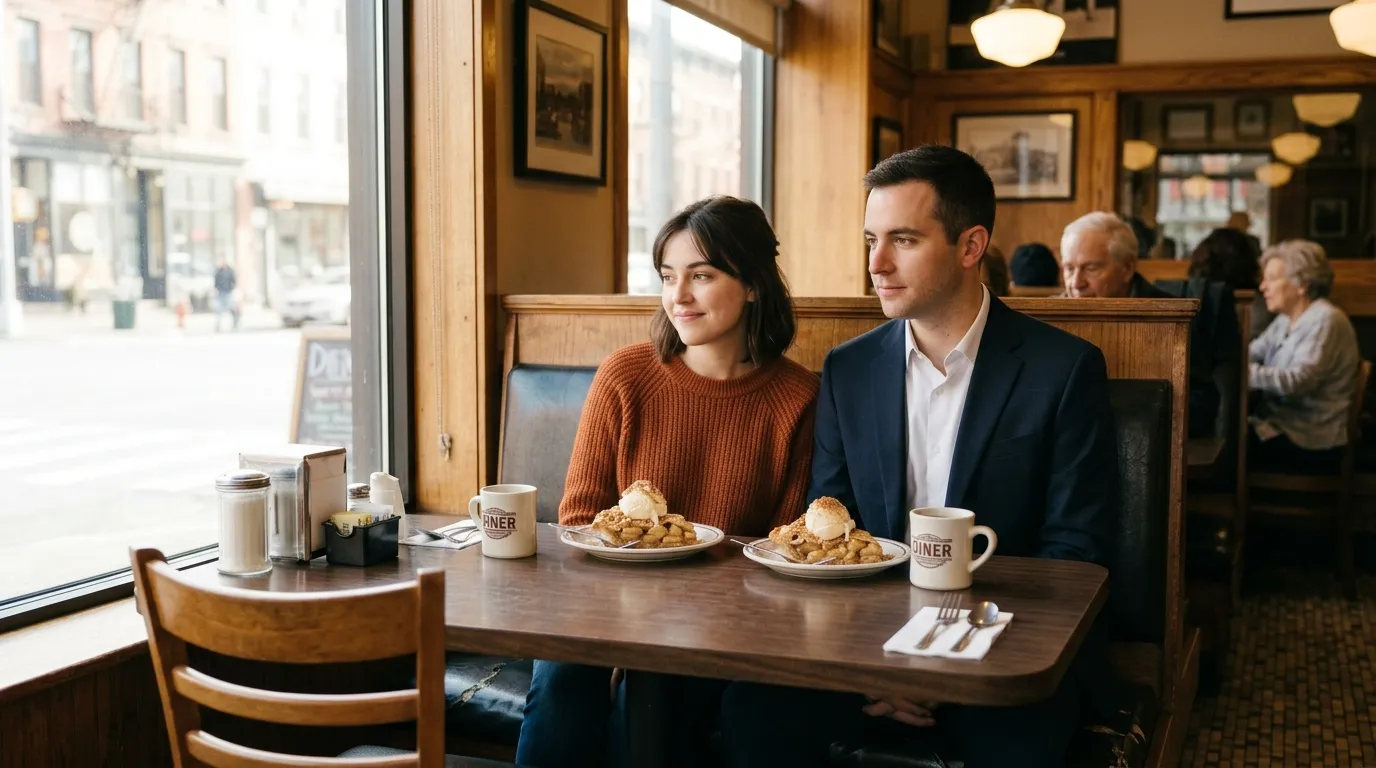
“Every single year, on your birthday, Nathan came to this exact booth, sat right where you are, and ordered two slices of apple pie. He’d eat one, and leave the other sitting right there.”
For a fleeting moment, I felt the hard, icy armor around my heart soften. But I quickly shook my head, reminding myself that missing someone from afar was not at all the same as stepping up and being a father to them.
As Eric and I reviewed the books, the reality set in. Six dedicated employees depended entirely on the diner to feed their families. Selling it would easily pay Nathan’s lingering debts and line our pockets, but it would also instantly erase their livelihoods.
Eric remained cold and practical, tapping his pen on the ledger.
“We can’t just blindly preserve every failing business in town because we feel a little guilty,” he argued.
“And you think selling it solves everything?” I shot back.
“It pays what is legally owed. It’s clean.”
“It also costs six innocent people their jobs, Eric. Six people who actually cared about him.”
Our voices had raised. The manager, a kind-eyed man named Paul, overheard our bickering. He walked over, wiping his hands on his apron, and gently interjected that Nathan had been desperately trying to restructure the business to make things right before he got sick.
Then, Eric did something completely unexpected.
He stood up. “He lied to her,” Eric said loudly, right in front of Paul, Rosa, and two line cooks who had peaked out from the kitchen. “She didn’t know Nathan was her father when she took care of him. But I did. I helped him hide it from her until the day he died.”
The bustling diner became pin-drop silent. Only the hum of the refrigerator could be heard.
“I chose to honor his selfish wishes over her basic right to know her own family,” Eric continued, his voice wavering just a fraction. “So, whatever happens to this diner, whatever decision is made… do not blame her. The fault is mine.”
It was the very first time in his entire life that Eric stopped protecting Nathan’s pristine reputation and took accountability.
Three days later, I received a thick envelope in the mail. Inside was a deeply sincere, handwritten apology from Eric. Alongside it was a legal notice: he offered to officially resign as the estate representative and pay out of his own pocket for an independent lawyer to review every single document to ensure I wasn’t being cheated.
His apology had finally cost him his pride, his power, and his money. It was real.
Moved by his gesture, I agreed to properly examine the diner’s tangled finances together. For four exhausting months, Eric and I met twice a week in that same corner booth. We argued passionately about staffing schedules, debt restructuring, changing the operating hours, and whether our shared desire to save Millie’s was rooted in misplaced loyalty or lingering guilt.
Eventually, we struck a brilliant compromise. We sold a large, unused piece of land situated behind the main building and reduced the operating hours to peak times, which ensured the remaining debts became entirely manageable.
Trust, frail and hesitant, developed slowly between us.
Eric began disclosing his minor mathematical mistakes before I could even discover them in the ledgers. During late-night planning sessions over stale coffee, I learned that he had secretly spent the vast majority of his own life savings paying for Nathan’s expensive experimental treatments. He, in turn, learned about the crushing exhaustion of working two minimum-wage jobs while nursing my mother through her final days.
Neither of these shared truths magically erased the deep pain of what had happened.
But they did change the shape of our anger, molding it into something resembling mutual understanding.
A year later, Millie’s Diner officially formed a charitable partnership with the local hospice. Once a month, the diner closed its doors to the public and served free, hot breakfasts to the families of hospice patients, giving them a brief moment of normalcy in their grief.
We did not rename the restaurant after Nathan. We didn’t hang his picture on the wall.
But we did leave the corner booth entirely unchanged.
 Love doesn’t erase anger, and anger doesn’t make love false. We found a way to hold both.
On the morning of my birthday, I arrived at the diner long before the “Open” sign was turned on. I walked to the back and found Eric already sitting in the corner booth. In the center of the table sat two steaming slices of apple pie.
“I suppose he finally got his table for two,” Eric said quietly, tracing the rim of his coffee mug.
I looked at the empty seat directly across from him. Nathan had manipulated me. He had cowardly denied me the chance to confront him in life. The fact that he sat in this booth missing me for years did not magically repair the devastating choice he made when he walked away from my mother.
But the six weeks we had shared at the hospice—the laughter, the walks on the beach, the coffee—had also been undeniably real.
Love did not erase the anger. But the anger did not make the love false, either.
I walked over, grabbed a third chair from an adjacent table, and pulled it firmly toward our booth.
“No,” I said, sitting down next to Eric. “He doesn’t get to decide who belongs at this table anymore.”
Eric studied the third chair for a long moment, then shifted over, making room for me beside him.
Before the front doors officially unlocked, Eric reached into his suit jacket and placed Nathan’s thick, unopened letter onto the table between us.
“I still haven’t read it,” Eric confessed.
“Why?” I asked.
“Because I already know what he’ll ask me to forgive. And I don’t know if I’m ready.”
“You don’t have to read it today,” I assured him, bumping my shoulder gently against his.
For once in our lives, neither of us allowed Nathan Cole to control the timing of our healing.
We sat together in comfortable, companionable silence until Rosa emerged from the back and cheerfully switched on the warm overhead lights. In the reflection of the large front window, three chairs appeared side by side, anchored by the two of us.
Outside, families from the hospice began gathering by the door, ready to enter for breakfast.
Nathan’s slice of pie remained untouched in the dead center of the table. Rosa walked by, took one look at the three chairs, offered a knowing smile, disappeared briefly into the bustling kitchen, and returned placing one more fork right in front of me.
Note:This work is inspired by real events and people, but it has been fictionalized for creative purposes. Names, characters, and details have been changed to protect privacy and enhance the narrative. Any resemblance to actual persons, living or dead, or actual events is purely coincidental and not intended by the author.
All images used in this article are AI-generated and intended for illustrative purposes only.