
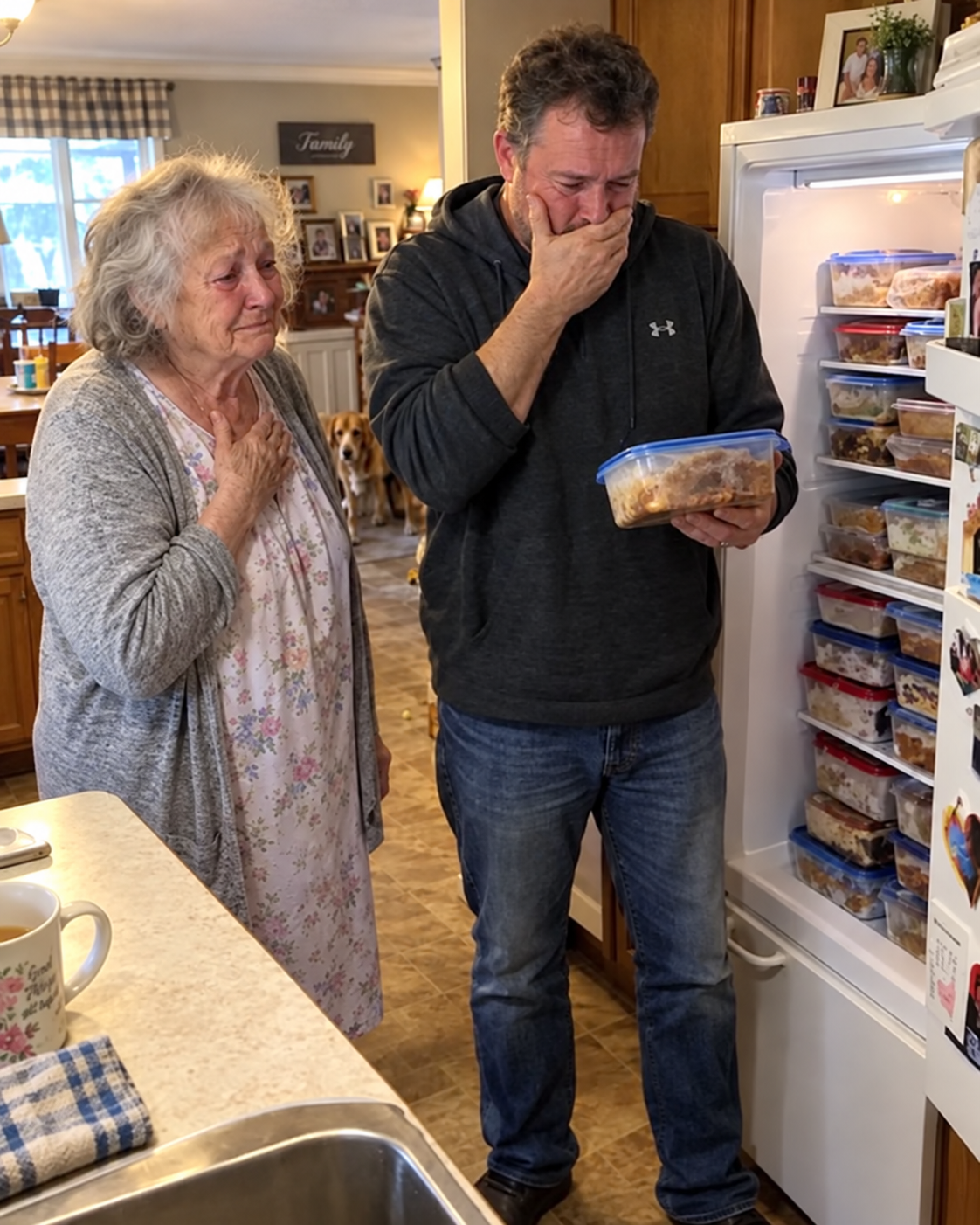
“Why are there twelve containers of pot roast in your freezer?”
Dozens of plastic containers, each dated in careful handwriting, marked the quiet Sundays she spent alone.
The Anchor of Forty Years
That was my mother, Winona Hale.
She was sixty-eight years old, a retired cardiac nurse, born and raised in middle Tennessee. Winona was the kind of woman who could spot an ear infection from across the yard before the fever even started. If a neighbor down the road lost a spouse, Mom was at their porch before noon with a warm chicken casserole wrapped in aluminum foil and an extra pound of sweet cream butter.
For almost four decades, our family’s entire calendar was anchored to one sacred ritual: Sunday dinner.
You never had to ask what time it started. You never asked what she was cooking.
Around one o’clock in the afternoon, car doors would slam in the driveway. The screen door would squeak on its hinge. You would walk in to the rich aroma of roast beef simmered in onions, crispy buttermilk fried chicken, golden biscuits resting under a flour-sack tea towel, and a glass pitcher of sweet tea beaded with condensation on the counter.
Mom was always in motion. She would weave between the stove and the table, reminding everyone to take their seats while flatly refusing to sit down herself.
Grandkids tore through the hallway, their socks sliding across the hardwood. Dad had the football game on in the den at full volume. Caleb would sneak into the kitchen to pick off the crispy edges of the roast before it was carved. And Mom would scold us for not helping—only to gently swat your hand away with a wooden spoon the moment you tried to stir the gravy.
It wasn’t just a meal; it was the rhythm of our lives.
For nearly forty years, Mom’s kitchen was the heart of our family’s weekends.
The Silence After the Split
Everything changed last winter.
After forty years of marriage, my parents made the quiet decision to divorce. There was no explosive scandal, no dramatic screaming matches on the front lawn, and nothing juicy enough to explain to acquaintances at the local grocery store.
The truth was simpler and heavier: they had spent four decades raising three kids, paying mortgages, managing night shifts, and caring for dying grandparents. Somewhere in the middle of keeping the household alive, they had simply forgotten how to be partners to one another.
Dad packed his belongings and moved into a small garden apartment twenty minutes across town. Mom remained in the family home.
And just like that, Sunday dinner vanished.
The first weekend after Dad moved out, Mom sent a message to our family group chat:
“Not cooking today, kids. Just going to rest and take it easy.”We completely understood. A little breathing room seemed only natural.
The following Sunday, her phone stayed quiet. Caleb figured she needed personal time to process everything. I assumed she was enjoying the quiet house. My sister, Erin, reasoned aloud: “Mom spent forty years cooking for an army every single weekend. Maybe she’s finally enjoying the break.”
It sounded logical. So we gave her space.
At least, that was the noble story we told ourselves.
We still checked in during the week, made brief phone calls during our commutes, and invited her along to middle-school band concerts. But our Sundays gradually morphed into personal free time. Caleb ate lunch after church with his in-laws. Erin took her kids for drive-thru burgers. My husband and I savored long, slow mornings without anywhere we had to be.
Through it all, Mom never uttered a word of complaint.
The Discovery in the Freezer
Then came a bright Saturday morning in June. Caleb had stopped by the house to borrow an extension ladder from the shed, stepped inside to grab a glass of tap water, and casually opened the deep freezer. That was when he found it: sixteen solid weeks of Sunday dinners. Fully cooked. Generously portioned into family-sized foil and plastic containers. Dated by hand. Frozen solid. Caleb called Erin and me immediately. By the time I walked through the side door, he was leaning against the laminate counter, visibly shaken. His frustration wasn’t born from anger; it was that defensive, sharp ache that hits you when you realize you have been blind to something right in front of your eyes. “Mom,” Caleb said, gesturing toward the open freezer door. “What is all of this?”
She slowly wiped down the counter with a damp dishcloth. “It’s food, Caleb.”
“I know it’s food. Why is it in here like this?”
“Then why did you ask?” she murmured.
Under normal circumstances, we would have laughed at her dry wit. Nobody laughed.
Caleb reached into the freezer and pulled out a large rectangular dish marked with black marker: March 8 – Pot Roast & Carrots.
He stacked another one on top: March 15 – Chicken & Rice Casserole.
Then another: March 22 – Glazed Ham.
His voice softened, catching in his throat. “You’ve been waking up every Sunday morning and making dinner this entire time?”
Mom looked down at the linoleum floor. “Yes.”
“Who were you cooking for, Mom?”
She didn’t answer right away.
A knot tightened in my chest. “Were you cooking for us?” I asked.
Sitting at the kitchen table, the silence of the past four months finally broke.
“I Was Trying to Find Out Something”
Mom turned toward the kitchen table—the same round oak table we had eaten at since we were toddlers. The top was a roadmap of our upbringing: the tiny indentations where Caleb had pressed too hard doing algebra homework, the pale heat ring left by a pot Dad had set down without a trivet, the faint yellow crayon mark from Erin’s oldest boy.
Mom pulled out her regular wooden chair and sat down slowly.
“I suppose I didn’t know who I was making it for,” she whispered.
Caleb shook his head, running a hand through his hair. “This doesn’t make any sense, Mom. If you wanted us here, why didn’t you just call us? Why didn’t you text the group?”
She laid the dishcloth flat on the table, carefully folding it in half, then in quarters.
“I spent forty years calling everybody,” she said evenly. There was no bitterness in her tone, which made the words cut deeper. “I called to tell you the table was set. I called to remind you when the electric bill was due. I called when a cousin had a baby. I called to ask if you made it home before the rain started. I called to remind you to check on your father when his back was acting up.”
She smoothed the folded towel with the palm of her hand.
“After the separation, I just wondered what would happen if I stopped calling.”
Caleb stared at her, stunned. “So this was a test?”
The word slipped out sharper than he intended. Mom flinched as if she had been struck.
“No,” she said firmly. “I would never test my children.”
“Then what was it?”
Her eyes brimmed with water, but she refused to let the tears spill over. That stubborn composure broke my heart.
“I was trying to find out if anyone came because they wanted to see me,” she said, her voice trembling slightly, “or if you only came because I put a plate of food in front of you.”
Note:This work is inspired by real events and people, but it has been fictionalized for creative purposes. Names, characters, and details have been changed to protect privacy and enhance the narrative. Any resemblance to actual persons, living or dead, or actual events is purely coincidental and not intended by the author. All images used in this article are AI-generated and intended for illustrative purposes only.
The Hidden Cost of Caretaking
The kitchen fell deathly still. Suddenly, forty years of Sunday afternoon memories took on an entirely different light. We remembered the laughter, the football games, the seconds of pie, and the ease of being cared for. Mom remembered standing on swollen feet after a sixty-hour hospital workweek, scrubbing cast iron pans, and jumping up every ninety seconds because someone needed extra napkins, fresh tea, or more warm rolls. We remembered family time. Mom remembered being the invisible engine that kept it running. Caleb pulled up a chair opposite her and leaned in. “You could have told us you felt that way.” “I know.” “You let us think you wanted to be left alone.” Mom looked straight into his eyes. “And you let me think you were relieved not to come.” The room seemed to run out of air. Caleb dropped his head into his hands. When he looked up, his face was pale. “Mom… we honestly thought you were exhausted from taking care of us your whole life.” Mom paused, studying his face for several seconds before answering with devastating honesty. “I was.” Caleb looked crushed. But before he could speak, Mom reached across the worn table and wrapped her fingers around his wrist. “I was tired of taking care of you,” she said gently. “But I was never tired of you. There’s a difference.” That was the line that shattered our defenses. Erin wiped a tear from her cheek; I choked back a sob, and even Caleb’s eyes turned red. Mom let out a shaky breath, and the tears she had held back for months finally fell. “I just didn’t know,” she confessed, “if there was any difference left between being your mother and just being convenient.” There it was—the unvarnished truth of so many mothers. We loved her without question, but we had become so comfortable receiving her love that we forgot to see the woman giving it. We thought giving her space was an act of mercy; she felt it as abandonment. She thought keeping silent would bring clarity; instead, it only deepened our isolation.The Table Turned
The following morning was Sunday. At 11:43 AM, the sound of gravel crunching broke the quiet outside Mom’s living room window. When she parted the curtains, she didn’t see one car—she saw three. Doors flew open. Caleb marched up the driveway carrying an oversized roasting pan covered in foil. Erin balanced a bowl of green beans and a basket of warm bread. I hurried behind with a pot of garlic mashed potatoes, while my husband carried two bakery boxes with freshly baked peach and pecan pies. The teenagers carried two giant jugs of iced tea. Nobody had texted her. Nobody had asked if she felt like entertaining. Nobody had asked what time we should eat. We just showed up.
For the first time in forty years, the front door opened to a meal she hadn’t prepared.
When she opened the front door, she stood frozen on the threshold, her hands hovering near her collarbone, looking completely bewildered.
Caleb held the warm roasting pan up between them. “Hope you’re hungry, Winona. Move aside—we’re cooking in your kitchen today.”
Mom stood there for a beat, looking at the parade of casseroles, pies, and her grandbabies bounding up the steps. Then she began to laugh, crying right through the middle of it.
Sitting Down Without an Apron
That afternoon, for the very first time in our lives, Winona Hale sat at the head of her own dining table while her children served her. The food wasn’t nearly as good as hers. Caleb had left the roast in the oven twenty minutes too long, leaving the edges a bit tough. My mashed potatoes were slightly too salty. Erin realized midway through the meal that she had forgotten the butter, and one of the grandkids dropped a warm yeast roll on the rug and ate it anyway. It was messy. It was imperfect. It was loud. And it was pure grace. The single detail that remains etched into my memory is simple: Mom sat at that table without an apron on. No dishtowel tucked over her shoulder. No nervous jumping up to wipe down grease splatters. No rushing back and forth to refill someone’s glass before it ran dry. Just our mother, sitting squarely among the family she built, letting herself be cherished. These days, Sunday dinner is back on the schedule, but under completely new ground rules. Mom isn’t allowed to carry the burden alone. Some weeks Caleb cooks, other weeks Erin or I host. Some Sundays we simply order three large sheet pizzas and eat them straight out of the cardboard boxes on paper plates. We learned the hard way that the fried chicken and pot roasts were never the real tradition. She was. It took an upright freezer full of untouched casseroles, sixteen weeks of deafening silence, and an honest reckoning to teach us what we should have known from the beginning: Sometimes the people who spend their entire lives making sure everyone else feels loved are quietly waiting to find out if they are loved in return.Note:This work is inspired by real events and people, but it has been fictionalized for creative purposes. Names, characters, and details have been changed to protect privacy and enhance the narrative. Any resemblance to actual persons, living or dead, or actual events is purely coincidental and not intended by the author. All images used in this article are AI-generated and intended for illustrative purposes only.