
“That’s why you stay in school.”
The father sitting near us said it quietly, leaning in closely toward his young son. But he briefly glanced down at my heavy work boots when he said it, and in the quiet hum of the elementary school cafeteria, I was just close enough to hear every single word.
Instinctively, I slid my feet backward, hiding them deep beneath the metal folding chair.
Pennsylvania winters have a way of clinging to you, no matter how hard you scrub.
There was a thick, pale ring of stubborn road salt around each sole of my boots. I had spent ten minutes scrubbing them with a bristled brush at the utility sink in my basement before coming to the school, but Pennsylvania winters have a way of staying on you. They leave their mark.
My grandson, Reid, was all the way across the cafeteria carefully balancing our paper cups of orange juice. He had explicitly told me not to move from our spot.
“I saved the good chair, Grandpa,” he had whispered earlier with a grin. “That other one wobbles.”
I am sixty-four years old. I have worked in city sanitation for thirty-eight years. Until that chilly Tuesday morning, I wouldn’t have believed a complete stranger in a pressed suit could make me feel like an insecure fourteen-year-old boy all over again.
But there I was, silently checking the distance to the side exit door.
A Morning of Comparisons
The school was hosting its annual career breakfast. Proud parents and grandparents sat at long tables decorated with hand-drawn paper placemats while the children happily passed around baskets of blueberry muffins. A polished woman near the bright windows had brought an impressive architectural model of a bridge she helped design. A man in a crisp, dry-cleaned shirt had a sleek laptop open, displaying glamorous pictures of the high-rise office building he managed.
I had brought absolutely nothing.
Reid had asked me to bring my thick leather work gloves to show his class, but in the morning rush, I had left them sitting on the passenger seat of my truck. They were clean enough for hauling trash, sure. But they certainly didn’t look clean enough to sit on a table where children were eating their breakfast.
The man sitting beside me—the one who had made the comment—straightened his son’s crisp collar.
“You want options in life,” he told the boy, his voice carrying an air of authority.
I reached deep into the pocket of my jacket, my fingers wrapping tightly around my truck keys.
I could easily tell Reid that dispatch had called me back in. He knew the drill; sometimes a garbage truck broke down, or somebody on the crew just didn’t show up for their shift. He would be incredibly disappointed, but he was a good kid. He would understand.
Honestly, that thought almost made the guilt worse.
I was still learning the ropes of being a solo parent again, but I always tried to do things the way June would have.
Just then, Reid came marching back carrying two plastic cups, concentrating so intensely on not spilling a drop that his tongue stuck out just a little bit from the corner of his mouth.
“They only had the kind with pulp,” he announced, setting the cups down. “I know you don’t like that, Grandpa. Just drink around it.”
He climbed into the wobbly chair beside me, looking immensely proud of himself.
He was wearing a light blue button-down shirt. When we bought it, it used to hang almost down to his knees. That morning, I had noticed with a pang in my chest that the cuffs were getting far too short for his growing arms.
My wife, June, would have noticed weeks ago. She would have already bought the next size up.
But June had been gone for nineteen months. Before the cancer took her, we had raised Reid together, stepping in as parents from the time we lost our own daughter when Reid was just three years old.
June was the one who knew the unwritten rules of elementary school. She knew exactly which permission slips needed signing and which ones were just informational flyers. She remembered picture day, library day, and the crucial difference between “bring a snack for yourself” and “bring enough snacks for the whole class.”
I was still learning.
Once, I had mistakenly sent him to school in a stiff dress shirt on pajama day. It broke my heart, but he had forgiven me long before I ever forgave myself.
That morning, before the breakfast, I had meticulously ironed his collar with a damp dish towel draped over it, exactly the way June always used to do to prevent burning the fabric. Then, I had stood in front of my own closet for twenty minutes, staring at my clothes, wondering what on earth a sanitation worker was supposed to wear when a school invited him to explain his life’s work.
“Are you staying for all of it?” Reid asked, his bright eyes looking up at me over his cup of pulpy juice.
I slowly let go of my truck keys, leaving them in my pocket.
“Sure, buddy. I wouldn’t miss it.”
When It Was Our Turn
The homeroom teacher stepped to the front and started the introductions. The format was simple: each child would stand up, proudly tell the room who they had brought with them, and then pass the floor to their grown-up to say a few words about their daily work.
I leaned over toward Reid, whispering nervously.
“Hey, you can just tell them I’m your grandpa. You don’t have to make a big speech or anything.”
He frowned at me, looking almost offended.
“But I practiced,” he whispered back.
From his pocket, he pulled a folded piece of lined notebook paper. It was covered in heavy pencil marks and frantic eraser smudges where he had clearly labored over the right words.
I looked down at my orange juice, suddenly feeling a lump form in my throat.
The bridge lady went first, speaking eloquently about engineering. Then came a pediatric nurse in bright scrubs. Then the man next to me, who managed the office building, stood up and smoothly explained how many important people depended on him to keep their businesses running without a hitch.
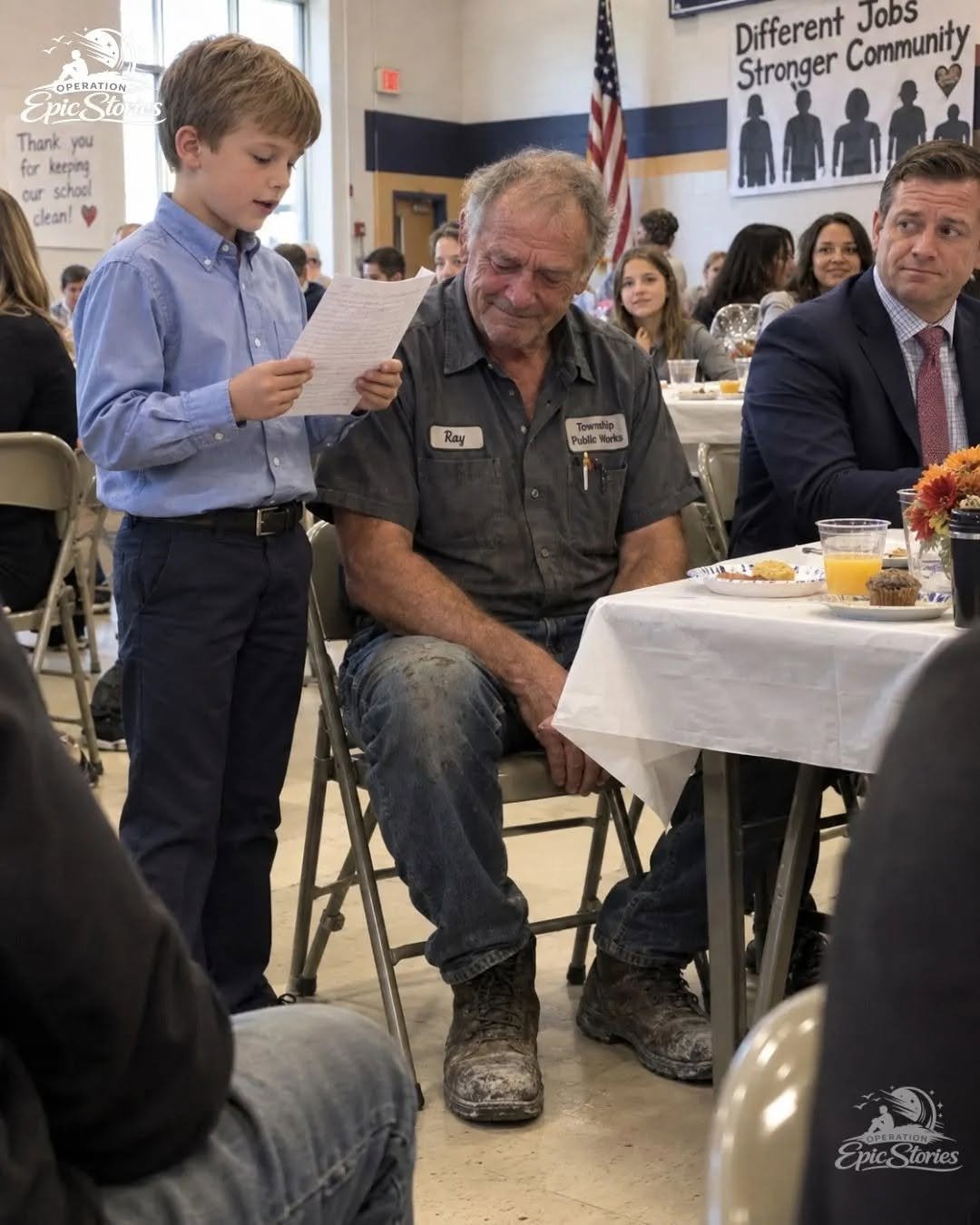
When it was finally our turn, Reid stood up so fast that his chair loudly scraped across the linoleum floor.
“This is my grandpa, Vernon Kline,” his voice rang out, clear and steady.
He looked down at his wrinkled paper, then up at me.
“He picks up garbage.”
The room stayed completely quiet, but I felt my face flush hot anyway. I tucked my salt-stained boots even farther back under the chair.
Reid held the paper with both hands, making sure the whole room heard exactly what he had written.
“He leaves for work when it’s still pitch dark outside,” Reid continued, reading carefully. “When Grandma was here, she stayed with me in the mornings. Now our neighbor comes over to watch me, and he pays her even when she tells him he doesn’t have to.”
A couple of parents across the table smiled softly.
“He says people shouldn’t have to work for free just because they’re nice.”
I swallowed hard. I hadn’t even known he had overheard that conversation with the neighbor.
Reid held his paper with both hands to keep it from shaking.
“He knows exactly which older people on his route can’t pull their heavy cans back up their driveways. So he walks up and does it for them. There’s a lady with a little white dog who waits by the window every single Tuesday just to wave at him.”
He paused for a second, his finger tracking down the page to find his place.
“And when everybody else wakes up and goes outside, their garbage is just gone. The streets are clean. Somebody has to be willing to get up first to do that.”
My large, calloused hands were resting flat on my knees. Looking down, I could see a dark crack of grease beside one thumbnail that the scrub brush hadn’t been able to reach.
Reid turned his attention to the teacher.
“Can he tell the part about school now?”
I stared at my grandson, completely caught off guard.
He gave me the smallest, most encouraging nod.
The Real Lesson
I stood up. As I did, I caught the toe of my heavy boot on the metal chair leg. It made a terrible, clattering racket, and a few of the younger children giggled. The tension broke, and I found myself laughing a little, too.
“Well,” I said, my voice a bit gruff, “I’m definitely a lot better at backing a twenty-ton truck into a tight alleyway than I am at speaking to a room full of people.”
The parents chuckled. That helped me breathe.
“I left high school when I was only sixteen years old. My dad got hurt at the mill, and my family desperately needed another paycheck to keep the lights on. I always meant to go back and finish.”
I rubbed my thick thumb along the plastic edge of the cafeteria table.
“Then, life happened. I kept meaning to go back for about thirty years.”
The teacher smiled gently at me. Nobody in the room rushed me. The silence wasn’t judgmental anymore; it was attentive.
“When I was forty-nine, my wife, June, found a flyer for an adult education program. She quietly left the information right beside my supper plate one evening.”
“What did you say to her?” a little girl with pigtails asked from the next table.
“I told her I was too old to go back to school.”
“And what did she say?”
I closed my eyes for a fraction of a second. I could almost hear June standing at the sink, cheerfully clearing the dinner dishes.
“She looked at me and said, ‘Vernon, you’re going to be fifty next year either way. Might as well be fifty with a diploma.’”
A wave of genuine, warm laughter washed over the grown-ups in the room.
“So, I went. It wasn’t easy. Some nights, after hauling trash for ten hours, I fell asleep right over my kitchen table with my pencil in my hand. Fractions gave me a terrible amount of trouble. A young fellow in my math class stayed late to help me figure them out, and in exchange, I let him use my truck to practice for his driving test.”
I looked down at Reid, who was beaming.
“I earned my high school diploma at fifty years old. I kept the exact same sanitation job afterward because I liked my crew, the pay was honest, and I was good at the work. But I went back because I needed to finish something I’d started.”
Reid was smiling so hard and looking at me with such fierce pride that I actually had to look away for a second to keep my composure.
His teacher thanked me warmly. The room clapped—not polite applause, but real applause. I sat back down in my wobbly chair and reached for my pulpy juice, though my throat was so tight it wouldn’t let me swallow much.
Under the table, Reid gently tapped his clean sneaker against my salt-stained boot.
“You forgot to tell them about the snowstorm,” he whispered.
“I think that was enough for one day, bud,” I whispered back.
“But that was a really good part.”
Framing the Future
When the career breakfast finally ended and chairs were being pushed in, the father sitting beside us waited patiently while his son put on his winter coat.
Then, he turned to face me directly.
“What I said earlier this morning… it was disrespectful,” he said quietly. His face had gone flush with embarrassment. “I made an assumption, and I’m very sorry.”
His son was standing right beside him, watching the exchange.
I deeply appreciated that the man hadn’t waited for the boy to walk away before owning up to his mistake. That takes a different kind of character.
“Thank you,” I said, offering a firm nod.
Outside in the biting Pennsylvania cold, Reid took the long way across the school parking lot specifically so he could step on the satisfyingly crunchy, thin ice frozen along the curb. When I unlocked the truck, he immediately spotted my thick work gloves resting on the passenger seat.
“You brought them!” he exclaimed.
“Forgot to take them inside.”
He picked them up and tucked them into his lap for the ride home, holding the scuffed leather carefully, like it was something truly worth keeping.
We drove in comfortable silence for a few blocks, the truck’s old heater rattling noisily against the cold. Out of nowhere, he asked where my graduation picture was kept.
“In a cardboard box in the hall closet, I think.”
“The one where Grandma’s kissing your cheek?”
“Yep. That’s the one.”
He rested his chin on his hand, watching the snowy houses pass by the window.
“Grandpa? When I graduate from high school, can we buy a frame and put our pictures in it together?”
I slowly came to a stop at a red light. A delivery truck turned ahead of us, and somewhere behind me, an impatient driver gave a quick, sharp tap on their horn after the light turned green. But I didn’t care. I was in no rush.
“Sure,” I said, my voice thick. “We can definitely do that.”
“Just don’t buy the frame yet,” he advised practically. “We don’t know how big my picture will be.”
Some accomplishments look a little different, but they carry exactly the same weight.
That afternoon, when we got home, we dug through the hall closet. We found the photograph tucked safely beneath a stack of old birthday cards. In it, June was beaming and kissing my cheek, and I was holding that hard-earned diploma with both of my hands.
Reid dusted it off and set it right on the kitchen shelf where we could see it every night while we ate supper.
My work boots were left by the front door, salt stains and all. I didn’t scrub them that night.
It turns out, the boots I had tried so hard to hide were the exact ones my grandson wanted to follow.
Have you ever had a moment where someone younger taught you a powerful lesson about your own worth?
Note:This work is inspired by real events and people, but it has been fictionalized for creative purposes. Names, characters, and details have been changed to protect privacy and enhance the narrative. Any resemblance to actual persons, living or dead, or actual events is purely coincidental and not intended by the author.
All images used in this article are AI-generated and intended for illustrative purposes only.