
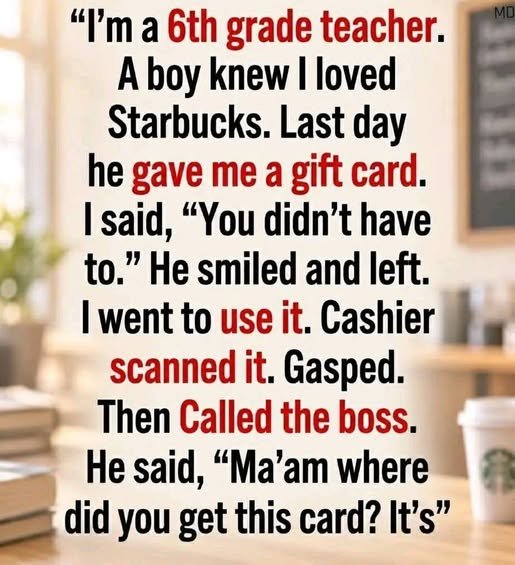
The final bell had already rung, but the sixth-grade classroom was still filled with the sounds of students saying goodbye, signing yearbooks, and getting ready for summer. Desks were left open, papers were scattered across the floor, and backpacks were being zipped shut.
As the room gradually emptied, one student stayed behind near the doorway.
When the last few classmates had gone, he quietly walked over to my desk and placed a small paper envelope in my hand.
“I wanted you to have this,” he said.
Inside was a Starbucks gift card.
At first glance, it looked like a simple end-of-year gift—the kind teachers sometimes receive from students and their families. I smiled, thanked him, and assumed his parents had picked it up for him.
He seemed relieved.
Then he hurried out to join his friends.
I didn’t think much about the gift until a few days later, when I stopped by the coffee shop and casually mentioned to the manager that one of my students had given me a gift card.
She looked at me for a moment.
Then she asked, “Was it from a young boy?”
I said yes.
Her expression immediately changed.
And that’s when she told me something I never could have guessed.
For nearly a month, that little boy had been coming into the shop with handfuls of coins.
Pennies. Nickels. Dimes.
Sometimes he brought a reasonable amount from his allowance. Other times, he had only a few cents. But every time, he asked the employees to put whatever he had onto the same gift card.
He was saving it for his favorite teacher.
The employees had watched the balance grow little by little, one small deposit at a time. They knew that every coin represented something he could have spent on himself, but instead, he had decided to save it for me.
When the manager told me this, the gift suddenly felt completely different.
It wasn’t just a Starbucks card anymore.
It was weeks of planning.
It was patience.
It was sacrifice.
And it was a sixth grader quietly deciding that his teacher deserved something special.
The staff had started recognizing him whenever he walked through the door. They watched patiently as he counted his coins and never made him feel embarrassed about how small each contribution was.
When he finally reached the amount he wanted, they congratulated him.
But even then, he wasn’t finished.
He wanted the envelope to look just right.
Standing there listening to the manager, I realized how completely wrong my first assumption had been. I thought his parents had simply bought the gift.
I had no idea that the gift had been built coin by coin by the child himself.
The dollar amount wasn’t large.
But the meaning behind it was enormous.
Teachers often wonder whether the everyday things they do actually stay with their students. The explanations, the encouragement, the difficult assignments, the quick conversations before class, and the moments spent helping a child who is struggling can sometimes feel ordinary.
We rarely know which of those moments will matter years later.
That little gift card gave me an answer.
He hadn’t simply given me something to spend on coffee.
He had given me something far more valuable: proof that he had noticed, that he cared, and that the ordinary moments we shared had meant something to him.
I kept the card long after the balance was gone.
Whenever teaching felt exhausting or thankless, I would remember that small envelope sitting on my desk.
That sixth grader had probably thought he was giving his teacher a gift.
Instead, he gave me a lesson I would carry for years:
Generosity isn’t measured by how much something costs. It’s measured by how much thought, effort, and heart someone is willing to put into giving it.