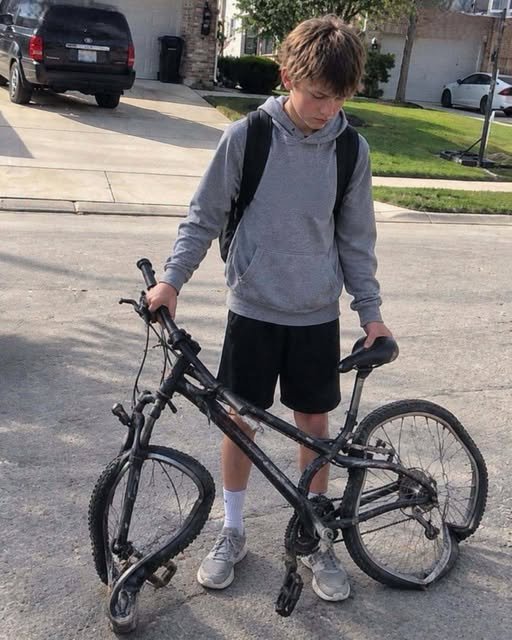
Jake explained that he had shown Gary his notebook. He didn’t threaten him or argue about legal responsibility. Instead, he asked Gary whether he had ever worked hard for something he truly cared about. Then he showed him every lawn, chore, and small job he had completed to earn those $420.
Finally, Jake asked Gary one simple question: “What do you think the right thing to do is?” Gary became quiet, left the room, and returned with an envelope containing exactly $420. He also gave Jake an apology, admitting he should have looked behind him and that he was wrong to act as though the bike didn’t matter.
We returned to the bike shop, where Jake bought the same matte-green model. He even added $2 of his own money for the tax because, as he explained, he wanted to be fair. On the drive home, he told me, “Arguing made him defend himself. I just wanted him to see what happened.”
That sentence stayed with me. I had spent days preparing to prove Gary was wrong. Jake had approached the situation differently. He didn’t ignore what happened or let Gary escape responsibility. He simply gave him a chance to make things right without humiliating him.
That evening, Jake told me Gary had asked where he learned to think that way. “I told him I watched my dad,” Jake said. Those words hit me hard. I realized my son had been watching how I handled difficult situations all his life.
The bike cost $420, but Jake had gained something worth far more: patience, confidence, discipline, and the ability to stand up for himself without becoming cruel. I had wanted to teach my neighbor a lesson. Instead, my twelve-year-old son taught me one: sometimes strength isn’t about being the loudest person in the room. Sometimes it means staying calm enough to help someone choose to do the right thing.