
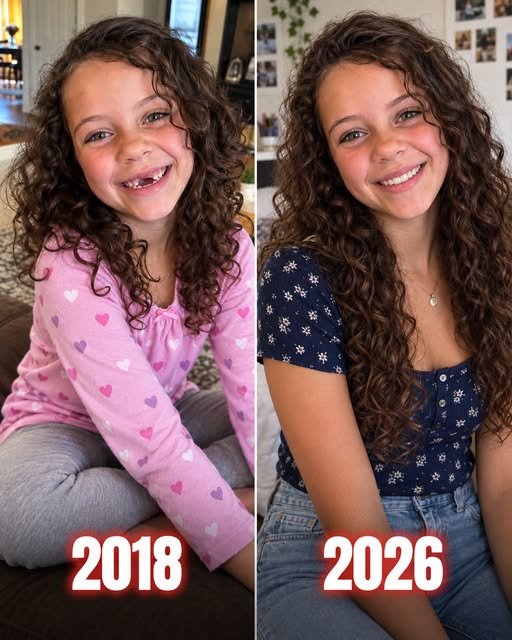
Part 1 — The Daughter I Never Stopped Missing
Eight years had passed since I buried my only daughter.
People like to say that time heals grief.
I don’t think that’s true.
Time teaches you how to live beside it.
It teaches you how to get out of bed when the person you love is still gone. How to answer ordinary questions. How to laugh without immediately feeling guilty. How to walk past a child’s bedroom without reaching for a doorknob that hasn’t been turned in years.
But grief doesn’t disappear.
Mine simply learned to be quiet.
My daughter, Maggie, was eight years old when she woke one morning with a fever.
She shuffled into our bedroom wearing her yellow pajamas and stood beside me with her hair tangled around her face.
“Mom,” she whispered, “my legs feel really heavy.”
I was awake instantly.
Paul lifted his head from the pillow.
Within an hour, we were at the hospital.
At first, no one seemed frightened.
Children got fevers. Children became weak. Doctors ordered tests, nurses smiled, and everyone kept using words like precaution and observation.
Then one test became five.
Five became twenty.
Specialists started appearing.
The smiles became tighter.
Nobody wanted to tell us they were worried, but Paul and I could see it in the way doctors gathered outside Maggie’s room.
For twelve days, we waited for an answer.
Every morning, I convinced myself that this would be the day someone walked through the door and said, We figured it out.
Instead, on the twelfth day, our daughter died.
There was no satisfying explanation.
There was no single disease I could learn to hate.
Her death certificate contained medical terminology, but none of those words explained how a laughing eight-year-old could disappear from our lives in less than two weeks.
For a long time, anger was easier than sorrow.
I blamed the doctors.
I blamed the hospital.
I blamed myself for every decision I had made during those twelve days.
And I hated anyone who tried to comfort me by saying Maggie was somewhere better.
There had been nowhere better for my daughter.
Her best place had been our kitchen, stealing strawberries while I cooked dinner.
Her best place had been curled between Paul and me during movie nights.
Her best place had been home.
With us.
After Maggie died, Paul and I never had another child.
Two years later, he asked me about it once.
We were lying in bed when he quietly said, “Do you ever think about trying again?”
I stared into the darkness.
“I can’t.”
There was a long silence.
Then Paul reached for my hand.
“Then we won’t.”
That was the end of the conversation.
We became a family of two.
Not the family we had imagined.
Not the family we had planned.
But somehow, eventually, still a family.
Years passed.
I stopped crying every morning.
Then I stopped crying every week.
Eventually, I could hear Maggie’s name without feeling as though someone had wrapped a hand around my throat.
That was when I decided to return to work full-time.
I became an English teacher at a local high school.
To my surprise, I loved it.
Teenagers were chaotic, dramatic, sarcastic, impulsive—and often far more thoughtful than adults expected them to be.
They filled my classroom with noise.
For years, silence had followed me everywhere.
I hadn’t realized how much I needed noise.
Then, one Tuesday morning in October, there was a knock on my classroom door.
And everything I thought I had learned about living with grief suddenly came apart.
Part 2 — The Girl in the Third Row
I was writing an essay question on the board when someone knocked.
“Come in,” I called.
The door opened.
“Sorry I’m late. I’m Lily.”
I turned around.
The marker fell from my fingers.
For several seconds, I forgot where I was.
A sixteen-year-old girl stood in the doorway.
Dark curls framed her face.
Her eyes were a strange gray-green.
There was a tiny crease near the left side of her mouth when she looked uncertain.
Then she lifted one hand and tucked a curl behind her left ear.
My stomach dropped.
Maggie used to do that.
Whenever she was nervous, embarrassed, or trying desperately not to laugh, she would push her hair behind that same ear.
I stared at Lily.
She wasn’t identical to the eight-year-old daughter I remembered.
That would have been easier.
Instead, she looked like an answer to a question I had spent eight years trying not to ask.
What would Maggie look like now?
Lily shifted awkwardly.
Her eyes dropped to the marker on the floor.
Then back to me.
“Are you okay?”
“Yes.”
The word came out too quickly.
I bent down to retrieve the marker so she wouldn’t see my hands trembling.
“Yes. Sorry. You’re the new transfer student, right?”
She nodded.
“Lily.”
I assigned her a seat in the third row and continued teaching.
At least, I think I continued teaching.
My mouth moved.
Words came out.
I wrote things on the board.
Students answered questions.
But my mind kept returning to the girl sitting in the third row.
Every glance in her direction hurt.
When lunch finally came, I locked myself inside a bathroom stall and cried silently into my hands.
I felt ridiculous.
Ashamed, even.
This child had done nothing.
She had simply walked into a classroom.
After several minutes, I washed my face and stared at my reflection.
“She is not Maggie,” I whispered.
Another teacher was washing her hands nearby and glanced toward me.
I pretended I had said nothing.
That evening, I almost told Paul.
But something stopped me.
Perhaps I was afraid he would think I had lost my mind.
I waited until the next night.
We were halfway through dinner when I finally said, “There’s a new student in my second-period class.”
Paul looked up.
“Okay.”
“She looks like Maggie.”
His fork froze halfway to his mouth.
Only for a moment.
But I noticed.
Something crossed his face before sorrow replaced it.
I immediately tried to soften what I had said.
“Not literally, obviously. I don’t know exactly what Maggie would look like at sixteen. But this girl has her eyes. And sometimes when she’s thinking, she makes the same expression.”
Paul slowly placed his fork down.
“Rachel, please.”
I frowned.
“What?”
“Don’t do this.”
“I’m not doing anything.”
“You’re taking some girl you barely know and turning her into Maggie.”
The exhaustion in his voice hurt more than anger would have.
“I know she isn’t Maggie.”
“Then leave it alone.”
I reached across the table.
Paul pulled his hand away.
That hurt too.
“Every time you tell me she looks like Maggie,” he whispered, “it feels like I lose our daughter all over again.”
After that, I stopped mentioning Lily.
But I couldn’t stop noticing her.
Part 3 — The Secret Lily Was Carrying
As the weeks passed, I got to know Lily as a student rather than a face.
That helped.
She was intelligent without needing everyone to know it.
She had a dry sense of humor.
She loved old mystery novels and had strong opinions about terrible endings.
Occasionally, she left book recommendations on sticky notes on my desk.
One morning, I found a note attached to a thick novel.
It starts slowly, but trust me.
I wrote beneath it:
That sounds exactly like what someone says before assigning another person six hundred pages of suffering.
The next morning, Lily had added one word underneath.
Coward.
I laughed so loudly one of my students asked what was wrong with me.
Gradually, something changed.
I stopped seeing Maggie every time Lily entered the room.
I started seeing Lily.
Then winter break came.
When school resumed, Lily was different.
At first, the changes were small.
An assignment arrived late.
Then another.
She forgot a reading response.
Then she failed a quiz.
That wasn’t like her.
Within several weeks, one of my strongest students was barely keeping up.
One Friday, I gave the class a short test.
Twenty minutes later, almost everyone was writing.
Lily hadn’t answered a single question.
Her test paper was blank.
Tears slid silently down her cheeks.
I walked over and crouched beside her desk.
“Lily?”
She quickly wiped her face.
“I’m fine.”
“No, you’re not.”
She looked away.
“Come outside with me.”
Once the classroom door closed behind us, Lily wrapped both arms around herself.
“What’s going on?”
“Nothing.”
“Something is happening. Your grades have changed, you’re missing work, and now you’re crying during a test.”
Her lower lip trembled.
Then she said something that instantly changed the way I understood the situation.
“Please don’t call my parents.”
My teacher instincts took over.
“Are you safe at home?”
Her head snapped up.
“Yes. Absolutely. They’re not hurting me.”
“Then why don’t you want me speaking to them?”
“It’s complicated.”
“What is?”
She shook her head.
“I can’t tell you.”
There was genuine fear in her face.
Not fear of punishment.
Fear of consequences.
I gave her several days, hoping she would come to me when she was ready.
She didn’t.
Her work continued to decline.
Eventually, I scheduled a parent conference.
When I told her, all the color disappeared from her face.
“Please cancel it.”
“Lily—”
“They already know I’m struggling.”
“Then talking to them shouldn’t be a problem.”
She stared at me.
“You really don’t need to meet them.”
That was the moment I understood that the problem wasn’t school.
The problem was getting her parents and me into the same room.
I just didn’t understand why.
Not yet.
Part 4 — The Man Who Looked Like My Husband
The conference was scheduled for Thursday at four.
Lily sat across from my desk while we waited.
Her knee bounced constantly.
Every few seconds, she looked toward the door.
At 4:07, footsteps approached.
Lily stopped moving.
She actually closed her eyes.
The handle turned.
I stood.
And when the door opened, my entire body went numb.
Paul stood in the doorway.
My husband.
Same height.
Same build.
Same face.
For one bewildering second, my brain simply refused to understand what I was seeing.
Why was Paul walking into my classroom for Lily’s parent conference?
Then the man frowned.
And I saw it.
His hair was shorter.
His nose bent slightly to one side from an old injury.
There was a hardness around his eyes that Paul didn’t have.
My heart began pounding.
Not Paul.
Daniel.
Paul’s identical twin brother.
A man I had not seen in almost eleven years.
Lily slowly stood.
“Dad.”
The room seemed to tilt.
Dad.
And then memories came rushing back.
Daniel had a daughter.
A little girl I had met years earlier, before the brothers’ feud divided the family.
She had been around five the last time I saw her.
I turned toward Lily.
Daniel’s daughter.
My niece.
“Oh my God.”
I caught the edge of my desk.
Daniel stared at me in equal shock.
“Rachel?”
“What are you doing here?”
His expression changed.
Confusion became realization.
Then horror.
“Oh, God.”
“What?”
He looked at Lily.
Then back at me.
“Paul didn’t tell you.”
Every sound in the room seemed to disappear.
I heard only my own heartbeat.
“Tell me what?”
Daniel slowly sat down.
“I moved back three months ago.”
I laughed once.
There was no humor in it.
“Three months?”
Daniel and Paul hadn’t spoken properly in years.
Their relationship had broken apart after a bitter dispute over their father’s estate. What began as an argument became resentment, and resentment eventually became silence.
When Maggie died, Daniel sent flowers.
Paul removed the card before I saw it.
That had been the last contact between our families.
“Why are you here?” I asked.
“My wife got a job nearby. Mom’s getting older. And…” He looked uncomfortable. “I got tired of pretending I wanted to stay angry with my brother forever.”
I stared at him.
“Does Paul know you came back?”
“Yes.”
“Does he know Lily attends this school?”
Daniel’s face drained of color.
“Yes.”
Something inside me cracked.
Paul knew.
He had known who Lily was.
He had known there was a perfectly logical reason she looked so much like Maggie.
And all those nights I had questioned myself…
All those moments I wondered whether grief had distorted my mind…
He had known.
I turned toward Lily.
Her cheeks were wet.
“You knew too?”
“Not at first,” she whispered.
“When?”
“A few weeks after I joined your class.”
“How?”
“I saw a photograph at Grandma’s house.”
My chest tightened.
“A photograph?”
“You. Uncle Paul. Maggie.”
Daniel closed his eyes.
Lily continued.
“Dad explained who you were. He told me the family situation was complicated and said I shouldn’t bring it up.”
Daniel leaned forward.
“I thought you already knew we were here, Rachel.”
I barely heard him.
I was looking at Lily.
“When did you realize I didn’t know?”
Her face crumpled.
“One day you looked at me when I put my hair up.”
I swallowed.
“And?”
“You looked so sad.”
The words were barely audible.
“That was when I understood.”
I covered my mouth.
Lily suddenly turned toward her father.
“You and Mom kept telling me the adults would deal with everything.”
Her voice began to rise.
“But nobody dealt with anything.”
Daniel lowered his eyes.
She was right.
A sixteen-year-old girl had been forced to carry the emotional consequences of a feud that began before she was old enough to understand it.
And I had unknowingly become part of that burden.
I picked up my phone.
I called Paul.
He answered almost immediately.
“Rachel?”
“Daniel and Lily are here.”
Silence.
I continued.
“Come home.”
“Rachel, wait—”
“No.”
My voice was shaking now.
“You can explain everything when you get here.”
Then I hung up.
Part 5 — What Paul Had Hidden From Me
That evening, Daniel and Lily sat in our living room.
Nobody knew what to say.
When the front door finally opened, Paul stepped inside and stopped.
He saw his brother.
Then Lily.
Then me.
His face collapsed.
“You brought her into this?”
I stood.
“She was already in it.”
Paul looked toward Lily.
She was sitting rigidly beside her father, her hands clenched together.
Then he looked at me.
“I was going to tell you.”
“When?”
“Rachel—”
“When, Paul? Because your brother has been living here for three months.”
He flinched.
“We were trying to work things out.”
“And I wasn’t allowed to know?”
“That’s not what I meant.”
“Then explain what you meant.”
His eyes filled.
For the first time since he walked through the door, some of my anger loosened enough for me to see how frightened he was.
But I was too hurt to rescue him from the conversation.
Paul sat down.
“I saw Lily before you did.”
Nobody spoke.
“Daniel sent me a picture when they moved back.”
His voice broke.
“When I saw her face, I felt sick.”
I closed my eyes.
Paul continued.
“She looked so much like Maggie. Not exactly. But enough.”
He wiped his face.
“I couldn’t breathe, Rachel.”
Anger and sympathy fought inside me.
“I thought if you saw her without warning, it would destroy you.”
I stared at him.
“But I did see her.”
“I know.”
“And then I came home and told you there was a girl in my classroom who looked like our daughter.”
“I know.”
“And you let me think grief was making me imagine things.”
“I thought you’d eventually stop noticing the resemblance.”
The room went quiet.
“I was trying to protect you,” he whispered.
Something in me hardened.
“No.”
Paul looked up.
“You were trying to control what happened.”
“That isn’t fair.”
“You decided what truth I could handle.”
“I lost Maggie too!”
His voice finally rose.
Everyone froze.
Paul pressed both hands against his face.
“Do you think looking at Lily didn’t tear me apart? Do you think I didn’t see Maggie too?”
My anger softened, but only slightly.
“I know you did.”
“Then why are you treating me like I wanted to hurt you?”
“I’m not.”
I pointed toward Lily.
“I’m angry because your fear didn’t only affect me.”
Paul followed my gaze.
Lily’s eyes were swollen from crying.
“You left a sixteen-year-old girl trapped inside an adult secret.”
“I never asked her to keep anything from you.”
Lily spoke before I could.
“You didn’t have to.”
Paul went completely still.
She pulled the sleeves of her sweater over her hands.
“Dad told me not to interfere. You knew who I was. Mrs. Harris didn’t.”
She looked at Paul.
“Every day, I had to decide what I was allowed to say.”
Her voice shook harder.
“I used to love coming to her class.”
She wiped her cheek.
“Then I started being scared I’d accidentally say something wrong.”
That broke my heart.
This was why her grades had collapsed.
Not laziness.
Not teenage rebellion.
She had been sitting in my classroom every morning carrying a secret that belonged to four adults.
Paul sank onto the couch.
“I’m sorry, Lily.”
She looked away.
Daniel finally spoke.
“She should never have been put between us.”
Paul met his brother’s eyes.
For perhaps the first time in years, there was no challenge in either man’s expression.
Only regret.
“I know,” Paul said.
Then he looked at me.
“I thought if Daniel and I could repair things first, I could tell you afterward. Once I knew it wasn’t going to fall apart again.”
“You were trying to make reality neat before giving it to me.”
He lowered his head.
“Yes.”
“You don’t get to do that.”
“I know.”
I shook my head.
“No. I think you’re only beginning to understand.”
Part 6 — No More Secrets
I didn’t forgive Paul that night.
There was no dramatic embrace.
No beautiful speech that repaired everything.
Real trust doesn’t work that way.
I told him I still loved him.
Then I told him something harder.
“I don’t trust you the same way I did yesterday.”
Paul cried.
So did I.
Daniel turned to Lily.
“I owe you an apology too.”
She looked at him.
“I made you responsible for protecting the peace between adults. That was wrong. None of this should have been yours to carry.”
Lily nodded.
She did not tell him it was okay.
I was glad.
Sometimes forgiveness should not be demanded simply because someone finally apologizes.
I looked at all three of them.
“From now on, there is one rule.”
Paul waited.
Daniel waited.
“No more secrets.”
Then I turned specifically toward Lily.
“And especially no secrets that you are expected to keep for us.”
Her eyes filled again.
“You’re sixteen years old. Our grief, our arguments, our family history—none of that is your responsibility.”
She stared down at her hands.
After a long silence, she whispered, “I don’t want you to think I’m Maggie.”
My chest tightened.
“I don’t.”
“But I look like her.”
I moved closer.
“You remind me of her sometimes.”
She looked up.
I chose my next words carefully.
“But Maggie was Maggie.”
My voice trembled.
“And you are Lily.”
For the first time that evening, something in her expression relaxed.
I swallowed the lump in my throat.
“And if you want…”
I paused.
“…I would really like the chance to know you as my niece.”
Lily started crying.
So did I.
She gave a watery laugh.
“Even though this is incredibly weird?”
I laughed through my tears.
“Oh, it’s definitely weird.”
That finally made her smile.
“Okay.”
It wasn’t a miracle.
It wasn’t an instant repair.
But it was a beginning.
Part 7 — Learning to See Lily
The weeks afterward were difficult.
Paul moved into the guest room.
It wasn’t punishment.
I simply needed space.
For eight years, we had survived the worst loss of our lives by believing we were completely honest with each other.
Discovering that Paul had withheld something so important made me question what safety between us actually meant.
We started marriage counseling.
There were painful conversations.
Paul admitted that after losing Maggie, he had become terrified of anything that might cause me pain.
Somewhere along the way, love and protection had blurred into control.
He believed that if he could predict every emotional danger, maybe he could stop another tragedy from entering our home.
I understood why.
But understanding someone’s fear does not erase the damage caused by their choices.
Trust returned slowly.
Daniel and Paul began repairing their relationship too.
This time, they didn’t conduct their reconciliation in shadows.
They talked openly.
They argued.
They apologized.
Sometimes one of them walked away angry.
Then they came back.
Most importantly, they stopped expecting everyone else to absorb the consequences of their conflict.
Lily improved almost immediately.
Her missing assignments became less frequent.
Her quiz scores climbed.
The tense expression she had carried into my classroom began disappearing.
And slowly, our relationship found its own shape.
I never tried to make her into Maggie.
I never asked whether Maggie might have liked the same books.
I never compared their personalities.
Lily deserved the freedom to exist without being measured against a girl she had barely known.
Then one morning, I arrived at school and found a mystery novel sitting on my desk.
There was a sticky note on the cover.
I smiled before I even read it.
Then I saw the words.
Aunt Rachel, you might actually like this one.
I stopped breathing for a moment.
Aunt Rachel.
I read those two words again.
And again.
By the time my students arrived, I had hidden the note inside my desk because I knew I would cry if I looked at it one more time.
That evening, I took it home.
Paul was in the kitchen.
I handed it to him without explaining.
He read it.
His eyes lingered on the first two words.
Then he looked at me.
“How does that feel?”
I considered the question.
“Happy.”
Then I added quietly, “And sad.”
Paul nodded.
He understood.
He reached toward my hand.
Then, remembering the distance I had asked for, he stopped before touching me.
For several seconds, his hand rested between us.
This time, I was the one who closed the distance.
I slipped my fingers into his.
Because loving Lily did not mean losing Maggie again.
And forgiving Paul did not mean pretending he had never hurt me.
Healing wasn’t replacement.
It wasn’t forgetting.
It was learning that love could continue without erasing what came before.
Maggie was still gone.
No reunion, apology, or new relationship would ever change that.
She would always be eight years old in my memories.
I would always wonder how her voice might have changed.
What books she might have loved.
Whether she would have rolled her eyes at me at sixteen.
Whether she would have wanted to borrow my clothes or considered everything I owned hopelessly embarrassing.
Those questions would always belong to me.
But Lily was not the answer to them.
She was not the teenager Maggie should have become.
She was not a second chance.
She was not a substitute daughter sent to fill an empty place.
She was Lily.
My niece.
A clever, stubborn, sarcastic sixteen-year-old who loved mystery novels, teased me about my reading habits, and had carried far too much because the adults around her had been afraid of the truth.
For months, whenever she entered my classroom, her face reminded me of everything death had taken from me.
Now the door opens, Lily walks in, tosses another ridiculous book recommendation onto my desk, and grins.
And when I look at her, I don’t see the future my daughter never had.
I see the girl standing in front of me.
I see my niece.
I see Lily.
Note: This story is a work of fiction inspired by real events. Names, characters, and details have been altered. Any resemblance is coincidental. The author and publisher disclaim accuracy, liability, and responsibility for interpretations or reliance. All images are for illustration purposes only.