
The Hero Behind the Register: Why an Army Colonel Halted a Grocery Line to Honor a Cashier
“Ma’am, I gave you a twenty.”
Ruthie Collins froze. The cash drawer was wide open, and three crisp bills trembled slightly between her aged fingers. The afternoon rush at the little neighborhood grocery store had stretched the line all the way past the candy rack. The man standing directly in front of her let out a heavy, exaggerated sigh—loud enough for every person in the aisle to hear.
“I know, sir,” Ruthie said, her voice steady but soft. “I’m just making sure I give you the exact right change.”
At 66 years old, Ruthie was a fixture in this small Oklahoma town. She had worked that very register long enough to remember a time when milk was delivered in returnable glass bottles and half the county still paid for their groceries with personal checks. She knew the heartbeat of the town. She knew whose grandson had just enlisted in the service, whose husband was recovering from knee surgery, which widow purchased a single frozen dinner every Tuesday evening, and which children were allowed a piece of penny candy.
Ruthie had spent her whole life being useful, but lately, the numbers had started to blur.
The Weight of the Years
But lately, Ruthie had started missing things. It wasn’t the people she forgot; it was the numbers. Her eyesight had been steadily declining. The eye doctor had recently given her condition a name she absolutely hated hearing: macular degeneration.
Some mornings, the digital green numbers on the register screen seemed to bleed into one another. Price tags became fuzzy smudges of ink. Faces across the store looked relatively clear around the edges, but strangely uncertain and clouded in the center. She was entirely too proud to tell anyone, so she simply leaned closer to the screen. She counted the change twice. Sometimes, she counted it three times just to be safe. And, inevitably, people began to notice.
“Maybe they ought to put somebody younger up here,” one customer had muttered just a few weeks prior. Another woman had chuckled when Ruthie accidentally scanned the same can of chicken noodle soup twice. “Bless your heart,” the woman had said dismissively. “You’re getting too old for this.”
Ruthie had forced a laugh and agreed with her. But as soon as her shift paused, she went into the tiny employee restroom, locked the door, and cried where nobody could see her vulnerability. It wasn’t the paycheck she feared losing most—it was her usefulness.
When her husband walked out suddenly when their son, Daniel, was only eight, he took much more than a packed suitcase. He took half their savings, the only reliable truck they owned, and the easy version of Ruthie’s life. So, Ruthie did what thousands of resilient mothers before her had done: she kept going.
She worked early mornings at the grocery store and spent her late evenings scrubbing floors and emptying trash cans at the county building. Some nights, she didn’t get home until after 11 PM. Her young son, Daniel, would already be asleep at the kitchen table, a math book open beneath his cheek. Ruthie would gently lift his head, slide the book away, and whisper, “Bed, sweetheart,” before packing his lunch for the next day.
Money was always tight, but there was always warm food on the table. There were always clean clothes to wear. And somehow, through sheer willpower, there was always enough saved up for Daniel’s school field trips, his baseball cleats, and, eventually, the bus ticket that took him away to begin his military career.
He carried no suitcase, just a dark garment bag and a lifetime of gratitude.
A Surprise in Uniform
Back at the register, Ruthie painstakingly counted the impatient customer’s change one more time. “Six dollars and forty-two cents,” she said proudly.
The man snatched the crinkled bills from her hand. “Finally.”
Behind him, somebody cleared his throat with a commanding presence. Ruthie looked up, squinting through the blur. A tall man in a pristine Army dress uniform stood near the sliding glass entrance. He carried no suitcase, just a dark garment bag slung over one broad shoulder. Silver dusted his temples now, and heavy decorations adorned his chest—medals Ruthie couldn’t quite make out from that distance. But she didn’t need to see the medals. She recognized the posture. A mother can lose many things, but she will always recognize her child.
Ruthie’s hand flew to her mouth. “Daniel?”
The distinguished Colonel smiled warmly. “Hi, Mom.”
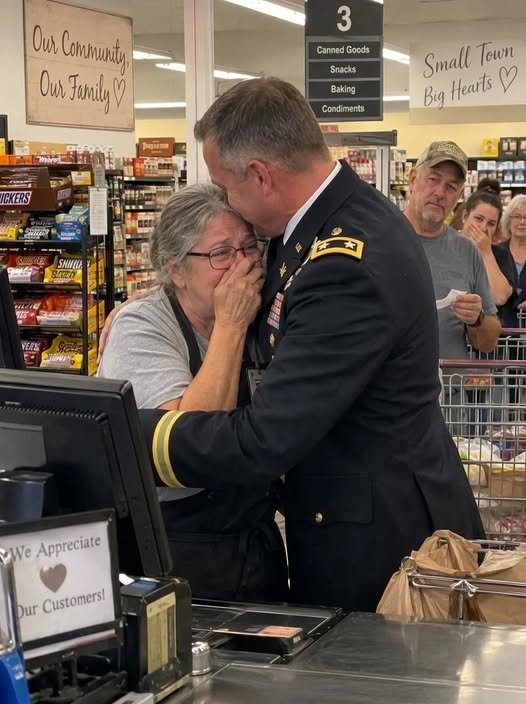
In that instant, the bustling store seemed to vanish. Ruthie stepped away from the register so quickly she nearly toppled the little wooden stool behind her. Daniel crossed the linoleum floor in long, purposeful strides. Right there, in front of the bread aisle, the cashier station, the impatient shoppers, and a teenage bagger who had never seen Ruthie move with such lightning speed, a 66-year-old grocery clerk threw her arms around a highly decorated Army Colonel like he was still the skinny boy leaving muddy footprints by her back door.
In front of impatient shoppers and a stunned teenage bagger, a mother embraced her hero.
“Oh, honey,” was all she could manage to say through her tears.
Daniel held her tightly. “I wanted to surprise you.”
Ruthie pulled back, keeping her hands on his face, pulling him closer because near was easier for her failing eyes to see. Daniel noticed the gesture immediately, his smile fading into a look of concern. “Mom?”
“I’m fine,” she brushed it off.
The man Ruthie had just checked out was still loitering near the register, forcefully stuffing the change into his leather wallet. He let out another irritated sigh. “Well, some of us are trying to get home.”
Daniel turned slowly. Ruthie instinctively touched his arm. “Daniel, don’t.”
He didn’t raise his voice. He didn’t have to. “Sir,” he said with an eerie, authoritative calmness, “my mother will take care of you.”
The man shrugged defensively. “I’m just saying, she’s slow.”
Daniel looked at his mother, then piercingly back at the impatient man. “Yes,” he said, his voice echoing slightly in the quiet store. “She is slower than she used to be. When I was eight years old, my father left.”
The entire checkout area grew completely silent. Ruthie whispered a plea, “Daniel…” but he simply squeezed her hand, refusing to stop.
“My mother worked this grocery store in the mornings and scrubbed county offices at night,” Daniel said, pointing a firm finger toward the worn register belt. “She stood behind counters exactly like this one when her feet were swollen and her back throbbed, because she had a little boy at home who needed dinner on the table. She bought my very first baseball glove with money she’d been desperately saving for her own new shoes.”
Nobody dared to speak.
Daniel’s voice softened as he looked down at his own decorated uniform. “When I wanted to leave home and build a life for myself, she didn’t ask me to stay close. She told me to go become somebody useful. So, I did my best. I’ve served with people from all over this country. I’ve met men and women with impressive titles, important jobs, and rooms full of medals.”
He turned his gaze directly to his mother, his eyes shining. “But the strongest person I’ve ever known still wears a grocery-store name tag.”
Ruthie began sobbing—not the quiet, hidden tears of the restroom, but the profound, releasing tears that come when someone finally speaks aloud the validation you spent a lifetime believing you didn’t need. The teenage bagger wiped his eyes with the back of his wrist. An older woman farther back in the line whispered a heartfelt, “Amen.”
Even the impatient customer seemed to shrink. He looked genuinely at Ruthie. “I’m sorry, ma’am.”
Ruthie nodded gracefully. “That’s all right.” And because she was Ruthie, she truly meant it.
The True Measure of a Life Well Lived
Later that afternoon, during her designated break, Daniel sat beside her in the dim little employee room behind the dairy cooler. Two ancient vending machines hummed a low, familiar tune against the wall. Ruthie held a steaming paper cup of coffee between both hands, seeking its warmth.
“You taught me to stand up when life knocks you down. You already did your job, Mom.”
“How bad are your eyes?” Daniel asked gently.
“Bad enough,” Ruthie admitted, staring into her cup. “I’m scared, Danny. I’m terrified of waking up one day and not being able to do anything for anybody.”
Daniel moved his chair closer and enveloped her worn hand in his. “Mom, do you think this uniform is the most important thing you gave me? You taught me to work. You taught me to keep my word. You taught me that nobody is beneath me. You taught me to stand up when life knocks you down.” He leaned in, his voice thick with emotion. “You already did your job, Mom.”
The next morning, Ruthie returned to work. She was at the same register, wearing the same name tag and the same thick glasses. But the atmosphere had profoundly shifted. Word of the Colonel’s speech had spread through the town like wildfire.
Customers no longer sighed when Ruthie counted their change twice. Teenagers politely offered to read the fine print on complex coupons for her. One little girl even insisted on coming through Ruthie’s line exclusively, simply because her grandmother had told her, “That lady right there raised a mighty good man.”
Ruthie never became famous, and her eyesight continued to fade until she eventually had to reduce her hours. But she fundamentally stopped measuring her worth by what she could visibly see, carry, or accomplish in a shift.
We are often far too quick to judge someone by a single, fleeting moment:
- The slow cashier holding up the line.
- The exhausted waitress forgetting an order.
- The elderly man taking too long to search his pockets.
We see the immediate inconvenience, but we rarely see the decades of sacrifice behind it. Never mistake someone’s slower steps for a smaller life; you might just be standing in front of the very person who made greatness possible.
Note:This work is inspired by real events and people, but it has been fictionalized for creative purposes. Names, characters, and details have been changed to protect privacy and enhance the narrative. Any resemblance to actual persons, living or dead, or actual events is purely coincidental and not intended by the author.
All images used in this article are AI-generated and intended for illustrative purposes only.