
The phone call that changed the trajectory of my life happened just after midnight.
I was sitting on the cold floor in the narrow hallway outside my tiny, cramped apartment. I was still wearing my grease-stained diner uniform, my feet throbbing with a dull ache after enduring a brutal twelve-hour shift. Right beside me, resting on the worn carpet, was my official acceptance letter to medical school. The thick paper was already creased and soft at the edges from how many times I’d frantically reread it.
I should’ve felt on top of the world. I should’ve felt incredibly victorious.
Instead, I was crying so intensely that my chest heaved, and I could barely pull enough air into my lungs to breathe.
The university’s financial aid package had arrived in the mail earlier that afternoon, and the numbers staring back at me were a cruel joke. It wasn’t enough. It wasn’t even close. By the time I added up the soaring tuition, the massive textbooks, housing costs, and mandatory lab fees, it stacked up into a sum so impossibly high that it made my chest physically hurt. It was a mountain I had no gear to climb.
The acceptance letter felt less like a ticket to my dreams and more like a cruel reminder of what I couldn’t afford.
The Call That Broke My Heart
I sat there staring at my cracked phone screen for almost an hour before I finally found the courage to call my mother.
The moment she answered, my brave facade completely crumbled. I broke instantly.
“Mom,” I whispered, aggressively wiping my tear-soaked face with the scratchy sleeve of my uniform. “I got in.”
There was a long, heavy silence on the other end of the line. Then, a surprised, almost breathy laugh escaped her. “You did?”
“I did.” I swallowed hard, tasting the salt of my tears. “But Mom… I can’t afford it. I just… I need help. Even just a little bit to cover the gap. I’ll work for the rest, I swear to you. I promise. I just can’t do all of it alone.”
I remember vividly hearing the low hum of the late-night television in her background. The faint, metallic clinking of dishes in the sink. Normal, everyday life was continuing on her end, while my entire world felt like it was violently collapsing on mine.
Then, she sighed.
It wasn’t a cruel sigh. It wasn’t angry or dismissive. It was just impossibly tired.
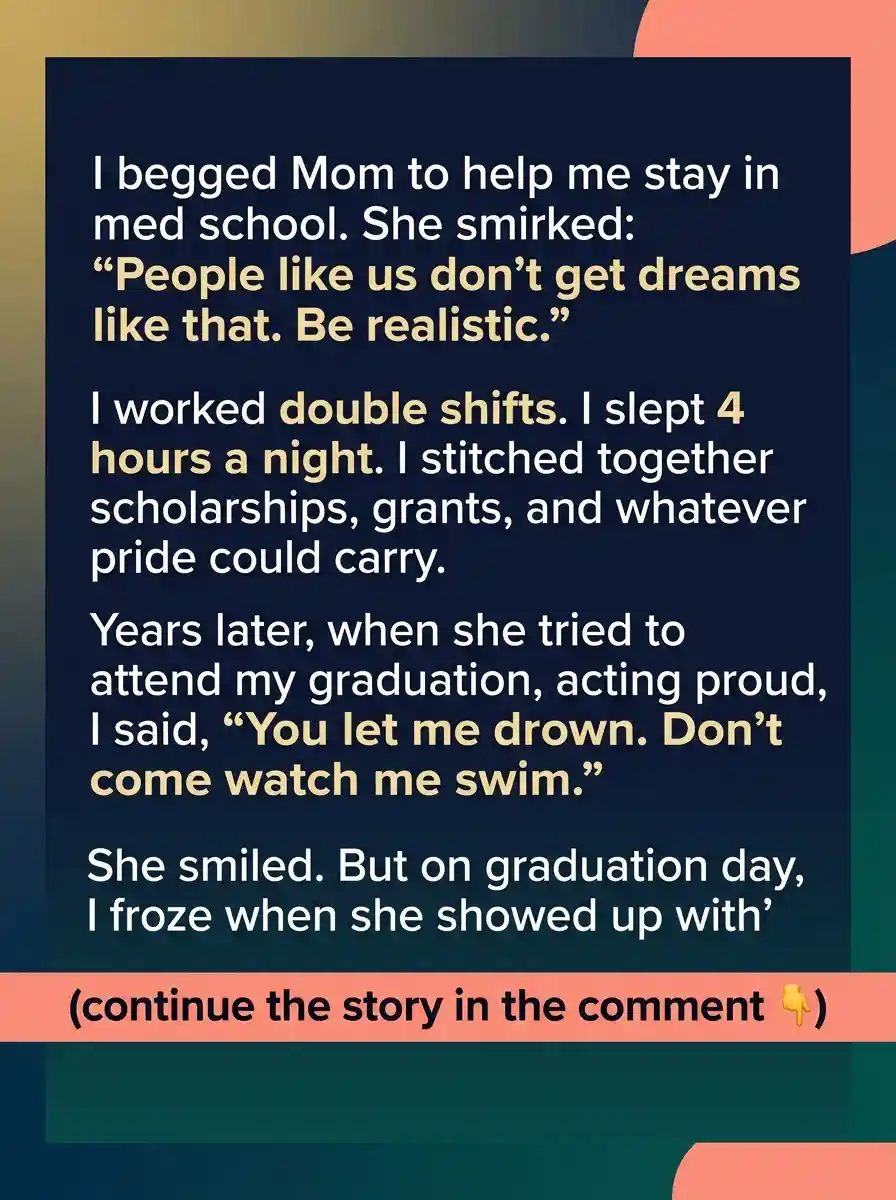
“Honey,” she said, her voice heavy with the weight of decades of generational poverty, “people like us don’t get dreams like that.”
I froze.
“You’re smart, you’ve always been so smart, but medical school?” she continued gently, trying to cushion the blow. “We have to be realistic here. Go to the community college first. Or work full-time for a while to save up. Maybe you could take nursing assistant classes? Something steady. Something stable.”
“I don’t want something stable,” I said quietly, my voice trembling with a mix of despair and rising indignation. “I want this.”
“You can’t build your life on wanting.”
Those seven words hit me harder and cut much deeper than yelling ever could have. I begged her for another ten minutes. I pleaded my case like a lawyer fighting for a life sentence. But she just kept offering alternatives. Practical, safe choices. Smaller dreams designed for people who didn’t have safety nets.
Finally, I hung up the phone before she could hear the full force of my sobbing.
Fueled by Anger, Not Hope
That night, sitting alone in the dark, something deep inside my chest hardened into solid stone.
If absolutely nobody believed that I could become a doctor—if even my own mother thought it was a foolish fairytale—then I would gladly drag myself across the finish line entirely alone.
And I did exactly that.
While my classmates worried only about exams, I worried about surviving the week.
The next four years were a blur of unimaginable exhaustion. I worked brutal double shifts at the diner whenever I wasn’t in class, and I took on weekend jobs cleaning corporate offices overnight when nobody was watching. I considered myself incredibly lucky if I managed to sleep four hours a night.
I learned exactly which vending machines in the hospital basement gave extra snacks when tilted hard enough. I meticulously stitched together obscure scholarships, desperate emergency grants, and suffocating student loans with the sheer, blinding desperation of a captain trying to hold shut the doors of a sinking ship.
There were nights I sat on the edge of my bed, studying complex anatomy diagrams while icing my terribly swollen feet. There were dark, lonely nights where I openly cried in empty hospital stairwells after failing a mock exam by a mere two points. There were countless nights where I almost picked up the phone to quit.
But every single time I felt my resolve slipping, I vividly remembered her tired voice saying, “People like us don’t get dreams like that.”
Pure, unadulterated anger carried me so much further than hope ever could have.
The Bitter Call Before Graduation
Years passed in a grueling marathon of caffeine and survival.
Then, suddenly, graduation was staring me in the face. A doctorate in medicine. Tangible, undeniable proof that I had not only survived, but conquered.
Exactly a month before the commencement ceremony, my phone rang. It was my mother.
“I was thinking,” she said carefully, her voice hesitant and small, “maybe I could come to the graduation.”
A harsh, bitter laugh escaped my lips before I could stop it.
“Oh, you want to celebrate now?” I asked, the resentment of the last four years dripping from every word.
“I know I wasn’t—”
“You let me drown,” I snapped, cutting her off completely. “Don’t come watch me swim.”
The silence on the line stretched out, long, thin, and suffocating.
Then, she said very softly, “Okay.”
There was no argument. There was no defense of her past actions. There was just a heartbreaking, defeated okay.
Graduation Day: A Sea of Faces
By the time graduation morning arrived, I had expertly convinced myself that I didn’t care about her absence
The campus was alive and overflowing with wildly proud families carrying massive bouquets of flowers and shiny foil balloons. Parents were crying into their smartphones while taking blurry, beautiful pictures of their kids. Little children sat perched on shoulders, screaming the names of the graduates across the sun-drenched lawn.
I sat quietly among my privileged classmates in my heavy black gown and crimson hood, staring straight ahead, fiercely pretending not to notice how many completely empty seats were waiting for me in the audience.
Then, about halfway through the long, drawn-out ceremony, I casually looked up.
And I saw her.
She stood in the shadows, watching the dream she thought was impossible finally come true.
She stood far away, near the back wrought-iron fence beneath the shade of a large oak tree, purposely distancing herself from the celebrating, joyful crowds.
She looked older than I remembered. Smaller, somehow. She wasn’t waving her arms. She wasn’t holding up a sign or trying to get my attention. She was just watching me quietly, with a look that suggested she knew that pride was something she no longer had the right to publicly claim.
My chest tightened violently, but I quickly forced myself to look away.
The Envelope That Changed Everything
After the ceremony officially ended, absolute chaos exploded around us on the lawn—loud laughter, endless cameras flashing, proud professors hugging their tearful students.
I was standing near a brick wall, awkwardly stuffing my hard-earned diploma into its leather case, when someone gently tapped my shoulder.
I turned around.
It was Mom.
For a long, tense second, neither of us spoke a word. The noise of the crowd seemed to fade entirely into the background.
Then, with trembling fingers, she held out a plain, unremarkable manila envelope.
“I won’t stay,” she said softly, her eyes avoiding mine. “I just wanted you to have this.”
I almost refused to take it. My pride screamed at me to walk away.
But something incredibly fragile and broken in her expression stopped me dead in my tracks.
I took the envelope and opened it slowly.
Inside was a piece of paper. A receipt.
At first, the complex string of numbers and university letterhead didn’t make any sense to my exhausted brain. Then, my eyes focused, and my stomach dropped completely out of my body.
PAID IN FULL.
It was a receipt for my entire final year of medical school tuition. Every single, astronomical cent.
I stared at the paper, utterly confused and disoriented. That final year had been a brutal, terrifying financial tightrope. I had foolishly believed that a completely random combination of mysterious aid adjustments, anonymous alumni scholarships, and deferred administrative fees had somehow miraculously saved me from dropping out.
My hands started visibly shaking.
The anger I carried for years instantly dissolved into a truth I was never prepared to face.
A folded, lined piece of notebook paper slipped from the envelope and fluttered into my hand.
The handwriting was careful, deliberate, and undeniably uneven from age and exhaustion.
“I knew you wouldn’t take the help directly from me. I also knew that I was terribly wrong back then. I’ve been saving every penny since the exact night you hung up the phone on me. I’m so incredibly proud of you… but especially because you did it anyway, without me.”
I read the words twice.
Then I read them a third time, the ink blurring as tears flooded my eyes.
Suddenly, all the fiery, protective anger I had carried like a shield for four long years felt infinitely heavier than before. Not because the anger had magically disappeared, but because now, that intense emotion finally had somewhere soft to go.
“I didn’t know,” I whispered, my voice breaking completely.
She nodded once, a single tear escaping down her weathered cheek.
“I know.”
Love Arrives in Unexpected Ways
Later, long after the graduation tents were taken down, I learned the incredible things she had never told me herself.
I learned that she had taken on grueling extra factory shifts for four years. I learned that she had quietly sold off her old, sentimental jewelry. I learned that she had obsessively followed every single school update online, reading complex medical articles about student awards she didn’t fully understand, and quietly printing pixelated photos of me from the university’s public website.
I learned that she talked about my medical degree at her work every single day, speaking about it like it was a grand, impossible miracle that she still couldn’t believe actually belonged to her own daughter.
But she never once asked me to forgive her.
She never once tried to make excuses, or erase the painful, dream-crushing things she had said to me on that dark night.
She simply spent years of her life working to correct the one and only thing she still had the power to fix.
She did it quietly. She did it completely without needing the credit, the praise, or the validation.
And standing there on that bright green lawn in my heavy graduation gown, holding the undeniable, paper proof of my mother’s ultimate sacrifice in my trembling hands, I realized something profound that I hadn’t been mature enough to understand before:
Sometimes, love arrives a little too late to look perfect. Sometimes, it comes packaged with rough edges from the very people who failed you first. And sometimes, the absolute deepest, most earth-shattering apologies are the ones that are never spoken out loud at all.
Note:This work is inspired by real events and people, but it has been fictionalized for creative purposes. Names, characters, and details have been changed to protect privacy and enhance the narrative. Any resemblance to actual persons, living or dead, or actual events is purely coincidental and not intended by the author.
All images used in this article are AI-generated and intended for illustrative purposes only.