
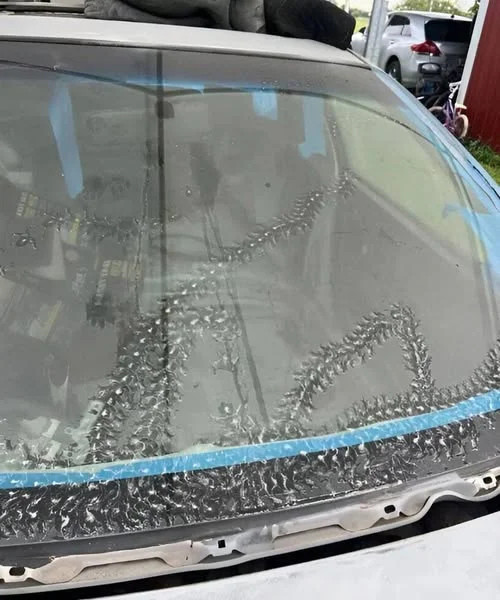
The discovery began with a pattern of faint, smeared markings on an automobile windshield. At first glance, they appeared random, but upon closer inspection, they revealed a distinct, looping trajectory. This biological signature pointed not to damage or vandalism, but to the nocturnal activities of tree frogs, whose specialized toe pads and nightly explorations left temporary, harmless evidence of their presence.
Tree frogs (family Hylidae) possess remarkable adhesive toe pads that allow them to climb smooth, vertical surfaces. These pads create a suction effect through a combination of capillary action and van der Waals forces, enabling the amphibians to traverse surfaces like glass and metal with ease. The “footprints” observed were actually moisture trails left by this process, not scratches or residue that could damage the surface.
This phenomenon typically occurs on nights with higher humidity, when these amphibians are most active. Attracted to the residual warmth and condensation on vehicles parked near vegetation, they investigate these novel surfaces as part of their nightly foraging and exploration. The resulting patterns provide a temporary record of their movement, easily washed away with water and causing no harm to the vehicle’s finish.
Understanding this natural behavior transforms a moment of confusion into an opportunity for observation. It serves as a reminder of the extensive biodiversity that exists in suburban and urban environments, often going unnoticed by human residents. Such encounters encourage a greater appreciation for the subtle ways wildlife adapts to and interacts with human-altered landscapes.
The incident underscores how citizen observation can lead to scientific understanding. By documenting and investigating these small mysteries, we deepen our connection to the natural world and recognize the value of paying attention to the subtle clues left by our non-human neighbors.