
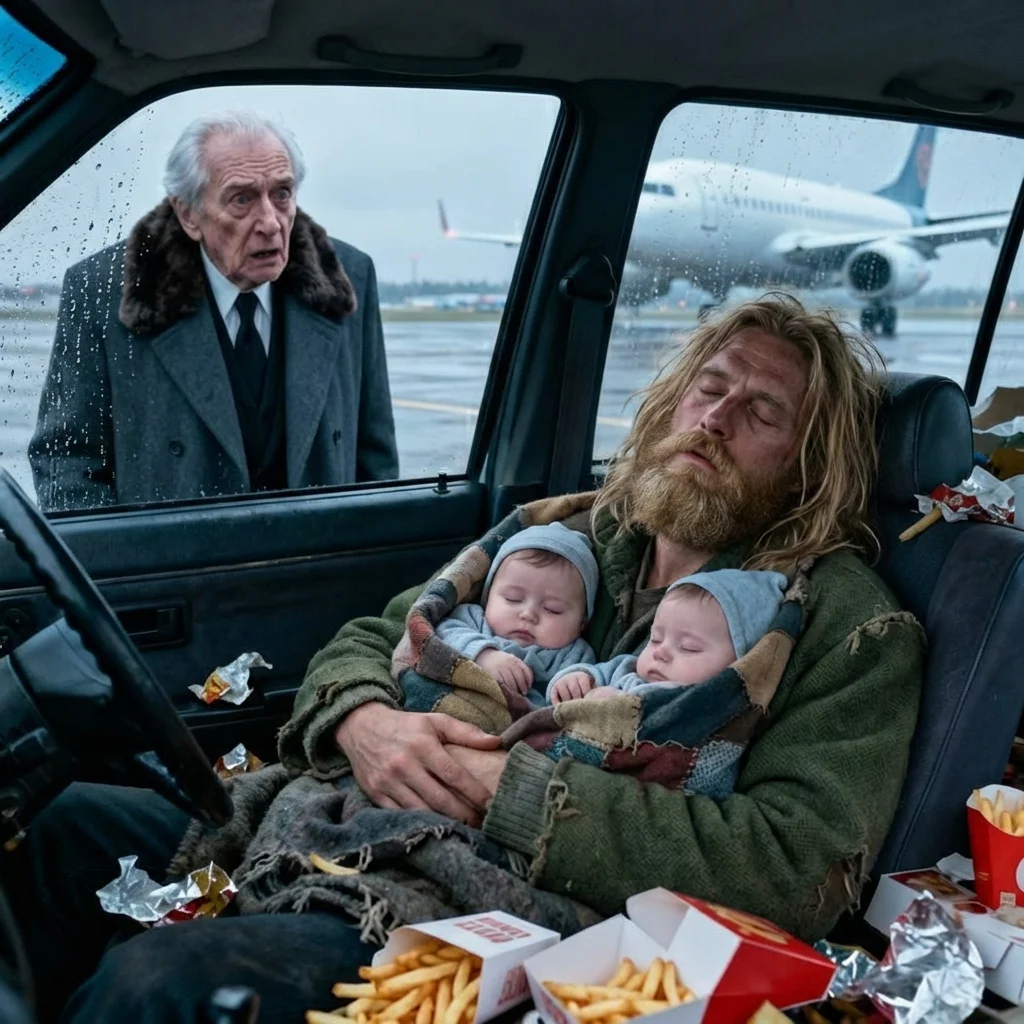
I Found My Son Sleeping in His Car at the Airport With His Twins. They Thought He Was Broken and Alone. They Were Wrong.
The biting March wind cut across the long-term parking lot at Toronto Pearson Airport like a blade.
It wasn’t the dramatic kind of cold—the kind that announces itself with snowstorms or blizzards. This was quieter. Sharper. The kind that seeps under your coat and into your bones without asking permission. I pulled my collar up and walked between rows of cars, still foggy from the red-eye flight but alert in that strange way exhaustion sometimes sharpens the senses.
I hadn’t told my son I was coming.
Michael was turning thirty-six, and I wanted to surprise him. A breakfast. A handshake that turned into a hug. A reminder that even grown men with children of their own are still someone’s kid.
I scanned the rows, looking for his car.
That’s when I froze.
It wasn’t the car itself that stopped me. It was the windows.
A Honda Civic sat at the far edge of the lot, tucked near a concrete divider like it didn’t want to be seen. The windows were fogged heavily from the inside, thick with condensation.
Anyone who’s lived through a Canadian winter knows what that means.
Bodies.
Too much breath trapped in too little space.
A sick instinct twisted in my stomach.
I told myself not to jump to conclusions. Told myself there were other explanations. But my feet were already moving, carrying me forward before my mind could catch up.
As I walked closer, I noticed the details that don’t lie.
Blankets shoved against the back window. Fast-food wrappers crushed underfoot. A child’s sneaker lying sideways on the floor.
My heart didn’t stop.
It plummeted.
I wiped a clear patch in the fogged glass with my sleeve and peered inside.
Michael was slumped in the driver’s seat, shoulders hunched forward, jaw clenched even in sleep. He looked thinner than the last time I’d seen him. Not just physically—something heavier had hollowed him out.
But it was the back seat that shattered me.
Curled together under a single heavy blanket were my grandsons, Nathan and Oliver. Their small bodies pressed close for warmth, faces pale, shoes still on.
Children sleep with their shoes on only when they’re afraid of being told to move.
My hands began to shake.
I knocked on the window.
Hard.
Michael jolted awake with the wild panic of a hunted animal. His eyes darted, scanning for danger, before landing on me.
The fear drained from his face.
What replaced it was worse.
Shame.
“Dad?” His voice was hoarse, barely working.
I stepped back as he fumbled with the door and pushed it open. Cold air rushed in, and one of the boys stirred but didn’t wake.
“Why,” I demanded, my voice cracking despite my effort to keep it steady, “are you living in a car with my grandsons?”
He stared at the steering wheel.
For a long moment, he couldn’t speak.
Then his shoulders collapsed inward, and everything he’d been holding together with sheer willpower finally gave way.
An hour later, we sat in a corner booth at a diner just off the airport highway.
The boys were asleep beside us, wrapped in coats and exhaustion. I’d ordered pancakes they barely touched before drifting off, their heads leaning against each other like they’d learned to make themselves small.
Michael cradled a mug of coffee with both hands as if it were the only thing keeping him upright.
“They took everything,” he said quietly.
I didn’t interrupt.
“She had me sign documents,” he continued. “Said it was temporary. Said it was for stability while things were stressful. Her parents handled the lawyers. I trusted her.”
He swallowed hard.
“They changed the locks. Filed a restraining order. Claimed I was mentally unstable.”
My jaw tightened.
“And the startup?” I asked.
He finally looked up at me.
“The money you invested,” he said, voice breaking. “The one hundred and fifty thousand dollars. They moved it. Labeled it ‘marital restructuring.’ I didn’t even realize until it was gone.”
The words landed like blows.
Her family had money. Connections. Influence. The kind of power that hides behind paperwork and smiles while destroying people quietly.
“I lost the house,” he said. “The business. My reputation. I can’t fight them, Dad. If I push back, they’ll try to take the boys completely.”
I watched my son crumble in front of me, and something inside me went cold and clear.
Shock gave way to calculation.
I reached across the table and gripped his wrist—not hard, but firm enough to anchor him.
“Maybe you can’t right now,” I said quietly. “But we can.”
He looked at me like he wasn’t sure he’d heard correctly.
That night, the boys slept in real beds for the first time in weeks.
I booked a hotel suite without thinking about the cost. Two rooms. Clean sheets. A door that locked.
Michael sat on the edge of the bed long after the boys fell asleep, watching them as if they might vanish if he blinked.
I waited.
When he finally looked at me, I said the words I’d been forming all evening.
“Pack your things,” I told him. “We’re fixing this now.”
He hesitated. “Dad—”
“I didn’t spend thirty years building a career and a network so my son could be erased by bullies with better lawyers,” I said evenly. “They think you’re isolated. They think you’re weak.”
I opened my laptop.
“They’re wrong.”
I wasn’t just a retired grandfather.
I was a man who had survived boardrooms, hostile takeovers, and people who mistook money for authority.
I dialed my corporate attorney.
“I need the name of the most aggressive family law attorney in Ontario,” I said, my voice flat. “Money is not an issue. I don’t want a mediator. I want someone who understands war.”
By morning, shock had hardened into purpose.
Michael sat at the small hotel desk staring at nothing while I watched my grandsons eat cereal on the bed—quiet, careful, as if afraid to take up space in a world that had already taken too much from them.
No child should learn silence this early.
That’s when I knew this wasn’t just about money anymore.
The attorney called back before noon.
Her name was Margaret Hale.
She didn’t offer sympathy. She offered strategy.
“False instability claims are common,” she said coolly. “But they’re also sloppy when weaponized by arrogant people. If your son is willing to fight, we can dismantle this.”
Michael hesitated. I saw the fear rise again—the fear of retaliation, of losing access to his children, of being crushed a second time.
I put my hand on his shoulder.
“They already took everything,” I said. “The only thing left to lose is the lie.”
That afternoon, we began.
Bank records. Emails. Text messages. The startup documents I had helped fund—signed under the phrase temporary mental distress, which now read like a trap in hindsight.
Margaret’s team worked like surgeons, peeling back the narrative his wife’s family had constructed.
Then came the first crack.
A therapist’s report cited in the restraining order turned out to be based on a single phone consultation—booked and paid for by his wife’s brother.
No evaluation. No diagnosis.
Just a suggestion, inflated into a weapon.
“Judges hate this,” Margaret said, a thin smile crossing her face. “It reeks of manipulation.”
Within a week, an emergency motion was filed.
Michael didn’t sleep the night before the hearing.
Neither did I.
At dawn, I watched him knot his tie with shaking hands. He looked like a man walking back into a burning house—not to save furniture, but to reclaim his name.
In the courtroom, his wife avoided his eyes.
Her parents sat behind her, polished and confident, as if this were another transaction they expected to win.
They didn’t expect me.
When Margaret asked permission to address the court regarding the startup funds, she introduced me not as a father—but as an investor.
One with records.
One with leverage.
One who did not appreciate fraud disguised as family conflict.
The judge leaned forward.
By the time we left the courthouse, the restraining order had been temporarily lifted, supervised visitation reinstated, and a full forensic review ordered into the asset transfer.
It wasn’t victory.
But it was something far more dangerous.
Momentum.
That night, as Michael tucked his sons into clean sheets, Nathan looked up and asked quietly,
“Daddy… are we going home now?”
Michael swallowed hard.
“Soon,” he said. “And this time—we’re not leaving.”
Across the city, powerful people were realizing their mistake.
They thought they had isolated a man.
They hadn’t realized they had awakened a family.
And this time—
we were done being quiet.
The days that followed the first court hearing moved slowly, but they moved forward.
That mattered.
Michael stayed close to the boys, never leaving them alone for long. He walked them to school himself, waited outside when they had appointments, and slept lightly at night, waking at the smallest sound. Trauma has a way of teaching vigilance faster than any parent ever wants to learn.
Nathan and Oliver began to speak more.
Not much. Not all at once.
But small things started to surface.
How they’d learned which parking lots were safer.
Which nights were quieter.
How to tell when their father was pretending everything was fine.
Michael listened without interrupting. Without correcting. Without minimizing.
I watched him change in real time—not into a harder man, but into a steadier one. There’s a difference. Hardness closes you off. Steadiness roots you in place.
The boys needed the second.
So did he.
Margaret Hale moved quickly.
Too quickly for Michael’s wife’s family to stay comfortable.
Subpoenas went out. Financial institutions were contacted. Independent forensic accountants began tracing the movement of money that had been labeled “restructuring” but behaved far more like extraction.
Every few days, Margaret would call with another update.
Another inconsistency.
Another unexplained transfer.
Another signature that didn’t align with standard practice.
“They assumed no one would check,” she said during one call. “People who rely on power forget that documentation is a double-edged sword.”
Michael sat across from me at the small dining table in the rental townhouse, hands wrapped around a mug he hadn’t touched.
“I trusted her,” he said quietly. “I trusted all of them.”
I nodded.
“Trust doesn’t make you weak,” I said. “It makes betrayal louder.”
Two weeks later, the first offer arrived.
It came in the form of an email from their legal counsel—brief, carefully worded, and wrapped in language meant to sound reasonable.
They proposed reinstating limited access to the boys in exchange for Michael dropping the forensic review.
Margaret’s response was immediate.
“No,” she said. “Now they’re nervous. That’s when we continue.”
Michael hesitated.
“They’re dangling my kids,” he said.
“And we’re holding the truth,” Margaret replied. “One lasts longer.”
The second hearing was different.
The tone had shifted.
Michael’s wife no longer looked bored. Her parents no longer whispered confidently behind her.
The forensic report had begun to take shape.
It painted a picture that was difficult to ignore.
Funds diverted through shell accounts.
Assets transferred under questionable claims of incapacity.
A restraining order reinforced by a therapist’s statement that now appeared dangerously thin.
The judge asked questions.
Direct ones.
Uncomfortable ones.
When Michael’s wife’s attorney attempted to redirect the conversation toward Michael’s “emotional instability,” Margaret calmly presented documentation showing no prior diagnosis, no clinical assessment, and no follow-up care.
Silence settled over the room.
The kind that tells you something important just broke.
That afternoon, Michael took the boys to a park near the townhouse.
They sat on a bench while Nathan and Oliver climbed slowly, cautiously, testing the ground beneath their feet like it might vanish.
“I like it here,” Oliver said suddenly.
Michael smiled. “Me too.”
“Are we staying?” Nathan asked.
Michael exhaled.
“For now,” he said honestly. “And we’re building something better.”
The boys nodded as if that answer was enough.
For the first time in a long while, it was.
Three months after the airport parking lot, the final ruling came down.
The forensic review was complete.
The court ordered the return of a substantial portion of the startup funds pending further investigation. Michael was granted primary physical custody, with shared legal custody under strict conditions.
The restraining order was formally dismissed.
The judge’s closing remarks were brief.
“False claims of incapacity undermine the integrity of this court,” she said. “They will not be tolerated.”
Michael didn’t smile.
He closed his eyes.
I felt something loosen in my chest that I hadn’t realized I’d been holding since that morning in the parking lot.
That night, we ate dinner together at the small table.
Nothing fancy. Pasta. Bread. A bottle of juice the boys insisted on pouring themselves.
Nathan raised his glass.
“To home,” he said quietly.
Oliver copied him.
Michael looked at me.
“Thank you,” he said.
I shook my head. “This wasn’t charity.”
He smiled faintly.
“I know.”
A week later, I flew home.
The boys hugged me tightly at the airport gate, refusing to let go until the last possible second.
“Come back soon,” Oliver said.
“I will,” I promised.
Michael walked me to security.
“I didn’t think I could survive this,” he admitted. “I didn’t think I was strong enough.”
I placed a hand on his shoulder.
“You didn’t survive because you were strong,” I said. “You survived because you didn’t disappear.”
He nodded.
That was true.
People like to believe that destruction happens loudly.
It doesn’t.
It happens quietly. Through paperwork. Through assumptions. Through people who count on silence to do the heavy lifting.
And repair?
Repair is rarely dramatic.
It’s cereal eaten carefully at the edge of a bed.
It’s court documents reviewed line by line.
It’s children relearning that sleep doesn’t have to be temporary.
They thought they had broken him.
They thought isolation would do what force could not.
They were wrong.
Because the most dangerous thing you can awaken in someone is not anger.
It’s resolve.
That Honda Civic is gone now.
Sold. Replaced. Forgotten.
But I still remember the condensation on the windows.
The sign that told me everything before a single word was spoken.
I remember thinking, standing there in the cold:
No.
Not this.
Not him.
And I remember knowing, with absolute clarity, that some moments don’t ask for permission.
They demand action.
That morning, I wasn’t just a father who found his son sleeping in a car.
I was a line they didn’t expect.
And crossing it changed everything.