
The Sound in the Middle of the Night
The very first time I woke up at three in the morning to find my husband sitting on the bathroom floor with the faucet running, I was exactly five weeks pregnant.
I had rolled over in the darkness to tell him I needed to use the restroom again—which seemed to be all I did in those early days of pregnancy—only to find his side of the bed completely empty. The sheets were already cold to the touch. Down the dark hallway, slipping out from underneath the bathroom door, there was a thin, piercing line of light. And then there was the sound. The steady, unbroken rush of water running into the sink, like somebody washing their hands and simply forgetting to turn it off.
I padded down the hall, shivering slightly in the cool night air, and knocked gently.
“Ben?” I called out softly.
The water just kept running.
“Ben, honey, are you okay in there?”
Suddenly, the faucet was shut off. A heavy moment passed in total silence before the door slowly creaked open.
The thin line of light under the bathroom door became a nightly mystery.
He was sitting on the floor, his back pressed hard against the side of the white porcelain bathtub, his knees pulled tightly up to his chest. He was wearing his favorite worn-out gray T-shirt and flannel pajama pants. Even in the dim light, I could see his face was incredibly pale, and his eyes were rimmed with red.
“Hey,” he whispered, attempting a weak smile. “Sorry. Did I wake you?”
“What are you doing on the floor, Ben?” I asked, kneeling beside him.
“My stomach’s just been bothering me,” he replied, looking away. “I didn’t want to wake you up. I ran the water so you wouldn’t have to hear me throwing up.” He let out a small, self-deprecating laugh. “Very romantic, I know.”
I sat down on the cold edge of the bathtub right next to him and gently ran my fingers through his dark hair.
“You really should see a doctor about this,” I told him, concern creeping into my voice.
“I will,” he promised quickly. “It’s probably just stress. Work’s been crazy lately.” He leaned his head heavily against my knee, sighing. “Go back to bed, Luce. You need your sleep right now. You’re growing a whole person in there.”
I went back to bed.
I believed him. After all, why wouldn’t I have?
The Price of a Miracle
My name is Lucy. Ben and I had been married for nine beautiful years, and we had spent six of those years desperately trying to have a baby.
I want to tell you about those six years, because they matter more than you could possibly know. Everything that happened later only makes sense if you truly understand exactly what it cost us to get to that positive test.
We started trying to conceive when I was twenty-nine. Like most young couples, we naively thought it would be effortless. Our friends were getting pregnant by accident. My own sister got pregnant on her honeymoon. We figured we would have a little one by Christmas. But we didn’t.
After a year of negative tests, we finally went to a doctor. After two years of heartbreak, we escalated to a specialist. There were endless tests. Blood work, painful ultrasounds, and invasive procedures with long, terrifying medical names that I eventually learned to pronounce effortlessly. Despite all of it, they couldn’t find a clear reason. Unexplained infertility, they labeled it. Which is really just a polite, clinical way for a doctor to tell you, “We have absolutely no idea.”
We endured three grueling rounds of IUI. Nothing happened.
We moved on to IVF. The very first round, a miracle happened—I got pregnant. But I lost the baby at nine weeks. The second round, I got pregnant again, only to lose it at seven weeks. By the third round, it simply didn’t take at all. Every single round cost us around fifteen thousand dollars, and our health insurance didn’t cover a dime of it.
Ben was a master electrician who ran his own small, successful business: Morrison Electric. It was just him and two fantastic guys, Danny and Rico, driving around town in a white work van with a bright blue lightning bolt painted on the side. He worked incredibly hard, and he was undeniably good at what he did. When the power went out in Riverside, Ben was the first person people called.
I was a baker. Or, at least, I used to be.
When I was a little girl, I spent every single summer at my grandmother’s beloved bakery on Main Street. It was called Rosie’s. My grandmother, Rose, was a local legend. She was up making fresh bread every morning at 4:00 AM, pulling cinnamon rolls the size of your head from the ovens, and baking pies that people would willingly drive two towns over just to purchase. I stood on a little wooden step stool right next to her, learning how to perfectly knead dough before I even learned how to ride a bicycle.
When I turned twenty-three, Grandma Rose passed away. The bakery closed its doors. The beautiful brick building just sat there, empty on Main Street, with sad brown paper taped over the windows and a faded FOR SALE sign hanging in the window that never seemed to go away.
I always swore to Ben that I’d reopen it someday. He used to playfully tease me about it, kissing my forehead and saying, “Someday, you’ll be the bread queen of Riverside.”
But “someday” costs money. And every spare dollar we had went straight to fertility doctors.
From “When” to “If”
Somewhere around year four, right after our second devastating miscarriage, we quietly stopped using the phrase “when we have a baby.”
Without even discussing it, we started saying “if.”
I’ll never forget the exact night the shift happened. We were lying in bed in the dark. My period had just arrived again, washing away another month of hope. I was sobbing silently into my pillow, and Ben was holding me as tight as he could.
“If it doesn’t happen,” he whispered into my hair, his voice thick with emotion, “we’re still going to be okay. Right? Just you and me?”
I froze. “If,” I repeated softly. “You just said if.”
He was dead quiet for a long, heavy time.
“I’m sorry,” he finally choked out.
“No,” I replied, wiping my tears. “You’re right to say it. It’s ‘if’ now.”
We eventually decided to try one final round of IVF. We took out a second mortgage on our home just to pay for it. We made a solemn pact that if it didn’t work, we were done. We would stop the madness. We would look into adoption, or we would learn to just be the two of us. We’d travel the world. We’d adopt a dog. We would find a new dream.
It didn’t work. The pregnancy test was starkly negative.
So, we stopped.
And then, miraculously, four months later on a random Tuesday morning in March—without a single doctor, without painful needles, and without spending fifteen thousand dollars—I took a cheap pharmacy pregnancy test. My period was eight days late, I felt horribly nauseous, and I honestly thought I was coming down with the flu.
Two bright pink lines stared back at me.
I sat on the edge of the bathtub, entirely paralyzed, staring at the plastic wand. My hands shaking, I took another one. Two pink lines. Frantic, I took a third one. Two pink lines.
Ben was out in the kitchen brewing his morning coffee. I walked out, barefoot and trembling, holding all three tests out in front of me.
He took one look at my face, and then he looked down at the tests in my shaking hands.
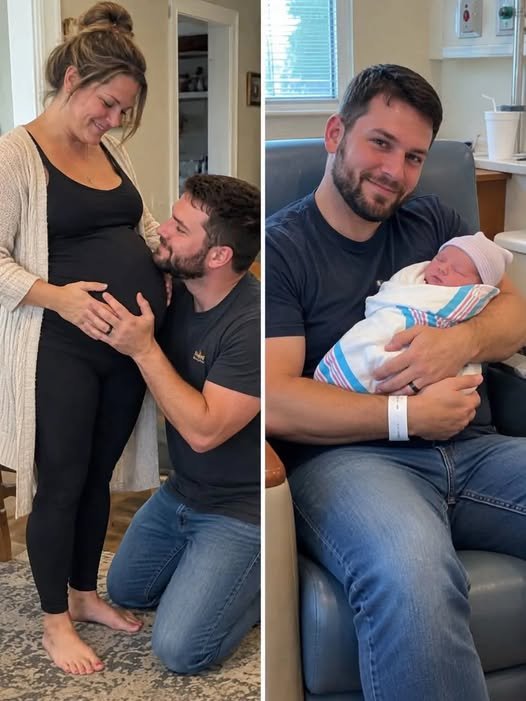
He carefully placed the glass coffee pot down on the counter. He walked slowly across the linoleum floor and literally dropped to his knees right in front of me. He wrapped his strong arms around my hips, pressed his face gently against my stomach, and began to cry. Big, massive, chest-shaking sobs, burying his face into my oversized t-shirt.
“We actually did it,” he kept repeating over and over, his voice muffled by the fabric. “Luce. We actually did it.”
I stood there in my sunny kitchen, my husband weeping on his knees, and I tangled my hands in his dark hair as tears streamed down my own face.
The Diagnosis He Hid
Exactly four weeks after that beautiful morning, my husband sat completely alone in a cold, sterile doctor’s office and was told that he was dying.
I didn’t know that terrifying fact at the time. I wouldn’t find out until much later. And when I did, the truth came from his mother.
Ben had been struggling with stomach pain for months. Even before I got pregnant, he had been quietly losing weight. He was perpetually exhausted. He told everyone it was just the stress of running the business and the emotional toll of our six-year fertility battle. It made sense to all of us.
But the pain had grown severe. After I finally got pregnant, he quietly made a doctor’s appointment. He went alone on a Thursday afternoon, telling me casually that he was quoting a big electrical job in Greenville.
They ran a scan. They urgently called him back the following week.
Pancreatic cancer. Stage four. It had already aggressively spread to his liver.
The oncologist was blunt. With aggressive treatment, he might have a year. Maybe a little more if he fought hard. Without treatment, significantly less.
He sat in that uncomfortable office chair. He was only thirty-seven years old. His wife was finally nine weeks pregnant with the miracle baby they’d spent half a decade and a second mortgage trying to have.
He didn’t tell me.
Not that evening over dinner. Not the following month. Not once.
I noticed the changes, of course I did. He was wasting away. His sturdy work jeans began hanging off his hips, and I watched him punch a new, tighter hole in his leather belt. I scolded him, telling him he was working far too hard and skipping lunches. I spent my evenings cooking massive portions of rich lasagna, meatloaf, and huge pots of hearty chili. He would eat a few bites, force a smile, and say he was stuffed.
I’d wake up in the pitch black of the night to find his side of the bed cold and empty. Twenty minutes later, he would crawl back under the covers, whispering that his stomach was acting up again. He’d blame the chili. He’d chuckle. And I would go back to sleep.
The Weight of the Secret
The second time I found him on the bathroom floor with the faucet loudly running, I was seven months pregnant and huge. It was 3:00 AM once again. I knocked on the door. The rushing water immediately stopped, and he pulled the door open.
He had been crying. It was unmistakable. His eyes were deeply swollen, his face flushed.
“Ben,” I said, my heart dropping. “What’s wrong with you?”
“Nothing,” he deflected quickly. “Stomach again.”
“You’ve been crying.”
He stared at me for a very long time. I saw something massive and heavy shift behind his eyes. For one fleeting second, I genuinely thought he was about to confess something terrible.
But then his gaze dropped down to my massive belly, where our daughter was actively kicking against my nightgown.
“I’m just really scared,” he whispered, his voice trembling. “About being a dad. That’s all it is. I’m so scared I’m going to mess it all up, Luce.”
I believed him. I awkwardly lowered myself down onto the hard bathroom floor, wrapping my arms tightly around his shaking shoulders.
“You are going to be the absolute best dad in the world,” I promised him.
He clung to me so fiercely it nearly bruised my ribs. “I really hope so,” he sobbed into my shoulder. “God, I really hope so.”
Around this time, his work hours exploded. He was leaving the house at 6:00 AM and not returning until 9:00 PM. He worked every Saturday, and most Sundays. He happily claimed Morrison Electric had scored a massive, lucrative contract wiring a whole new office building over in Clayton, and they were under a strict deadline to finish before the baby arrived.
“I want to have a big cushion of money saved up,” he explained over late-night dinners. “So I can take real time off when she’s born. I want to be home with you guys.”
His mother, Marian, suddenly started coming around constantly. Marian was sixty-four, a sweet, quiet retired school librarian who wore her reading glasses on a beaded chain. She was always kind to me, but she was never the intrusive type.
Now, she was over twice a week. She brought heavy casseroles. She quietly folded our laundry. She would sit beside me on the sofa and gently rub my swollen, aching feet.
But I noticed she looked at Ben in a way I couldn’t quite decipher. She looked at him as if she was desperately trying to memorize his face.
One afternoon, I walked into the kitchen and caught her openly weeping. She was standing at my sink, her back to me, her narrow shoulders shaking violently.
“Marian? Oh my goodness, are you okay?” I asked, rushing over.
She spun around, quickly wiping her wet cheeks with the back of her hand.
“Oh, it’s just hormones,” she choked out, forcing a watery laugh. “Isn’t that supposed to be your excuse these days?”
I laughed along with her, completely oblivious. I never gave it a second thought.
For eight long months, my husband carried the heaviest burden in the world, entirely alone. He smiled as I agonizingly debated over crib styles. He helped me paint the nursery a soft, buttery yellow. He listened as I read him chapters from baby books, and he sat in the waiting room holding my hand at every single prenatal appointment.
He held my hand in that cheerful maternity waiting room, completely hiding the fact that on the floor exactly one level above us, he was receiving his own devastating oncology scans.
The Truth Comes Out
Our beautiful daughter arrived on a crisp Saturday morning in November.
We named her Hazel Rose Morrison. She weighed seven pounds, two ounces, and boasted a full head of thick, dark hair exactly like her father’s. She let out a furious, life-affirming cry that filled the entire delivery room.
Ben stepped up to cut the umbilical cord. I watched his hands shake so violently that the delivery nurse had to reach out and gently steady his wrists.
They laid her on my chest for a few golden minutes, and then they carefully bundled her up and placed her into Ben’s waiting arms.
He sank into the vinyl chair next to my hospital bed, utterly mesmerized. He sat in total silence, tracing her tiny fingers, her button nose, the delicate curve of her ears.
“Hi, Hazel,” he whispered, his voice breaking. “Hi, sweet baby girl. I’m your dad.”
Then he buried his face gently against her tiny head, and his broad shoulders began to heave with silent sobs.
The nurse caught my eye and smiled warmly. “They always cry,” she whispered to me. “The new dads. Every single one of them.”
I smiled back happily.
I had absolutely no idea he wasn’t crying because he was overwhelmed with joy. Or at least, not only because of joy. He was crying because he had fought a silent, agonizing war for eight months just to survive long enough to hold her.
He finally told me the truth when Hazel was exactly six weeks old.
He simply couldn’t hide the physical toll anymore. He had dropped forty pounds. His skin had taken on a frightening, sickly yellow pallor, and the whites of his eyes were jaundiced. I had been relentlessly begging him to see a doctor for weeks, and he finally relented, promising he’d go on Monday.
But on Sunday night, after we had put Hazel to sleep in her bedside bassinet, he walked into the living room and sat down beside me on the couch.
He reached out and took both of my hands in his.
“Luce,” he said, his voice terrifyingly calm. “I need to tell you something. And I need you to promise to let me get through the entire thing before you say a single word.”
I knew right then. I can’t explain how, but my soul knew. The moment his cold hands gripped mine, the bottom fell out of my world.
He confessed everything.
Stage four pancreatic cancer. The diagnosis back in April, just four weeks after we celebrated the positive pregnancy test. The appointments in Greenville that never existed. The chemo infusions he had been silently enduring every other week for six months—scheduled on the mornings he claimed he was going in early for jobs.
He explained the bathroom floor at 3:00 AM. The faucet was running to drown out the horrible sounds of him violently throwing up from the chemotherapy.
The crying fits. He wasn’t crying because he was terrified of being a father. He was weeping because he knew he would never truly get the chance to be one.
He laid it all bare, holding my trembling hands on our couch in the soft, yellow lamplight, while our six-week-old daughter slept peacefully in the next room.
When he finally stopped speaking, a thick, suffocating silence filled the room.
Slowly, deliberately, I pulled my hands out of his grasp.
“You lied to me,” I said, my voice shockingly flat. “For eight months. Every single day of my pregnancy.”
“Yes.”
“I asked you, Ben. I asked you over and over again. I found you curled up on the bathroom floor. Twice. And you looked me dead in the eyes and lied.”
“Yes.”
“Why?” The word tore out of my throat.
He looked at me, his eyes brimming with tears, the edges yellow with liver failure.
“Because you had already lost two babies, Luce,” he pleaded softly. “Two of them. At seven weeks and nine weeks. You remember what Dr. Hammond told us after the second miscarriage. She explicitly said extreme stress was a massive factor. She warned us that if you got pregnant again, the entire first trimester would be high-risk. She told us to keep everything as completely calm as possible.”
I remembered the appointment vividly.
“I sat in that oncology office in April,” Ben continued, a tear spilling down his cheek. “They told me I had a year left to live. And all I could think about was you. You were nine weeks pregnant with the miracle baby we just spent six years fighting for. And Dr. Hammond’s voice was ringing in my head: keep things calm.” His voice cracked violently. “How in God’s name was I supposed to come home, look at my pregnant wife, and say, ‘Honey, I’m dying, please try not to miscarry from the shock’?”
“You do not get to make that decision for me!” I screamed, bolting upright. “That was my decision! That was my life! You are my husband!”
“I know,” he wept.
“You let me paint a damn nursery!” I yelled, pacing the floor. “You let me pick out cribs and rockers. You sat in that waiting room with me holding my hand, talking about family vacations next summer and her first Christmas. You let me plan an entire beautiful future that you secretly knew you weren’t going to be a part of!”
“I know,” he sobbed. “God, I am so sorry.”
“You stole eight months from me!” I cried, falling back onto the couch. “Eight months I could have spent knowing. Taking care of you. Saying everything I needed to say to you. You stole them!”
He didn’t fight back. He just sat there and absorbed every ounce of my rage.
“I would do it all exactly the same way again,” he said finally, his voice dropping to a quiet whisper. “I’m incredibly sorry, and I know that is not what you want to hear. But I would. Because she’s here.” He nodded toward the bedroom. “She is here, Luce. She’s healthy. She’s perfect. And you didn’t spend your entire pregnancy sobbing in a cold hospital chair next to me. You spent it joyfully painting a yellow nursery.” He swallowed hard. “That was the only thing I had left to give you as a husband. So I gave it.”
I hated him fiercely in that moment. I hated him for about an hour.
And then I crawled across the couch cushions, wrapped my arms tightly around his frail body, and we held each other, sobbing into the night until Hazel woke up hungry.
The Final Ten Weeks
We had exactly ten more weeks together.
They were simultaneously the most profoundly beautiful and intensely agonizing ten weeks of my entire life. I don’t know how to properly articulate that feeling; it is something you simply have to survive to understand.
He was far too sick to work anymore. But on the rare days the pain was manageable, he poured every ounce of his failing energy into Hazel. He insisted on changing her messy diapers. He would force himself out of bed at 2:00 AM to give her bottles of my pumped milk so I could get some sleep. He would sit in the rocking chair, singing horribly off-key Johnny Cash songs to her. I Walk the Line. She would stare up at him with wide, captivated eyes, like he was the center of the universe.
He took thousands of photographs on his phone. Hazel sleeping. Hazel yawning. Hazel in a tiny onesie from Marian that read DADDY’S LITTLE GIRL.
On the devastatingly bad days, he would simply lie flat in our bed, and I would gently place Hazel on his chest. She would fall asleep there, her tiny body rising and falling perfectly in rhythm with his labored breathing.
He was physically present for exactly four months of her life.
He got to witness her very first real smile. Naturally, it was directed right at him. He was making a ridiculous face, puffing his hollow cheeks out like a blowfish, and she broke into a massive gummy grin. He instantly burst into tears. He cried at absolutely everything by the end.
He was there to hear her first belly laugh. He was there the first time she firmly grasped his index finger and refused to let go.
He was not there when she finally rolled over. He missed her sitting up. He missed her first word.
Ben died on a Thursday afternoon in March. He passed away in our bed, with the window cracked open because it was the very first warm, breezy day of spring, and he had whispered that he wanted to hear the birds sing.
Hazel was fast asleep on his chest. I was curled up right beside him, holding his hand. Marian was sitting quietly in the armchair by the window.
He was incredibly weak and had slept through most of the day. Around 3:00 PM, his eyes fluttered open for just a few moments. He looked down at Hazel resting over his heart, and weakly rested his hand on her tiny back.
“Hey, baby girl,” he breathed.
Then he turned his head slowly to look at me.
“Luce,” he rasped. “You were totally right. I’m really sorry I stole those months from you.”
“It’s okay,” I choked out, kissing his knuckles. “I completely forgive you.”
“Don’t forgive me just yet,” he whispered, the absolute faintest hint of a smirk touching his lips. “Wait until you read the letter.”
“What letter, Ben?”
But his eyes were already closed.
He didn’t open them again.
The Envelope and the Key
The silence that settled over our house after the funeral was suffocating.
It wasn’t just the soul-crushing grief—I had spent ten agonizing weeks preparing myself for the grief. It was the literal silence. The absence of his off-key singing in the middle of the night, the lack of his heavy work boots dropping by the back door, the empty space in the driveway where the Morrison Electric van used to park.
And beneath the silence, there was a nagging, unspoken puzzle I couldn’t solve. I felt it constantly, like a person obsessively running their tongue over a jagged, missing tooth.
He had kept his terminal diagnosis a secret for eight months. I understood his reasoning about the baby. But there was something else missing from the equation.
If he had stage four cancer and was receiving brutal chemotherapy every other week… how on earth had he been working sixty-hour weeks? The massive contract in Clayton. Working through Saturdays and Sundays. The nights he stumbled through the front door at 9:00 PM reeking of fresh sawdust and paint.
None of the math made sense.
Four agonizing days after the funeral, Marian showed up at my house.
It was a bleak, rainy Friday afternoon. Hazel was dozing in her living room swing. I was huddled on the couch wearing Ben’s oversized gray sweatshirt, staring blankly at the wall.
Marian didn’t even knock; she used her key and let herself in. She didn’t take off her wet coat. She walked straight over and sat down intimately close to me on the sofa, our knees brushing.
Without a word, she reached into her large leather handbag and pulled out a thick, heavy manila envelope. The edges were worn and soft, looking like it had been carried around for months.
She held it tightly for a moment before gently pressing it into my lap.
Written across the front, in Ben’s familiar, messy scrawl, it read:
For my little girls. In case I don’t make it.
“He made me swear,” Marian whispered, her voice trembling. “Back in April. The exact day he got the diagnosis. He sat down, wrote this, handed it to me, and made me promise on my life to keep it hidden. To keep everything hidden. Until after he was gone.”
I stared at her, stunned. “April? You’ve known since April?”
She nodded, refusing to meet my eyes.
“You knew,” I breathed, a fresh wave of betrayal hitting me. “The entire time. Eight months. You watched me and you knew.”
“Yes.”
“And you never said a word to me.”
“He made me promise, Lucy,” she cried, her voice cracking. “He’s my only son. He was dying in front of me and he begged me to keep his secret. What was I supposed to do?”
I suddenly remembered walking in on her sobbing at my kitchen sink. Hormones.
With trembling fingers, I tore open the manila envelope.
Inside were dozens of pages of lined spiral notebook paper. The handwriting was all in blue ink. Some pages were written neatly; others were slanted and erratic, clearly written on days when the chemo made his hands shake.
The first page was dated in April, the day after the worst news of his life.
Luce,
If you’re reading this, it means I didn’t make it. I’m so sorry. I am so, so sorry.
I barely made it two pages before the tears blinded me completely. I was reading the words, but my brain couldn’t process them. I had to keep wiping my eyes and starting over.
He wrote about sitting in the hospital parking lot for two straight hours after the doctor told him. He wrote about driving home and watching me through the kitchen window from the driveway. He watched me—nine weeks pregnant, wearing my grandmother’s flour-stained green apron—happily humming while cooking dinner.
I sat in the van for twenty minutes just watching you through the glass. And I knew I couldn’t ruin it. I just couldn’t tell you. Not then. Not like that.
He poured out his soul on those pages. His profound fear of death. His blazing anger at the universe. He wrote about sitting on the cold bathroom tile at 3:00 AM, the faucet running loudly so I wouldn’t wake up and catch him sobbing.
I’m not crying because I’m dying, Luce. I mean, I am, a little bit. But mostly I’m crying because I’m never going to get to see our baby ride a bike. Or go to her first day of school. Or get married. And I’m crying because I’m never going to get to stand there and watch you become the bread queen of Riverside.
I read through pages of random, beautiful advice. How to fix the finicky garbage disposal. Where he hid the spare key to the van. An admission that he was the one who ate the last slice of my birthday cake three years ago and blamed it on a dog we didn’t even own.
Then, near the very end, dated in late October just weeks before Hazel arrived, his handwriting shifted. It became bolder, looser. Like he was grinning as he penned it.
Now. Knowing you, you’re sitting there crying on the couch thinking: you absolute idiot, Ben. You kept all of this from me, you left me alone, and all you managed to give us was a messy stack of notebook paper?
Come on, Luce. You know me way better than that.
I didn’t spend the little time I had left doing nothing.
There’s something I desperately need you to go see. Something I built for both of my little girls.
Mom knows. Ask her.
I slowly lowered the paper to my lap and looked over at Marian.
She was already wiping her eyes with a tissue. Without saying a word, she reached back into her leather handbag.
She pulled out a key.
It was an antique, heavy brass key with a beautifully ornate curled top. Tied to the shaft was a faded red ribbon attached to a tiny cardboard tag. In Ben’s messy scrawl, the tag read:
For the bread queen.
My heart stopped in my chest. I knew that brass key instantly. I had seen it hanging on a hook by the back door of a beloved building on Main Street every summer of my childhood. It was my grandmother’s key.
The key to Rosie’s Bakery.
“No,” I whispered, shaking my head. “No, Marian. That’s absolutely not possible.”
“Get Hazel,” Marian commanded softly, standing up. “Get your rain coat. I’m driving.”
The Blue Door on Main Street
Main Street was slick with rain and incredibly quiet. The small-town shops—the hardware store, the diner, the antique shop—were all closing up for the evening.
Marian pulled her car right up to the curb in front of the old brick building in the center of the block. I hadn’t walked down this specific stretch of Main Street in years. It simply hurt too much to look at the brown paper taped over the windows and the depressing FOR SALE sign on my grandmother’s legacy.
But the brown paper was completely gone.
The faded FOR SALE sign was gone.
The heavy wooden front door had been freshly painted a striking, glossy deep blue—the exact shade of the vintage enamel mixing bowls my grandmother used to bake with.
The paper over the windows was gone, replaced by a warm, inviting glow.
Hanging proudly above the door was a brand-new, hand-carved wooden sign with elegant gold lettering. It read:
LITTLE GIRLS BAKERY
Est. 1962 by Rose Whitaker. Reopened by her granddaughter.
I stood frozen on the wet sidewalk, the rain misting my face, with Hazel strapped tightly to my chest in her baby carrier. I literally couldn’t force my legs to move.
Marian stepped up beside me and gently took my arm.
“He bought the building,” she said softly. “In May. Exactly five weeks after he got his cancer diagnosis.”
“How?” I gasped, tears mixing with the rain. “We had no money. We had a second mortgage. IVF drained everything we had.”
“He immediately sold his fishing boat,” Marian explained. “And he sold his grandfather’s vintage Mustang. The one he’d been meticulously restoring since he was a teenager.” She swallowed hard. “And I marched down to the bank and cashed in a huge chunk of my retirement savings. He tried to fight me on it. I told him I’d been saving that money for grandchildren my entire life, and now that I finally had one on the way, I was going to spend it exactly how I wanted.”
“Marian, no—”
“He took out a small business loan entirely in his own name,” she continued over me. “And he spent hours making sure his life insurance policy would cover every single penny of it upon his death. So you would never owe the bank a dime. He made the insurance agent sit down and explain the math to him three separate times. He needed to be absolutely certain that you would own this building free and clear.”
I couldn’t catch my breath.
“The long hours,” I realized aloud. “The massive electrical contract in Clayton. Working through the weekends…”
“There was never a contract in Clayton, Lucy,” Marian smiled sadly. “He was right here. Every single day. Every night. Every weekend. It was him, Danny, and Rico. I came and helped clean when I could. By the end, half the retired men from the VFW were here helping swing hammers, and the ladies from the church were painting.”
She pressed the heavy brass key into my trembling palm.
“Go on inside,” she nudged me gently. “He was adamant that you had to be the one to open the door.”
Inside the Dream
My hands were shaking so uncontrollably that it took me three attempts to slide the key into the lock. The deadbolt clicked loudly. I pushed the heavy blue door open, and a cheerful little brass bell jingled overhead.
It was my grandmother’s bell. The exact same bell that used to announce my arrival when I was a dusty, flour-covered six-year-old.
I stepped inside and instantly stopped breathing.
It was my grandmother’s beloved bakery… and yet, it was entirely new. It was a perfect marriage of the past and the future.
The iconic black-and-white checkered floor was still there, but it had been scrubbed, repaired, and polished until it gleamed. The massive wooden front counter was still there—the exact spot where Grandma Rose rolled out her famous pie dough—but it had been lovingly sanded down and refinished until the rich wood glowed warmly.
The walls were painted a soothing, pale cream. Brand new shelves built from gorgeous reclaimed wood lined the walls, thoughtfully decorated with vintage blue enamel mixing bowls.
Near the large front windows sat six mismatched wooden cafe tables. Someone had clearly scoured estate sales to find the chairs, and they had been painted in cheerful pastel shades of yellow, pink, and mint green.
And the lighting overhead was breathtaking. Beautiful, vintage-inspired pendant lights with varying glass shades hung from the high tin ceiling. Some looked like expensive antiques; others were cleverly fashioned out of old glass mason jars. Every single fixture was wired flawlessly.
Of course they were. My husband was a master electrician.
Still in a trance, I walked past the glowing display cases and stepped into the back kitchen.
The massive, ancient ovens were gone. In their place stood two state-of-the-art, gleaming stainless steel commercial ovens. There was a massive professional stand mixer, a huge steel prep island, cooling racks, and a shiny new walk-in refrigerator.
Everything in the kitchen was perfectly modern and professional.
Except for one tiny corner.
Against the far back wall sat a small, low-to-the-ground workbench built out of reclaimed wood, with a little wooden step stool placed neatly in front of it.
Carved deeply into the front edge of the little bench—with jagged, careful letters clearly cut by someone whose hands were trembling—were the words:
HAZEL’S STATION
Hazel’s station was waiting for her, built by trembling hands.
Next to the tiny workbench, a child-sized yellow apron hung on a wall hook. It already had a distinct white flour handprint pressed perfectly into the center of the fabric.
Right above the apron hung a framed photograph. It was a picture of me at six years old, standing on a step stool next to my grandmother in this very kitchen, both of us covered in flour and laughing hysterically. I didn’t even know that photo existed.
Next to it hung a completely empty picture frame. Tucked into the corner of the glass was a small note card in Ben’s handwriting:
For when it’s her turn.
My legs simply gave out. I collapsed onto the pristine white tile floor of the kitchen, clutching Hazel to my chest, and I wailed.
Marian followed me in and immediately sat down on the hard floor right next to me in her nice wool coat.
“There’s still more, sweetheart,” she whispered gently, rubbing my back. “Whenever you’re ready.”
“How could there possibly be more?” I cried.
Marian pointed to a tall, glass-front wooden cabinet across the room that I hadn’t noticed yet. Inside the cabinet, sitting neatly on the shelves, were rows of small, beautifully crafted wooden keepsake boxes.
They were all identical in size. Each one had a number delicately painted on the lid in blue.
1. 2. 3. All the way up to 18.
And at the very end of the row sat one final, slightly larger box without a number. The lid simply read: Wedding Day.
“He spent hours down here making one for every single birthday,” Marian explained, her voice thick with emotion. “Until she turns eighteen. And one for her wedding day. He explicitly made sure I knew that if she never wants to get married, she doesn’t have to. He stressed that part twice.”
I stared at the boxes, completely speechless.
“Each box has a letter inside,” Marian continued. “And a video recording saved on a thumb drive. He filmed them late at night. In your bathroom. At three in the morning.” She looked me in the eyes. “That’s what the running faucet was really for, honey. It wasn’t just to hide the sickness. He would lock himself in there with his phone, turn on the water so you couldn’t hear him, and record a video message for her for every single year of her childhood.”
I vividly remembered finding him curled on the bathmat, red-eyed and shaking. I’m just scared about being a dad, he had lied.
He was being a dad. He was being a father in the only way he physically had left.
The Final Letter
Marian reached into her coat pocket and pulled out one final, sealed white envelope.
Across the front, it just read: Luce.
I tore it open right there on the floor of my grandmother’s kitchen.
Luce,
So. You found it.
I’m writing this in October. Hazel is due in three weeks. The new ovens finally arrived today. Danny almost dropped one of them off the delivery truck, and Rico yelled a word I refuse to write down just in case Hazel ever reads this letter.
I want to explain myself. Because I know you, Lucy. I know you’re sitting on the floor of the kitchen right now, sobbing, and thinking, “Why? Why didn’t he just tell me? Why on earth did he spend his final months building this instead of just being at home with me?”
Here is why.
When the doctor gave me the news, I sat in my van and I wasn’t thinking about dying. I was thinking about you. I was picturing you after I was gone. Alone. Raising a newborn. Drowning under a second mortgage. Working a miserable part-time job at the grocery store bakery making cheap cupcakes for other people’s kids, when I know you used to dream about something so much bigger.
I couldn’t stomach the idea of leaving you with nothing.
I couldn’t magically give you more time with me. God knows I tried everything. Every brutal treatment they offered, I agreed to. But I realized I could give you this. A place that is entirely yours. A place where you will never have to ask a boss for permission to be exactly who you were born to be. A place where our daughter can grow up exactly the way you did—standing on a wooden step stool, covered in flour, standing next to somebody who loves her more than life itself.
So I spent my remaining time building this. Not INSTEAD of you. I did it FOR you. Every single nail I hammered, every piece of wire I pulled through the walls, I was picturing you standing proudly behind that bakery counter.
And Luce, regarding the secret… I am so sorry. I know I robbed you of something. I know you would have wanted to be here, helping pick out the paint colors and the tile.
But if I had told you the truth in April, you would have spent eight months doing nothing but taking care of me. That is exactly who you are. You would have quit your job. You would have spent every waking minute sitting by my bed, pouring every ounce of your soul into trying to keep me alive just a little bit longer.
And the awful truth is, I would be gone anyway. And you would have absolutely nothing to show for it. No building. No bakery dream. Just the haunting memory of me suffering in a hospital bed, and a towering pile of medical bills.
I refused to be the very last thing you sacrificed everything for.
So I did it myself. With my mom, Danny, Rico, and about forty other amazing people in this town who love you and remember your grandmother. This entire town rallied together to build this for you. They just let me take all the credit.
I am not sorry I kept the cancer a secret. I still think about it every night on the bathroom floor, and I’m still not sorry. Because our little girl is going to be here in three weeks. Healthy. And you are going to open that blue front door.
Bake something amazing for me, Luce. Make those blueberry muffins. Your grandmother’s famous recipe. Put one on a little plate on the counter on opening day. Just leave it sitting there. I promise I’ll come get it.
I love you. I have loved you since our second date, when you enthusiastically told me you were going to be the bread queen of Riverside and accidentally got flour on my favorite jacket.
Go be the bread queen, Luce. Do it for both of us.
— Ben
P.S. Hazel’s baking station is regulation height for a three-year-old. I double-checked the measurements. But don’t let her use the big commercial ovens until she’s at least eight.
I don’t know how long I sat there on the cold tile floor. Hazel eventually fell back asleep against my chest, and the rain continued to wash down Main Street outside.
Marian wrapped her arm around my shoulders.
“I was so incredibly angry at him,” I confessed softly. “For keeping the biggest secret in the world from me. I was angry at you, too.”
“I know, sweetheart,” Marian sighed.
“I think I’m still angry.”
“I know,” she replied. “To be honest, so am I.” She let out a small, tired laugh. “I told him he was wrong to hide it a hundred different times. We had the most vicious fight of our entire lives about it right in this very kitchen. But he looked at me and said, ‘Mom, you raised me alone. You worked two awful jobs and never got to chase your own dreams. Do you want that life for Lucy?’” She wiped a tear away. “And I had no answer for him. Because he was absolutely right about you. If you had known, you would have sacrificed this dream, too.”
I thought about it long and hard. I knew she was right. I would have gladly traded the bakery, the dream, and everything else we owned just to have one more week sitting beside him in a hospital.
“You are perfectly allowed to be furious at him,” Marian whispered. “You can be blindingly angry and overwhelmingly grateful at the exact same time. For the rest of your life. That’s allowed.”
The Bread Queen of Riverside
I officially opened Little Girls Bakery eleven weeks later, on the first sunny Saturday in June.
I didn’t sleep a wink the night before. I showed up at the bakery at 3:00 AM. I stood alone in my grandmother’s gorgeous kitchen, wearing her original vintage apron, and I baked.
I baked six different types of rustic bread. I made massive, gooey cinnamon rolls. I baked two kinds of fresh pie.
And I meticulously followed my grandmother’s recipe on a butter-stained index card from 1971 to bake a huge batch of blueberry muffins.
At 6:45 AM, just fifteen minutes before our grand opening, I took one perfectly domed blueberry muffin out of the oven. I placed it gently on a small white plate, and I set it on the far end of the counter, right beside the cash register. Just like he asked.
At exactly 7:00 AM, I unlocked the heavy blue door.
There was a line wrapped completely around the block in the early morning sunshine. The old veterans from the VFW were standing there in their caps. The church ladies who painted my chairs were chatting in line. Danny, Rico, their wives, and all their kids were there. Even my obstetrician, Dr. Hammond, had shown up in her jogging clothes.
People who fondly remembered my grandmother, and people who had heard the heartbreaking, beautiful story of Ben Morrison’s final project.
We completely sold out of every single crumb in the building by 10:30 AM.
At eleven o’ clock, after the final happy customer exited the shop, I walked over to wipe down the front counter.
The blueberry muffin was gone.
I froze, staring down at the empty white plate.
“Danny!” I shouted toward the kitchen. “Did you seriously eat the muffin I left on the end of the counter?”
Danny poked his bearded face out, wiping his hands on a towel. He looked at the empty plate, his eyes widening. “No! I swear to God, Lucy, I didn’t touch it.”
“Rico?”
“Wasn’t me, boss!” Rico called out.
I slowly turned to look at Marian, who was sitting at a yellow table bouncing Hazel on her knee. She just shook her head.
“Don’t look at me,” she smiled. “My hands have been full of baby all morning.”
I stood behind the beautiful, glowing wood counter and stared at the empty plate. And then I started laughing. I laughed until tears streamed down my face, and then I cried until I started laughing all over again. To this day, I still don’t know who ate the muffin, and nobody will ever admit to it.
But honestly? I don’t really want to know.
One Year Later
It’s been an entire year now.
The bakery isn’t just surviving; it’s thriving. I’ve already had to hire two employees to help keep up with the town’s demand. The building is entirely paid off, every last cent of it, exactly as Ben promised.
Hanging prominently on the wall right behind the register is a framed photograph of Ben. He is standing in this very kitchen, covered head-to-toe in sawdust, holding a framing hammer. He looks incredibly thin and terribly sick, but he is grinning at the camera like a man who holds the greatest secret in the universe.
Mounted directly beneath his photo is a heavy brass plaque that Danny had custom engraved:
BEN MORRISON.
Master Electrician. Secret Keeper. Builder of Dreams.
Hazel turned one year old last week.
We hosted a small, private family birthday party right here in the bakery after closing hours.
After she hilariously smashed the cupcake directly into her face, Marian quietly slipped into the kitchen and returned holding the small wooden keepsake box with the blue number “1” painted on the lid.
The first of eighteen birthday boxes left behind.
Inside was a tiny, hand-knitted pink winter hat with a hilariously crooked pom-pom, a short letter, and a silver thumb drive.
Marian set up her laptop, and with trembling fingers, I plugged the drive in.
The video flickered to life. It was Ben. He was sitting on our bathroom floor, leaning against the bathtub. You could clearly hear the bathroom sink faucet running loudly in the background. He looked pale and exhausted, but his smile was radiant.
“Hi, Hazel,” he whispered to the camera. “It’s Dad. You’re one today. That’s pretty great.”
Hazel instantly froze on my lap, dropping her cupcake, and stared transfixed at the laptop screen.
“I don’t know what you look like yet, kiddo,” he continued, laughing softly. “You’re still inside Mom right now. But I want you to know something important. I was there. Before you were born, I was building you something. You and your mom. And every year on your birthday, I’m going to tell you a little bit more about it.”
He leaned closer to the phone lens.
“This year’s lesson is the most important one. Ready? Your mom is the bravest person I’ve ever met. She’s going to try to do everything in the world all by herself. Don’t let her. Make her let you help. Even if all you can do right now is smash a cupcake, that counts. Promise me you’ll help your mom.”
Hazel reached out a chubby, frosting-covered hand and pressed it flat against the laptop screen, right over her father’s face, leaving a pink smear of frosting on his cheek.
“Da,” she babbled clearly.
It was her very first word.
The entire bakery fell dead silent. Marian started weeping. Then my sister. Then big, tough Danny.
But I didn’t cry. I just held my beautiful daughter close in my grandmother’s bustling bakery, bathed in the perfect warm glow of the lights her father installed for us.
I used to believe that the worst thing my husband ever did was keep his illness a secret from me.
I don’t believe that anymore.
The true tragedy would have been if he had spent his final eight months the way most of us would—paralyzed by fear, consumed by anger, just sitting around waiting for the inevitable.
Instead, he spent his final days building a future he would never get to see.
He didn’t just leave us a stack of letters. He left us an entire life.
And every single night before I lock the blue front door, I leave one fresh blueberry muffin on a small white plate at the end of the counter. And I leave one single, vintage pendant light glowing softly in the front window.
He meticulously wired the lights for us. The least I can do is make sure we always keep them on.
Note:This work is inspired by real events and people, but it has been fictionalized for creative purposes. Names, characters, and details have been changed to protect privacy and enhance the narrative. Any resemblance to actual persons, living or dead, or actual events is purely coincidental and not intended by the author.
All images used in this article are AI-generated and intended for illustrative purposes only.