
The Quiet Cost of Patience: How Six Stones Saved My Garden
There is a very specific, deeply profound kind of satisfaction that comes from knowing exactly what you are going to do. I am not talking about the loud, chaotic satisfaction of starting a heated argument. Nor do I mean the temporary, hollow rush of saying something cruel in the heat of the moment just to score points.
I mean the quiet kind.
The kind of certainty that settles deep inside your bones after you have tolerated something for far too long. It is the peace of finally figuring out how to make your point so clearly, so undeniably, that nobody can reasonably accuse you of overreacting.
I set my alarm for 7:15 AM. My neighbor, Marguerite, usually came outside at 7:40 AM. That gave me exactly twenty-five minutes to execute my plan.
But before I explain what happened on that chilly October morning, you need to understand the six long months that led up to it. Six months of kneeling on my front lawn. Six months of wearing through the fingertips of my garden gloves. Six months of giving my neighbor the benefit of the doubt. And, most importantly, six months of slowly, painfully realizing that my endless patience was being mistaken for permission.
To fully grasp this, you also need to understand exactly what my yard means to me—and what Marguerite dared to say at the neighborhood association meeting.
My garden is not just plants and soil; it is years of love, attention, and endless patience.
The Garden I Built by Hand
My name doesn’t really matter for this story, but my yard certainly does. My husband Tom and I have lived on Sycamore Lane for seven wonderful years. We bought the house when our oldest child, Oliver, was still just a baby. That means I have spent nearly as much time growing and nurturing that garden as I have raising our children.
Our yard isn’t massive. Our house and Marguerite’s sit fairly close together, separated only by a narrow strip of driveway and a property line that I know almost down to the absolute inch—mostly because I have planted along nearly every single part of it.
But what the yard lacks in square footage, I have made up for with sheer time, fierce attention, and overwhelming love.
The hydrangeas are my pride and joy, lining the back fence like a lush, colorful wall. I started with just three humble bushes and now have a thriving collection of nine. Two of them I propagated myself from small cuttings, a delicate process that took far more patience than I ever expected. They bloom in brilliant blue, crisp white, and sometimes a rare, dusty purple that I have spent years trying to consistently reproduce. Every July, when they are at their absolute peak, I stand there and think they might just be the most beautiful thing I have ever created with my own two hands.
The front lawn, however, belongs mostly to the children. Tom handles the mowing, but I handle absolutely everything else. Aerating the soil. Feeding the grass. Overseeding the thin spots. Constantly repairing the same worn-out patches where the kids insist on playing their games over and over again.
Then there are the delicate flower beds lining the foundation of the house. Those took me two full seasons to get right because the soil’s drainage was initially terrible. I spent countless hours on my knees in that damp dirt until things finally began growing the way I envisioned. I love that yard fiercely. Not because it is flawless, but because I made it slowly, with my own effort.
Enter Marguerite and Winston
Marguerite knew how much I cared about my yard. She had watched me work on it for years. She moved into the house next door two years after we arrived. She showed up in a rented moving truck with an astonishing amount of high-end decorative furniture and a sister who helped unpack but was rarely seen again.
Marguerite was somewhere in her late fifties, and she was elegant in a very deliberate, practiced sort of way. Her silver-streaked hair was usually pinned neatly back. She favored silk blouses and carefully chosen, tasteful jewelry. Having lived alone for quite some time, she had developed very particular, rigid opinions about exactly how life around her should operate.
At first, she was a perfectly decent, if somewhat distant, neighbor. We politely exchanged misplaced packages. I gave her extra vine-ripened tomatoes in the summer. We waved to each other from our driveways. Sometimes we even spoke for a few minutes about ordinary, trivial things.
She complimented my garden often, although eventually, I noticed that her compliments were usually veiled questions. “What fertilizer do you use?” “Why are your hydrangeas so blue?” “What on earth is in your soil?” “How do yours bloom so beautifully when mine barely grow at all?”
I answered every single question politely, though she rarely seemed to actually use the advice I offered. Still, we got along fine.
Then, Winston arrived.
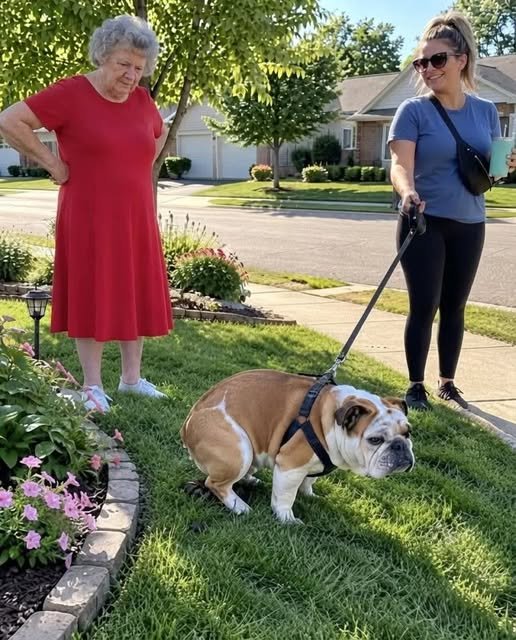
Winston was a wonderful dog; the problem was never him, but rather the person holding the leash.
Winston is an English bulldog. A remarkably large one. He has the kind of wonderfully squished face that makes him look mildly disappointed with the entire world, and my children absolutely adore him. My six-year-old son, Oliver, has been actively campaigning for a bulldog of his own practically since the day Winston waddled onto the block.
Even Tom loves him. He often stands holding his morning coffee at the kitchen window, commenting on Winston’s slow, deliberate movements as though he is narrating a prestigious wildlife documentary.
I want to be clear: I have absolutely nothing against Winston. That part matters deeply. Winston is a dog. He goes where his owner takes him, and he does exactly what dogs do. The problem was never, ever Winston.
The problem was Marguerite.
The Boundary is Breached
The first time Winston relieved himself on the pristine corner of my front lawn, I assumed it was a simple accident. Marguerite casually walked him back to her house without bothering to clean it up. I told myself she probably just hadn’t noticed. Or maybe she was running late for an appointment. I went outside with a bag and cleaned it up myself.
The second time, I happened to be watching from the front window. Winston stopped. Marguerite looked directly down at the spot. Then, she deliberately glanced toward my house. And then, she simply walked home. She had seen it. She knew.
I went out and cleaned it again. And I said absolutely nothing.
Why? Because we lived a mere twelve feet apart. Because I had young children who played outside. Because I had seen small, petty neighborhood disagreements escalate into years of bitter hostility, and I didn’t want that toxic energy anywhere near my home.
So, I told myself she probably just wasn’t thinking. Then I told myself maybe she was embarrassed and didn’t have a bag. Then I told myself surely she would start bringing bags tomorrow. Then I told myself it would eventually stop on its own.
I told myself a great many lies during the next six months.
Meanwhile, like clockwork, every morning around 7:40 AM, Winston crossed onto my lawn. And nearly every single morning afterward, I quietly went outside and cleaned up the mess that Marguerite knowingly left behind. It was only five minutes of work. That was all.
But the real cost was not the five minutes of my time. The real cost was the corrosive effect it slowly had on the way I viewed her. Every time I cleaned up after Winston, I spent a little more of the grace and generosity I had originally extended to her. A little more patience vanished. A little more goodwill evaporated. A little more of the belief that she simply didn’t understand what she was doing faded away.
Eventually, that emotional bank account ran completely dry.
The Neighborhood Meeting
The breaking point arrived at the neighborhood association meeting. They happen on the final Thursday of each month. I don’t always attend—between managing two children, juggling part-time work from home, and handling everything else, I go only when I can spare the time. But that particular October evening happened to be free, so I went.
Anyone who has ever attended a local neighborhood meeting knows the familiar, tedious pattern. Complaints about streetlights. Debates over stop signs. Arguments about holiday decorations being left up too long. Parking grievances.
Then comes the open-floor portion where residents can raise personal concerns. Marguerite gracefully lifted her hand. Before she even spoke a word, I noticed how perfectly composed she looked. She had clearly rehearsed what she was going to say.
She began by explaining that some children in the neighborhood were extremely loud while playing outside, and that their unruly noise interfered with her morning yoga routine.
Then, her voice took on a sharp, lecturing tone, and she said, “Certain people should learn responsibility before they have children. If you can’t be responsible for what you’ve tamed, you shouldn’t take it on.”
And as she said those words, she looked directly across the room at me.
Several neighbors shifted uncomfortably and followed her gaze. My face burned hot with embarrassment and sudden, intense anger. For about four agonizing seconds, my mind raced through every possible response available to me.
I could ruthlessly expose her right there. I could tell the whole room that the elegant woman lecturing us all about “responsibility” had spent the last six months leaving her dog’s mess on my front lawn. I could politely but firmly raise the issue. I could make a biting, sarcastic joke. I could loudly defend my children.
Instead, I did absolutely none of those things.
I simply looked right back at her. And I smiled. It wasn’t a friendly smile. It wasn’t an angry one, either. It was the calm, chilling smile of someone who had just made a very firm decision.
Then, I went home.
Tom was wiping down the counters in the kitchen when I walked in. He took one look at my face and stopped. “What happened?” he asked.
I told him everything. He became instantly quiet. Tom always gets very quiet right before he gets angry. I could practically watch the gears turning in his head as he considered marching right next door to give her a piece of his mind. But then he stopped himself, taking a deep breath.
“What are you going to do?” he asked.
“I already know,” I replied, and I laid out my plan.
He stared at me in silence for a long second. Then, a slow grin spread across his face. “Set the alarm for 7:15.”
“Already done.”
“Need me?”
“No. Stay in bed.”
He gave me that deeply familiar, affectionate look he sometimes gets when I do something that reminds him exactly why he married me in the first place. “Okay,” he said softly. “I’ll make a big breakfast afterward.”
The Morning of Six Stones
That night, lying in the dark, I felt strangely, powerfully calm. I wasn’t giddy or excited about causing a neighborhood scene. I wasn’t plotting to hurt anyone. I was simply echoing Marguerite’s own arrogant words in my head.
You are responsible for what you tame.
She was right. She was completely, utterly right. She simply had absolutely no idea how soon those exact words were going to come right back to haunt her.
My alarm buzzed softly at 7:15 AM. Tom and the children were still sound asleep. I slipped out of bed and deliberately put on my gardening clothes. Not pajamas. Not a cozy morning robe. My actual, dirt-stained yard-work clothes. That detail was intentional.
I crept into the garage and collected the supplies I had carefully prepared the night before. Then, I stepped out into the crisp autumn air.
Six carefully placed stones. Six silent reminders that patience is not the same thing as permission.
Late October mornings carry a particular, biting coldness. The street was dead quiet. The neighboring houses sat completely still in the dawn light. My breath plumed in little white clouds as I confidently walked across my lawn.
Over the previous week, anticipating this, I had been paying much closer attention to Winston’s daily visits. I had dutifully collected every single bit of evidence he had left behind. Carefully. Neatly bagged.
I walked across the narrow strip of driveway toward Marguerite’s immaculate house. And I returned what belonged to her.
I didn’t throw anything in a fit of rage. I didn’t smear anything on her pristine porch. I didn’t damage a single piece of her property. I simply, methodically placed one small, neatly tied bagged deposit in the exact center of each large decorative paving stone that lined her beautiful front walkway.
Six stones. Six unavoidable reminders. One for every single month I had spent silently cleaning up after her dog.
There was no angrily scribbled note. No dramatic accusation. No long-winded explanation. Nothing whatsoever linking the display to me—except the glaringly obvious context.
She would know exactly what it meant. I would know that she knew. And she would know that I knew she knew. That unspoken understanding was entirely enough.
I finished my task at precisely 7:32 AM. Then I went back home, thoroughly washed my hands, and started a pot of coffee.
At 7:38 AM, I heard the distinctive click of her front door opening. I stood silently near my kitchen window, coffee mug in hand, watching.
Marguerite stepped out into the cold wearing her usual pristine morning attire. A flowing silk robe. A beautiful ceramic coffee mug. She wore the composed, satisfied expression of someone fully expecting her day to begin exactly as she had planned it.
She took exactly three confident steps down her walkway.
Then, she stopped dead in her tracks.
She looked down at the first stone. Then her eyes darted to the second. Then the third. Even from my window, I could watch the wave of understanding crash across her face. She knew exactly what she was looking at. And she knew exactly who had put it there.
She stood frozen in the cold air, gripping her coffee. But she didn’t look toward my house. That tiny detail told me more than anything else.
Because if she looked toward my house, she would have to consciously decide whether or not to confront me. And what, exactly, could she possibly say? I hadn’t shouted at her. I hadn’t threatened her. I hadn’t penned a hysterical letter. I had simply returned something she had repeatedly and knowingly left on my property. Only this time, it was sitting right where she lived.
Eventually, her shoulders slumped, she turned around, and she went back inside.
By nine o’clock, when I pulled out of the driveway to take Oliver to school, every single stone was spotless. Marguerite had cleaned everything up. Thoroughly. Without anyone needing to ask her. Without a single heated argument. Without a single spoken word.
She had finally cleaned up after her own dog. And apparently, the message had been received loud and clear.
The Apology and the Realization
Later that same afternoon, our paths crossed. She had a paper grocery bag in one hand as I was pulling into my driveway. We locked eyes. I stood by my car and waited. I had already made my point brilliantly; whatever happened next was entirely her choice.
“I owe you a deep apology,” she said. Her words sounded a bit stiff and rehearsed, but not at all insincere.
“For the lawn. I should have been taking responsibility and cleaning up after Winston. I simply wasn’t thinking.”
“Thank you for saying that,” I replied evenly.
She hesitated, shifting the grocery bag. “And… the meeting.”
I just waited.
“What I said in front of everyone wasn’t really about some general neighborhood concern. I know that.”
“I knew that too,” I said.
She looked down at her polished shoes. “I was having an incredibly bad week. That isn’t an excuse. Just… context.”
I took a breath and thought about what I actually wanted out of this. I didn’t need her public humiliation. I didn’t crave some dramatic revenge. I certainly didn’t need her begging for my forgiveness. I just wanted her to understand boundaries. And I wanted the disrespect to stop.
From what I had already witnessed that morning, it had.
“Marguerite,” I said, my voice softening just a fraction, “we’ve lived beside each other for five years. I would much rather have a good, respectful neighbor than win a bitter argument.”
She looked up at me, relief washing over her features. “I’d rather have that too.”
“Then that’s exactly what we’ll do.”
She nodded gratefully, and we both retreated into our respective homes.
But over the next few weeks, as life returned to normal, I found myself thinking about the situation much more deeply. On the surface, the narrative was incredibly simple: My neighbor behaved inconsiderately. I tolerated it stoically. She publicly insulted me. I responded cleverly. She understood. Problem permanently solved.
But underneath that tidy surface was a much less comfortable reality.
For six whole months, I had been making a deliberate choice, too. Every single morning, I grabbed a bag, cleaned up after Winston, and quietly patted myself on the back, telling myself I was being mature. Patient. Reasonable. The bigger person. The kind of neighbor who didn’t create unnecessary drama over small things.
Those things were perhaps partly true. But there was another, harsher truth I deeply didn’t want to admit.
I was avoiding confrontation at all costs.
I told myself my silence was an act of kindness. Marguerite, unfortunately, interpreted it as an act of permission. She certainly wasn’t waking up each morning thinking, How incredibly generous of my lovely neighbor to handle this mess so quietly. She probably wasn’t thinking about me at all. My ongoing silence had simply trained her to believe that absolutely nothing would happen if she ignored the rules.
And then she felt emboldened enough to stand up in a public neighborhood meeting and lecture me about responsibility.
That was different. Six months of dog mess was thoughtless and inconsiderate. The meeting was a deliberate attack. She looked at me while saying it because she fully expected me to simply lower my eyes and remain silent. And honestly, why wouldn’t she? I had expertly trained her to expect silence from me. For six months, I had been perfectly, reliably docile about absorbing the inconvenience and saying nothing at all.
What I needed her to understand that crisp morning was actually quite simple: My silence had been a choice. It was not born of weakness. It was not ignorance. It was not an inability to defend myself. I knew exactly what she was doing every day. I had simply chosen patience over conflict.
But patience is not the same thing as permission.
Those six stones were how I finally articulated that thought. Without ever raising my voice, I said: I have noticed. I have been patient. And now, I am choosing differently.
Conversations in the Garden
Two weeks later, Oliver was playing in the front when he saw Marguerite walking Winston—but this time, she was taking him all the way around the block instead of across our pristine lawn.
“Mom, why doesn’t Winston come over here to say hi anymore?” he asked, watching the bulldog waddle away.
“He goes to the big park now,” I told him.
“That’s far away.”
“It’s only two blocks.”
He thought very seriously about that fact. “Does Marguerite know he really likes our yard?”
“Yes, sweetie, she knows.”
“Then why can’t he use it?”
I crouched down and chose my words carefully. “Because sometimes, even if we really like something, it still belongs to someone else.”
Oliver frowned, trying to process the logic. “Like when I want to play with another kid’s toy?”
“Sort of,” I said. “Except what she was taking wasn’t really the lawn itself. It was the time and energy someone else had to spend cleaning it up.”
He stared at me, his eyes widening. “Wait. You were cleaning up after Winston?”
“Yes.”
“Every single day?”
“Almost every day.”
“For how long?!”
“Six months.”
Oliver looked genuinely, profoundly horrified. Children have such a fierce, uncomplicated sense of justice. “Mom, why didn’t you just tell her to stop?”
I opened my mouth with a ready excuse. Then, I stopped completely. Because out of the mouths of babes comes absolute truth. He was entirely right.
“I really should have,” I admitted softly.
“Why didn’t you?”
“Because… because I didn’t want to start a big fight.”
“But you were doing all the hard work.”
“Yes, I was.”
“That’s not fair at all.”
“No, buddy. It wasn’t fair.”
He looked thoughtfully toward the thick green grass. “Did you finally tell her?”
“In a way, yes.”
“What way?”
“A very quiet way.”
“Did it work?”
I looked across the expanse of the clean, beautiful lawn. “Yes. It worked perfectly.”
“Good,” he declared with finality. Then, satisfied, he ran away across the grass with his arms stretched out like an airplane.
But his innocent, piercing question stayed with me long after he ran off. Why didn’t you just tell her?
It was the only right question to ask. The painful, honest answer was that I had completely confused avoiding conflict with being a gracious person. Yes, some of my patience was genuine kindness. But a large part of it was simply fear, cleverly disguised as maturity.
If I had walked those twelve short feet across the driveway during the third week of the mess and simply smiled and said, “Marguerite, Winston has been using my lawn as a bathroom. Would you mind making sure you clean up after him?” the entire uncomfortable conversation probably would have lasted less than sixty seconds.
Maybe it would have been slightly awkward. But it certainly would have been significantly less uncomfortable than carrying around six heavy months of silent, brewing resentment.
I still feel deeply satisfied with what I eventually did with those stones. It was effective. But I also know now, with absolute certainty, that I waited entirely too long to protect my own boundaries.
There is a massive difference between deciding something genuinely isn’t a big enough deal to address, and avoiding it simply because you don’t want to pay the awkward emotional toll of speaking up. I had been boldly telling myself I was doing the first thing. In stark reality, I was cowardly doing the second.
Marguerite’s cruel comment at the neighborhood meeting finally stripped away that convenient excuse. Her audacity forced me to stop pretending I wasn’t immensely bothered. And strangely enough, in the grand scheme of things, that push was incredibly useful.
Because I finally discovered that my voice and my strength had been there the entire time. Even when that voice happened to take the highly unorthodox form of six very carefully arranged dog bags on decorative paving stones.
Blooming Boundaries
Sometimes you must wait. Sometimes you must speak. Gardening teaches you the exact difference.
By the time spring rolled around, the garden looked better than it ever had in seven years. Maybe that was pure botanical coincidence. Maybe not.
I sometimes like to think that gardens vividly reflect the inner state of the person actively tending to them. That year, I had finally stopped swallowing down frustrations that desperately needed to be addressed out loud. My active children finally had their clean front lawn back. I finally had my mental peace back. And the hydrangeas? They were nothing short of incredible.
All nine bushes bloomed furiously. Even the two fragile ones I had painstakingly propagated myself finally produced massive, stunning clusters of flowers.
One warm afternoon in late June, Marguerite was walking by and stopped near the edge of the sidewalk. She stood silently for a moment, just staring in awe at the massive wall of blooms.
“What on earth do you do to them to make them look like that?” she asked, genuine wonder in her voice.
I stood up and wiped my dirt-stained hands on my apron, looking at her. Eight full months had passed since the morning of the stones. She had been diligently walking Winston completely around the block every single day ever since. No problems. No hidden messes. No more arguments. It was exactly the peaceful coexistence I had originally wanted.
“Good soil drainage,” I said with a small smile.
Then, I paused, letting the silence hang for a moment.
“And patience.”
Another meaningful pause.
“And, most importantly, knowing exactly when to stop waiting for things to magically fix themselves.”
She looked deeply at me. I looked calmly right back. We both knew perfectly well that we weren’t just standing there talking about gardening techniques.
A small, knowing smile tugged at the corner of her mouth. “I think I’ll try that,” she said softly.
“It works,” I assured her.
Then, she nodded once and went back to her beautiful home. I returned to my knees in the flower bed, burying my hands back in the cool, rich earth.
Oliver eventually came bounding outside, slowing down to crouch beside me in the dirt. “Mom, can Winston ever come into our yard again to play?”
I thought about it for a second. “Yes, he can.”
“As long as Marguerite cleans up after him right away?”
“Exactly.”
“Will she really do it?”
“I think so, yes.”
“How do you know for sure?”
I looked across the lush green expanse of the lawn. At the towering, vibrant hydrangeas. At the intricate flower beds I had spent literally years getting just right. At the little slice of the world I had built so slowly, so carefully, with my own hands.
“Because,” I told my son with a satisfied smile, “now she knows that I notice.”
Oliver considered that profound truth for a moment. “Good,” he agreed.
Then he ran off to chase a butterfly, leaving me there with my hands grounded in the soil.
Gardening teaches you many strange, beautiful things about life. It teaches you that patience is essential to growth. But it also teaches you that patience has firm, necessary limits. Sometimes you must wait quietly. Sometimes you must intervene quickly. Sometimes you must speak loudly. And sometimes, the message that finally gets through loud and clear requires absolutely no words at all.
The truly important thing in life is learning how to recognize which response will actually solve the root of the problem, instead of simply doing what makes you feel comfortable for thirty fleeting seconds.
Winston still waddles past our house every Tuesday and Thursday morning. Oliver eagerly waits on the front porch just to pet his droopy face. Marguerite cleans up after him. Every. Single. Time.
And this year? The hydrangeas are blue. The exact, breathtaking shade of blue I had been trying to grow for seven long years.
Note:This work is inspired by real events and people, but it has been fictionalized for creative purposes. Names, characters, and details have been changed to protect privacy and enhance the narrative. Any resemblance to actual persons, living or dead, or actual events is purely coincidental and not intended by the author.
All images used in this article are AI-generated and intended for illustrative purposes only.