
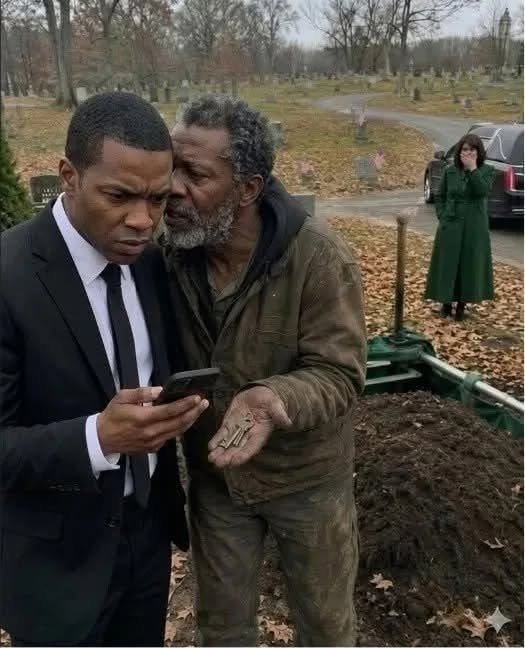
The ground beneath the cemetery turf was frozen solid, but the icy New Jersey wind was nothing compared to the chill that gripped my spine when the gravedigger took hold of my sleeve.
The final prayer had ended barely five minutes earlier. Across the manicured lawn of Saint Jude’s Cemetery, relatives and neighbors were already dispersing toward their warm sedans, murmuring the usual empty condolences people recite when they know tragedy cannot be fixed. My mother, Eleanor, stood beside the hearse with a gloved hand pressed against her mouth. My wife, Celeste, was gently herding our two shivering children toward the parking lot.
I had spent the last three days playing the pillar of the family. I picked out the mahogany casket, signed death certificates, picked the lilies, and accepted the coroner’s verdict without a single question: Raymond Mercer, sixty-six years old, dead of an unexpected cardiac arrest in his locked study.
Then, as the mourners cleared, the gravedigger stepped up beside me. His hands were calloused, his canvas jacket stained with dark soil, and his voice barely rose above the sound of the bare oaks scraping against one another.
“Sir,” he muttered, his eyes darting across the empty rows of granite headstones. “Your father paid me to bury an empty coffin.”
A secret passed between tombstones: the brass key marked Unit 17.
The Brass Key and the Silent Warning
For a few seconds, my brain simply refused to process the words. Grief is a heavy fog, and shock makes you deaf.
“Excuse me?” I managed, staring at the man. “What did you just say?”
“I said the box down there is filled with sixty pounds of landscaping ballast,” the gravedigger said plainly. “Your father is not in that grave. You saw what he needed you to see.”
“That’s impossible,” I snapped, stepping back. “I identified his body at the county morgue.”
“You saw what you were directed to see,” the man repeated, refusing to blink. Before I could shout or call the funeral director, he reached into his coat and pressed a cold piece of metal into my palm.
It was a small, heavy brass padlock key. Stamped deeply across its flat face was the number 17.
“Listen to me closely, Julian,” the old man whispered. He had never asked my name. “Do not go home. It doesn’t matter who calls you. It doesn’t matter who begs you to come back to the house. Get in your car and drive directly to Route 9 Self-Storage. Unit 17. Your father set this in motion.”
Right at that exact second, the phone in my breast pocket vibrated against my ribs.
I pulled it out with trembling fingers. The screen lit up with a new text message from my mother.
Come home alone.
Three words. No greeting. No punctuation. No “honey.”
My mother was an English teacher who never sent a message shorter than three paragraphs. She littered every sentence with commas, exclamation points, and terms of endearment. Even when she asked me to pick up a carton of half-and-half on the way to Sunday dinner, she signed it with love. Now, standing barely thirty yards away beside the hearse, she was texting like a ghost.
The gravedigger glanced at the screen of my phone. The color drained from his weathered cheeks.
“Don’t do it,” he rasped. “Whatever you do, stay away from that house.”
He reached inside his coat once more and pulled out a thick, yellowed envelope. Written across the front in faded black fountain pen ink was my own name—in my father’s sharp, unmistakable cursive.
“He gave me this envelope twenty years ago,” the gravedigger confessed, his knuckles white against his coat. “He told me I would know the day it was time to hand it to you. That day is today.”
Without waiting for another word, the man turned and disappeared into the fog between the family mausoleums, walking with the heavy gait of someone who had carried a terrible burden for two decades and finally set it down.
Route 9 Self-Storage under the twilight sky, where the truth waited inside Unit 17.
The Rendezvous at Unit 17
I sat in my sedan at the far edge of the cemetery parking lot, my hands shaking so violently I could barely slit open the yellowed paper. Inside lay a single folded note:
Julian,
If you are reading this, the curtain has fallen. Do not go back to the house. Head straight to Unit 17 at Route 9 Storage. Trust the woman waiting under the awning. Do not stop until you understand why I had to die.
—Dad
By the time I reached Route 9, winter twilight had turned the New Jersey sky into bruised purple slate. The storage facility sat hidden behind a rusted chain-link fence, nestled between a shuttered diner and a sprawling row of abandoned industrial warehouses. A faded American flag whipped violently in the wind beside the rental office.
Under the security canopy, standing motionless beneath a flickering sodium lamp, stood a woman in a long, dark wool overcoat. She didn’t look like a stranger looking for an extra locker. She stood with the rigid, poised balance of a trained predator.
As my headlights swept over her, she stepped toward my car without hesitation. Before I could roll down my window to demand an explanation, she flicked open a leather wallet, revealing a gold shield.
Federal Bureau of Investigation.
“Julian Mercer,” she stated, her voice clipped and professional. “I am Special Agent Karen Holt. Your father briefed us that you would be coming alone.”
My stomach twisted into a knot. “My father is supposed to be six feet underground right now.”
“Your father knew what he was doing,” Agent Holt replied, gesturing toward the metal roll-up door marked with a painted stencil: 17. “The answer you need is right behind that door.”
I gripped the brass key tightly in my palm. The padlock looked ancient, but the mechanism turned smoothly under my fingers. With a sharp squeal of rusted springs, the corrugated door rolled upward into the ceiling.
Inside, the bay was nearly barren. No old furniture. No family albums. Only a single metal folding table in the center, upon which sat a ruggedized, military-spec laptop. A small red power light was pulsing on the lid, accompanied by a rhythmic, low-frequency electronic chime.
Suddenly, my phone rang. The screen buzzed violently against the concrete silence.
Mother calling.
Agent Holt looked down at my phone, her eyes narrowing into cold slits. “Do not answer that. Step inside and let the recording run.”
The glowing screen revealed the impossible: Raymond Mercer alive, delivering a desperate warning.
The Face on the Screen
I set the phone face down on the table. My thumb struck the laptop’s trackpad, and the screen flashed to life. A media player opened automatically, buffering a video file stored on the local drive.
A second later, the breath left my lungs.
Raymond Mercer appeared on the high-definition display. He was dressed in a dark wool sweater, sitting in an unfamiliar room with pine-paneled walls. His silver hair was unkempt, his face lined with deep exhaustion, but his eyes were sharper than I had seen them in years.
“Listen carefully, Julian,” my father’s voice boomed through the small speakers, echoing against the concrete walls of the locker. “I am not dead. Faking my demise was the only viable way to disappear before they put a bullet through my skull.”
He leaned forward, pressing both hands against the desk in the video.
“For five long years, I suspected your mother, Eleanor, was leaking my financial audits and corporate findings to the syndicate we were investigating. I spent years doubting the woman I loved. But last month, I realized how horribly blind I had been.”
Beside me, Agent Karen Holt stood completely rigid. I could hear the faint, sharp intake of her breath.
“Eleanor was never the traitor,” my father continued, his voice dropping into a deadly whisper. “Eleanor was trying to warn me. The mole inside the bureau—the person who sold off our witnesses, liquidated our evidence, and arranged the hit on my life—is standing right next to you.”
My father raised his index finger on the screen and pointed directly at the camera lens.
“The threat is Agent Karen Holt. If she is beside you right now, Julian, run.”
The Ambush in the Dark
Everything collided in a fraction of a second.
Holt’s hand plunged under her heavy coat toward her shoulder holster. I didn’t think; instinct took over. I lunged forward, throwing my entire body weight into the folding table and slamming the laptop shut against my chest.
Holt recovered instantly, drawing a black Glock and leveling it squarely at my forehead. Her composed, law-enforcement demeanor evaporated into pure, murderous fury.
“Put the computer down on the floor, Julian,” she hissed, her voice devoid of any warmth. “Now.”
“You were the one,” I whispered, backing against the cold corrugated wall. “The empty coffin… he did it to draw you out.”
“Your father was a stubborn old fool who should have retired a decade ago,” she spat, tightening her finger on the trigger. “Give me the drive, and you might walk out of here alive.”
Before she could finish the sentence, the exterior twilight shattered.
“FEDERAL AGENTS! DROP YOUR WEAPON!”
High-intensity tactical spotlights flooded into Unit 17, blinding us in searing white brilliance. Heavy boots slammed against the gravel. A half-dozen federal tactical officers in body armor swarmed the entrance from both flanks.
Holt spun on her heel, firing a single desperate shot toward the doorway. The round shattered a concrete beam above, raining pulverized plaster down like snow. Within half a heartbeat, two heavily armored agents tackled her to the concrete floor, knocking the weapon from her grip and pinning her wrists behind her back with zip-ties.
I sank down against the corrugated wall, clutching the laptop to my chest like an infant, my heart hammering against my ribs.
A tall man with silver hair and an FBI tactical windbreaker stepped over Holt and knelt down in front of me. He pulled down his ballistic goggles.
“Julian Mercer? I’m Assistant Director Miller,” he said calmly. “Are you hit?”
“No,” I stammered, shaking violently. “No. My father… the video…”
Director Miller gently took the laptop from my arms, flipped it open, and resumed playback. My father’s image returned to the display, his expression softening into a familiar, tired smile.
“Julian,” my father spoke gently, “if you are hearing this part of the recording, it means Director Miller’s team did their job and Holt is in custody. I am deeply sorry for putting you and Celeste through the agony of a funeral. But keeping you in the dark was the only way to make the deception completely airtight.”
The camera panned slightly, displaying a set of GPS coordinates printed on a handwritten index card alongside a radio frequency.
“It’s time to bring the family together, son. Come find me.”
The final coordinates pointed deep into the snowbound Maine wilderness.
The True Message
The screen faded to black. The storage bay fell dead silent, save for the muffled cursing of Karen Holt as she was dragged toward a waiting tactical cruiser.
Then, my phone buzzed one final time on the folding table.
I picked it up. A new message from my mother sat on the glowing screen. This time, it wasn’t the cold command that had sent me running from the cemetery.
I found his trail, honey. Celeste and the kids are safe with me. We are heading north. See you at the cabin.
Director Miller looked over my shoulder, reading the screen with a faint, knowing grin.
“It looks like your old man isn’t the only Mercer who knows how to run an operation,” Miller remarked softly, patting my shoulder. “Let’s get you an escort to Maine.”
Outside, large white flakes began drifting down across the desolate storage yard, dusting the asphalt in silence. That morning, I had buried my father in an empty grave. Tonight, I was driving through the snow to bring him home.
Note:This work is inspired by real events and people, but it has been fictionalized for creative purposes. Names, characters, and details have been changed to protect privacy and enhance the narrative. Any resemblance to actual persons, living or dead, or actual events is purely coincidental and not intended by the author.
All images used in this article are AI-generated and intended for illustrative purposes only.