
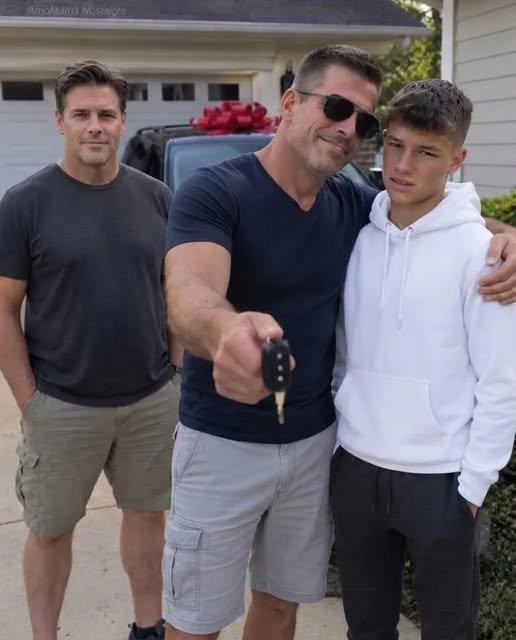
My biological father returned on my seventeenth birthday after fourteen years of radio silence, fully convinced that a shiny luxury purchase could wipe the slate clean.
“Come on, son,” he said with a dazzling, practiced grin, holding out the heavy chrome key fob to a brand-new black sedan parked at our curb. He glanced toward our modest front porch, his eyes narrowing slightly at the man standing there. “He could never give you something like this.”
He waited for my jaw to drop. He expected tears of gratitude, an embrace, a sudden rush of validation bought and paid for in single invoice.
Instead, I stepped back into our hallway, walked up the stairs, and came down holding a small, unvarnished wooden box.
That was the exact moment his confident smile began to fray.
The truth was, I hadn’t laid eyes on my biological father since I was three years old. For the vast majority of my life, the world consisted simply of Mom and me. We didn’t discuss money, but growing up in a single-parent home means you don’t need anyone to explain financial stress to you; you learn to read the room like a weather vane.
You notice when the kitchen cupboards become sparser near the end of the month. You notice when Mom quietly stops picking up the little things she used to enjoy—her favorite brand of tea, an extra magazine at the checkout, a new cardigan for church. When my sneakers wore through at the toes, new shoes were purchased, but pizza nights vanished for two months. By the time I turned thirteen, I had developed a sixth sense for quiet survival: I never asked for anything unless going without it was genuinely impossible.
Then, when I was fifteen, Mom introduced us to Ray.
Ray was a tradesman—broad-shouldered, quiet-spoken, with grease under his fingernails and work boots that had seen better decades. He brought two kids of his own into the equation, Danny and Cara, who stayed with us on alternating weekends. Almost overnight, our cramped, quiet little home became a whirlwind of laundry piles, spilled cereal, sibling squabbles, and relentless noise.
Yet, in all that chaos, Ray never once treated me like an outsider or an extra mouth to feed. He never acted like a man doing a charity run. He just showed up.
Ray never gave long speeches—he simply pulled up a chair and stayed until the job was done.
He was in the bleachers for every single Friday night football game. Even during my sophomore year, when I spent practically the entire autumn riding the bench with a towel draped over my shoulders, Ray stood by the metal perimeter fence in the biting October cold.
One night, after a brutal defeat where I played exactly three downs in garbage time, I walked over to the fence, my helmet dangling from my hand.
“You know I was only out there for about two minutes, right?” I asked, feeling foolish.
“I know,” he said mildly.
“You stood by that chain-link fence for two and a half hours, Ray.”
“Yep.”
“Why?”
He looked at me with genuine bewilderment, as though I had just asked why the sun rises in the morning. “Because you were here.”
That was the measure of Ray. He didn’t offer grand promises or poetic declarations. He simply anchored himself where you needed him. When sophomore chemistry threatened to ruin my grade-point average, he sat with me at our formica kitchen table until midnight, tracing periodic tables and balancing chemical equations he hadn’t seen in twenty-five years.
“You realize you’re probably making this harder than it needs to be,” I muttered around eleven-thirty, rubbing my temples.
“Probably,” he answered, squinting over my textbook.
“Then why are you still sitting here?”
He didn’t even look up from the page. “Parents don’t tap out before their kids do.”
He said the word parents without a single beat of hesitation. He didn’t even realize the weight of what he had dropped into the room. But I heard it. And I never forgot it.
When he and Mom got married a few months later, things didn’t magically get wealthy. If anything, expenses doubled. Yet one Saturday afternoon, Ray sat down with Mom and set up a modest college savings fund in my name. There was never an abundance of money to throw into it. With Danny needing dental work, Cara growing out of her winter coats, and household bills constantly stacking up, contributions were sporadic at best.
Some months they managed thirty dollars. Other months, nothing at all. I knew the reality of our household, so I never expected the account to amount to much, nor did I ever ask about it.
Until the morning of my seventeenth birthday.
Ray came up the stairs and knocked lightly on my bedroom door frame, holding a small wooden box made from scrap cedar. It wasn’t artisan perfection. One corner had an extra layer of sanding to hide an uneven cut, and you could see where the hinge had been repositioned to sit flush. But burned carefully across the top lid were my initials: J.M.
The cedar box wasn’t flawless, but every millimeter was crafted with deliberate care.
“Did you build this?” I asked, running my thumb over the grain.
“Took me about six weeks out in the garage,” he muttered, rubbing the back of his neck like he was embarrassed. “Open it up.”
Inside lay a stack of folded bank statements documenting every single deposit made into my college account over the last two years. But when I flipped the first paper over, I stopped breathing. In the margin, written in Ray’s blunt carpenter’s pencil, were brief notes documenting where every single dollar had come from:
Boots can wait another season — $40.
Packed lunch every day this month — $25.
Truck oil change pushed to next month — $60.
Then I came across one from the previous November:
Danny needed new glasses. Rough month — $0.
Directly beneath it on the following month’s slip:
Took Saturday overtime shift to make it up — $80.
I looked up at him, my throat suddenly tight. “You kept track of what you gave up?”
Ray shifted his weight, looking down at his socks. “I just didn’t want you to think we weren’t trying, even when we couldn’t put much away. I wanted you to know we were still moving forward. Together.”
At the bottom of the box rested a three-line card in his hurried scrawl:
Kid,
It isn’t enough yet.
We’ll keep going.
— Ray
In monetary terms, it was the cheapest birthday gift in the world: scrap wood, hinges, and paper. In human terms, it was the most valuable thing I had ever held.
Three hours later, an aggressive, rhythmic rap echoed against our front door.
Mom answered. I heard a deep, polished voice from the entry hall say, “I came to see my son.”
I froze in the kitchen. When I walked out to the living room, the man standing in our foyer looked like an advertisement for middle-aged success. Tailored Italian jacket, platinum timepiece on his wrist, silver dusting his temples in that dignified, barbershop way. I had only seen his face in two faded, dog-eared photographs Mom kept in an old envelope, but I recognized him in an instant.
My biological father.
“Happy birthday, son,” he said smoothly, stepping forward with his arms slightly raised.
Fourteen years without a telephone call. Fourteen years without a twenty-dollar birthday card. Fourteen years of leaving my mother to battle every utility bill and doctor visit alone. And just like that, I was supposed to answer to “son.”
He chuckled, brushing off the past with an easy wave of his manicured hand. He said he knew we needed to talk, but insisted today wasn’t about heavy conversations. “Come outside,” he urged, ushering me toward the porch. “I have something for you.”
He arrived with four wheels and a red bow, convinced a price tag could substitute for fourteen years of absence.
Parked in front of our cracked concrete driveway was a brand-new black sports sedan, so clean it mirrored the cloudy sky, topped with an absurdly large red velvet ribbon. The keys dangled from his fingers, catching the afternoon light.
“Happy seventeenth,” he beamed. “Title’s clear. Completely paid in cash.”
I stared at the paint. “That’s… for me?”
“Every bit of it.” Then his gaze drifted toward the porch rail, where Ray had stepped out, wiping his hands on a clean rag. My father’s smile shifted from celebratory to triumphant. He lowered his voice, making sure it carried across the yard. “Come on, son. Take the keys. Your stepdad could never give you something like this.”
Ray looked down at his boots, keeping silent.
I looked at the shiny chrome grill of the car, and then back to the man who had been a ghost my entire life until ten minutes ago.
“Can I ask you three questions?” I said quietly.
He grinned, confident he was closing the deal. “Ask me anything you want, kid.”
“What position do I play on the varsity football team?”
His smile twitched. “Well… football. Wide receiver? Defense?”
“What colleges am I applying to this winter?”
Nothing. Just a blank, uneasy stare.
I tilted my head toward the porch. “What high school class did I nearly flunk out of last spring?”
His jaw stiffened, irritation replacing his charm. “How on earth would I know that? I haven’t been here.”
“Exactly,” I said. “You wouldn’t.”
He stepped closer, thrusting the keys forward until they nearly brushed my chest. “Look, I know mistakes were made. I missed out. That’s why I’m standing here today! I’m trying to make up for lost time. A car like this is a real head start in life.” He cast another dismissive glance toward the porch. “It’s certainly a lot better than whatever scrap he managed to put together.”
“Stay right there,” I told him.
I walked up the porch steps, past Ray—who wouldn’t meet my eyes—and went inside. When I came back out, I was carrying the cedar box.
My biological father looked down at the wooden box and let out a dry, condescending laugh. “That? That’s what you went back inside for? A block of pine?”
“No,” I answered, unlatching the brass hook and lifting the lid. “Not the wood. This.”
I pulled the stack of bank statements out and held them up. I turned them over so the pencil handwriting was visible in the daylight. I read the margins out loud to him, right there on the pavement:
Boots can wait.
Brought lunch all week.
Truck service postponed.
Danny needed glasses.
My father frowned, his arrogance giving way to confusion. “What is that, grocery receipts?”
“It’s my college fund,” I said, keeping my voice steady. “Every month, Ray put money aside for my future. Sometimes it was eighty dollars. Sometimes it was twenty. Sometimes it was five dollars scraped out of the console of his truck. Not because he had cash lying around, but because he was willing to sacrifice things he actually needed so that I wouldn’t have to start life from zero.”
I pointed toward the black sedan sitting at the curb.
“You bought that car with money you already had to spare,” I said, looking him dead in the eye. Then I looked up at the porch. “Ray has been building my future with money he needed to survive.”
My biological father’s face turned an ugly shade of red. “You really think that man cares about you more than your own flesh and blood? I am your father!”
“You don’t even know what number I wear on my jersey.”
“Your mother kept you from me!” he snapped, his facade completely unraveling.
“Did she?” I asked. “You knew our town. You knew this address. You knew today was my birthday, because you managed to show up right on schedule when you wanted to put on a show. You could have sent one postcard in fourteen years. You had five thousand days to find me. You chose today because you wanted an audience.”
He held the keys out one last time, desperate now. “Take the car, son. Don’t be an idiot. It’s thirty thousand dollars on wheels. Don’t ruin your life over pride.”
And for half a second, the temptation flared. I was seventeen. I had spent two years riding public transit in the rain, asking friends for rides home from practice, staring at car commercials late at night. The temptation of raw freedom was right there in the palm of my hand.
Then I remembered the worn soles of Ray’s work boots. I remembered him sitting at our kitchen table at midnight when his own back was throbbing from a twelve-hour shift, refusing to leave my side until I understood covalent bonds.
I reached out and took the keys.
A triumphant, arrogant breath of relief left my father’s chest. But before he could celebrate, I took his right hand, placed the heavy key fob back into his open palm, and gently folded his fingers back over it.
“I’ve wanted a car for two years,” I told him quietly. “But I wanted a father for fourteen.”
The street fell dead silent.
He stared down at his closed fist, completely stunned. “So that’s it? You’re choosing him over me?”
I shook my head.
“No,” I said. “He chose me.”
There was nothing left to say. My biological father stood on our driveway for another thirty seconds, realizing there was no angle left to work, no audience to impress. He walked back to his new sedan, slammed the door, and drove away without looking back.
Ray didn’t say a word either. He just walked back into the house.
True fatherhood isn’t proved in a dramatic driveway show—it lives in the everyday, quiet work.
Ten minutes later, after the sound of the luxury exhaust had faded down our street, I walked into the kitchen. Ray was standing in front of the ceramic sink, his flannel sleeves rolled up, scrubbing the leftover egg off our birthday breakfast plates as if nothing out of the ordinary had occurred.
“Ray,” I said.
He turned the tap off and wiped his soapy hands on a dish towel. “Yeah?”
“Thank you.”
“For what?”
“The cedar box. The account. Standing by that fence. Everything.”
He looked uncomfortable again, turning back toward the faucet. I asked him the same question I had asked two years prior at the kitchen table: “You didn’t have to do any of that, Ray. You had your own kids to take care of. Why did you do all this for me?”
He didn’t make a joke this time. He didn’t shrug it off. He rested both hands on the edge of the sink, looked out the small window above it, and gave the only answer that ever mattered:
“You’re my kid.”
That was all. No emotional monologue. No grand performance. Just four words from a man who had already spent two years proving their truth through sweat, worn soles, and quiet sacrifice.
The following month, Ray finally went down to the local supply store and bought himself a brand-new pair of work boots. My college fund kept growing, twenty and fifty dollars at a time. And as the months turned into years, Ray stopped writing what he had sacrificed in the margins of those bank statements. Instead, he began writing what he was celebrating:
Passed chemistry with a B — $50.
Started at safety on Friday night — $30.
And on the slip from the summer I graduated high school:
Proud of you, kid — $100.
My biological father called a couple of years later, offering a civil conversation over coffee. We spoke, but there were no keys on the table, no flashy watches, and he never once insulted Ray again. Perhaps he finally understood what had happened that afternoon on the driveway.
When you are young, you assume fatherhood is an accident of biology or a matter of bloodlines. Ray taught me the real truth. One man came back after fourteen years eager to show off what money could purchase; the other had spent years giving me what wealth can never buy.
His consistency. His time. His dignity. His quiet, unshakeable presence.
That gleaming sports car vanished down the street in a cloud of exhaust years ago, and I don’t remember what model it was. But that cedar box still sits on my desk, uneven corner and all. And whenever life gets loud or uncertain, I can still hear the quiet voice of the man at the kitchen sink, speaking the words that changed my life forever:
“You’re my kid.”
Note:This work is inspired by real events and people, but it has been fictionalized for creative purposes. Names, characters, and details have been changed to protect privacy and enhance the narrative. Any resemblance to actual persons, living or dead, or actual events is purely coincidental and not intended by the author.
All images used in this article are AI-generated and intended for illustrative purposes only.