
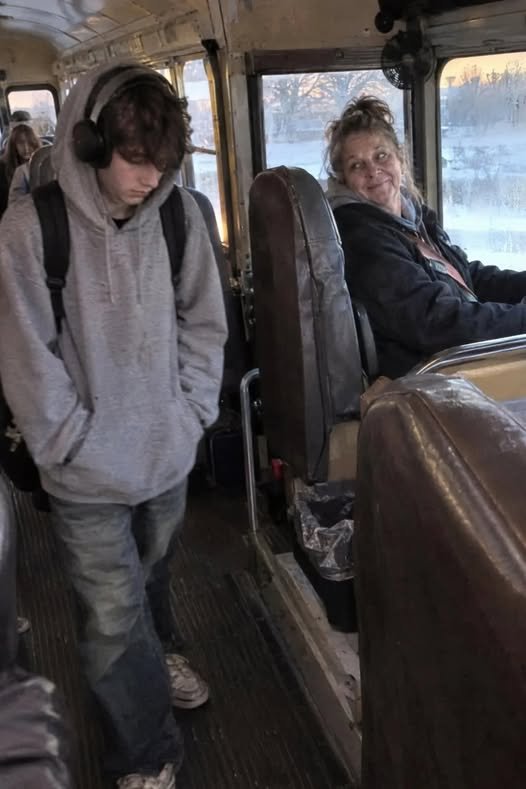
The air brake let out a sharp, shuddering hiss, and the heavy folding doors parted to let the bitter November wind tear through the cabin. Outside, the morning sky was the color of wet slate.
Kellan stepped up the rubberized stairs, keeping his eyes glued to the scuffed toes of his sneakers. His oversized heather-gray sweatshirt was pulled up tight, the hood cinched so closely around his face that only the bridge of his nose caught the cabin light. Clamped over the fleece were giant black over-ear headphones, sealing him inside a world of his own making.
“Good morning, Kellan,” I said, keeping my voice bright and steady over the idling rumble of the engine.
He slipped right past the driver’s console without breaking his stride, without a nod, without so much as a flicker of his eyelids. He navigated the narrow aisle with the quiet balance of someone who didn’t want to bump against a single soul, took his regular place in the very back corner, slumped against the frosted glass, and shut his eyes.
Back at the depot during driver layovers, the breakroom chatter was rarely kind to kids like Kellan. The other drivers called him sullen. They called him disrespectful. They shook their heads over lukewarm coffee and lumped him into the convenient pile of teenagers who couldn’t muster basic courtesy for the adults tasked with keeping them safe.
I never chimed in. I didn’t see defiance; I saw a child balancing a load far too heavy for thirteen-year-old shoulders.
Five years earlier, my twenty-eight-year-old daughter slipped away into the quiet, irreversible dark of an accidental overdose. In the long, agonizing aftermath of that loss, something fundamental shifted behind my ribs. My eyes stopped tracking the loud, cheerful children who demanded the room, and I found myself watching the quiet ones—the ones who retreated into shadows and learned how to disappear in plain sight. My grief taught me the hardest truth I know: silence isn’t an attitude. Most of the time, silence is pure armor.
So, every afternoon when he dropped down the bus steps at the corner of Linden and Maple, I looked right at him and said, “Have a good evening, Kellan.”
And every afternoon, he stepped into the cold without answering.
That rhythm held for four solid months. I never pushed. I never demanded he peel an ear cushion back. I just offered the words like an open door, making sure he knew that on this forty-foot stretch of asphalt, he was seen.
Silence is rarely defiance; more often, it is armor.
The Blizzard and the Warmest Seat
The turn came during the late-January blizzard. A blinding whiteout swept across the county right at dismissal, and the district held the bus fleet at the middle school curb for more than an hour while road crews cleared the main arteries. The majority of the students remained inside the heated cafeteria, but Kellan had boarded early. It was just the two of us sitting in the rumbling cabin while the heater fought against the howling drafts.
I glanced into the broad convex rearview mirror. Kellan was huddled against the vinyl, blowing into his bare hands. His jacket was paper-thin—barely adequate for autumn, let alone zero-degree gusts.
I twisted open my thermos, poured a steaming cup of hot chocolate, walked down the center aisle, and tapped gently on the seat frame ahead of him.
He flinched, instinctively slipping one headphone down to his collarbone.
“Figured you could use some warmth,” I smiled, holding the cup steady.
He looked from the steam to my face for several long heartbeats before his cold fingers wrapped around the plastic. “Thank you,” he muttered. His voice was gravelly and dry, the sound of vocal cords rarely used during daylight hours.
I took the seat across from him. “You always look run ragged, Kellan. Are you getting any sleep at home?”
He stared into the dark liquid. For a second, I thought he was going to pull the headphone back over his ear and shut me out. Instead, the dam cracked.
He told me his father had been incarcerated over the summer. His mother had taken on night shifts at an industrial distribution center across the county line, working twelve-hour stretches just to cover basic rent and keep milk in the carton. That left Kellan.
Every single morning, well before the streetlights flickered off, thirteen-year-old Kellan was the adult in the apartment. He coaxed his six- and eight-year-old sisters out of bed. He warmed their oatmeal, double-checked their homework folders, brushed out their tangles, and walked them four snowy blocks to their elementary bus stop. Only after the little yellow bus swallowed them up did he sprint through the slush to catch mine.
“I keep the headphones on because the other kids yell and roughhouse, and my head feels like it’s going to split,” he whispered, his knuckles white against the cup. “I’m just tired. I don’t have any room left for noise.”
My chest ached. Here was an eighth grader doing the work of two grown adults, being written off by passing strangers as sulky and bad-tempered.
“You’re taking wonderful care of those girls, Kellan,” I said gently. “Your mother is blessed to have you.”
He didn’t answer, but his shoulder hitched, and he dragged the rough gray fleece of his sleeve across his eyes.
The following morning, when Kellan stepped onto the bus, an orange safety cone was sitting on the very front seat directly behind my shoulder. He halted, staring at it in confusion.
I set the cone down beside the pedals. “This one’s yours from now on. It’s right above the heating core, and nobody talks up here. Sleep if you need to.”
He took the seat without a word, drew his hood forward, and slumped his head against the window pillar.
From that day forward, I retired the standard cheerful greetings. Whenever he boarded, I asked just one thing under my breath: “Did everybody make it through yesterday?”
He would give me a single, quiet nod. That was our pact. But within three weeks, the knot between his shoulder blades had begun to loosen.
By late May, the frost had long since washed away into green lawns. As the bus slowed at his corner, Kellan stood up, paused with his sneaker hovering above the first step, and lowered his headphones to his neck. He looked me straight in the eyes.
“You have a good evening too, Miss Nancy.”
I had to grip the steering wheel with both hands just to keep from crying right there at the stop sign.
June brought the close of the school term and the conclusion of my seventeen years behind the wheel. My arthritis had flared up badly, and sixty-one felt like the right time to hang up the keys. On my final route, Kellan waited until every other student had cleared the doors. He walked up to the driver’s barrier and placed a small, bent envelope on the vinyl dashboard pad.
“Thank you,” he said.
“You don’t owe me thanks, Kellan.”
He looked at me with an old, solemn gaze that broke my heart all over again. “Yes, I do. You were the only grown-up who noticed when I was tired.”
He turned and stepped down into the summer sun. When I slipped my finger under the flap, I found a card drawn in purple crayon with lopsided hearts and yellow stars, signed by two little girls I had never met: Thank you for keeping our brother safe.
I sat in the silence of that empty bus and let the tears come.
The Knock in July
I thought the story concluded with that crayon drawing on my refrigerator. Retirement settled in with an eerie stillness. Every morning, like clockwork, my eyes snapped open at 5:02 AM—the exact hour my body had risen for nearly two decades. Without the hiss of air brakes or the chatter of children, the quiet felt heavy.
Then, six weeks into summer, three sharp knocks rattled my front screen door.
I dried my hands on a tea towel and answered. Kellan was standing on my porch. His hood was pulled back, his black headphones rested on his shoulders, and behind him stood his two sisters. The youngest carried a pink school pack; the older one held a plastic grocery sack with a torn handle.
When children protect adults, they often use carefully guarded truths.
“Kellan? What’s going on?”
He kept his eyes on the painted deck boards. “Can we sit here for a little while, Miss Nancy?”
Within minutes, the girls were sitting at my kitchen table with crackers and cold lemonade. Kellan remained on his feet, stiff as a post. Slowly, the truth came tumbling out. His mother had taken a hard spill at the warehouse loading dock. Her wrist wasn’t fractured, but the severe sprain meant she couldn’t lift shipping crates. Her regular hours had been slashed to whatever clerical desk shifts opened up when someone called out sick.
“Where were you three walking?” I asked.
“The grocery store,” he said.
The nearest discount grocer was nearly two miles down the highway, in ninety-degree midsummer heat. But that wasn’t the real reason he had walked to my door.
“I found a job,” Kellan told me, his voice dropping low. “Mr. Bell at the corner market said I can sweep up and stock cereal boxes before opening. It’s only a couple hours.”
“At what time, Kellan?”
He hesitated. “Five in the morning.”
“You are thirteen years old.”
“Fourteen next month,” he fired back.
“Does your mother know?”
He didn’t answer. The silence said everything. He looked straight into my eyes, desperate and fiercely determined. “We need the money, Miss Nancy. You can’t tell her. Please. I’ll quit once her wrist gets better. Just don’t tell anybody.”
I felt pulled apart from the inside. One part of me recognized a child begging an adult not to strip away the few shreds of control he had left. The other part saw a boy walking straight toward a cliff. When my own daughter was struggling, I kept her secrets because I thought love meant blind loyalty; I had spent five years wondering if that silence had been cowardice instead of kindness.
“I won’t make a spectacle of your family, Kellan,” I said carefully. “But I will not promise to keep a secret if I know it is actively destroying you.”
His face instantly shuttered. “You’re just like everyone else,” he snapped, gathering his sisters. “Come on.”
I insisted on driving them to the store and then back to their small rental home. When we pulled into the gravel drive, their mother, Elena, was already hurrying toward us, her wrist tightly bound in an elastic brace. The worry on her face was sharp and defensive.
“I appreciate the ride, Nancy,” she said quietly after the groceries were unloaded, her voice tight with weary dignity. “I really do. But I don’t want my family turned into somebody’s charity project. People mean well, but too often help comes with an audience.”
That phrase lodged deep in my throat. Help comes with an audience. She wasn’t wrong. Too many people offer assistance only when they can take credit for the rescue.
“I hear you, Elena,” I answered. “No audience. Ever.”
Breaking the Secret
For three days, I carried the weight of Kellan’s confidence. On the fourth morning, I drove past Bell’s Market at 5:18 AM. Through the broad front plate glass, I saw his slight frame pushing a wide dust mop down an empty aisle, his shoulders already slumped with exhaustion.
That afternoon, I called Elena and laid it all bare.
She didn’t shout. She broke down in quiet, racking sobs. “He thinks I don’t notice how scared he is,” she wept. “I notice the way he checks the mail. I notice him skipping second helpings so the girls have enough for lunch tomorrow. I see all of it. But knowing it doesn’t pay the electric bill.”
“What actually helps right now?” I asked. “Not what looks good on paper. What genuinely helps?”
She paused for a long time. “Time. If someone could get the girls to their morning enrichment program three days a week, I could accept the early dispatch shifts they keep offering me.”
“Consider it done,” I said.
She was quiet, then firm. “No handouts. No money envelopes.”
“Just a ride three mornings a week,” I promised.
When I pulled up to their porch the next morning at 7:30, Kellan answered the door with eyes like flint. “You promised,” he said coldly.
“I told you I wouldn’t let you drown,” I replied gently. “You’re furious with me, and you have every right to be. But being strong enough to carry something doesn’t mean it belongs on your back. You are allowed to be somebody’s kid, Kellan.”
“I don’t know how to do that,” he whispered, staring past me before walking inside.
For weeks, he barely gave me a nod when I arrived to pick up the girls. But Elena took the early shifts. The overdue notices stopped arriving. Kellan stepped away from the 5:00 AM market shifts, and the family found room to breathe.
The Ghost at the Table
In mid-August, another shift rattled their household. Kellan’s father, Marcus, was released from state custody on September 3. Elena chose not to bring him back into the family house; he took a modest room above a tire shop across town and found labor with a flooring crew.
For the first month, Marcus came to Sunday dinner, and Kellan ate in his bedroom with the door shut. On Wednesday mornings, Marcus would walk to the porch before sunrise to take the girls to their elementary bus stop, only to have Kellan bar the doorway and take them himself. Marcus never argued; he simply set down a hot drink and walked away.
Then came a Wednesday in mid-October when rain hammered against the roof in driving sheets. Mia had been coughing through the night, and Kellan had barely slept an hour. When the knock came at 5:45 AM, Kellan opened the door to find Marcus standing on the porch, drenched in a yellow raincoat.
“Let me walk them,” Marcus said quietly.
Kellan stood frozen on the threshold. For a minute, the storm was the only sound between them. Slowly, Kellan stepped back from the jamb.
“Sophie’s bus comes at 6:25,” Kellan said, his voice flat. “She hates getting her socks wet in puddles. Mia forgets her lunch bag if you don’t hand it to her at the door. And if the bus is running late, you stay at the curb. You don’t leave them.”
“I won’t leave them,” Marcus answered.
Kellan climbed the stairs, got back into his bed, and slept for forty-three extra minutes. It wasn’t full forgiveness, but it was forty-three minutes of hard-won trust.
Reconciliation rarely begins with grand speeches; often, it starts over a shared pot of oatmeal.
Marcus never missed a morning after that. By late October, the small rituals expanded. One morning, when Elena had an early warehouse run, Marcus was at the stove making breakfast when Kellan came down the stairs.
“You put way too much water in that pot,” Kellan remarked, eyeing the stove.
Marcus blinked down at the saucepan. “I followed the directions on the canister.”
“You don’t follow the directions on rolled oats,” Kellan said, taking the wooden spoon from his father’s hand. “You just know when it’s right.”
For ten minutes, neither man nor boy apologized for the past year. They simply cooked breakfast side by side in the gray morning light.
A Little Mercy
The transition wasn’t seamless. Exhaustion leaves deep scars on a developing body, and Kellan began nodding off in his afternoon classes at school. An overwhelmed teacher, managing thirty-two students in an overcrowded room, mistook his drooping eyelids for apathy and scolded him sharply in front of his peers.
When the school requested a conference, Kellan dug his heels in. “I’m not sitting there while a bunch of adults talk about me like I’m broken,” he told me from my porch.
“Then speak first,” I advised him. “You don’t have to lay out your private family life on the table. You can protect your dignity and still tell them what you need to survive the day.”
At the meeting the following afternoon, Kellan sat between Elena and me, with Marcus seated quietly on the end. Before the administrator could launch into his prepared agenda, Kellan unfolded a piece of lined notebook paper with shaking hands.
“My name is Kellan Ruiz,” he read, his voice steadying with every syllable. “I am not sleeping because I don’t care about school. My family had a hard year, and I carry a lot of the morning routine for my sisters. I don’t want special privileges. I just need a little mercy without having to broadcast my personal business.”
The conference room went utterly still. The teacher’s eyes grew glassy, and she leaned forward to offer a sincere apology. Together, they established a quiet arrangement: Kellan could arrive fifteen minutes before the bell to sit in the quiet counseling suite, grab breakfast if he hadn’t eaten, and if a morning went sideways at home, Elena could send a simple one-line note without prying questions.
Help without humiliation. That was all he had ever needed.
The greatest gift we can offer the strong is a quiet place to lay their burdens down.
The True Nature of Strength
One year to the day after Kellan first stepped onto my bus in that freezing November gale, a knock sounded on my kitchen door at 6:10 AM.
Standing on the porch was Kellan, accompanied by Marcus and the two girls in their winter jackets. Kellan reached into his bag, pulled out his black headphones—the ones patched with electrical tape—and held them out with a dry grin.
“Still got them,” he said. “I just don’t put them on every single morning anymore.”
“Is that so?” I asked.
“Sometimes I sit with the guys from track,” he admitted, looking away with that familiar flush on his cheeks.
Down the street, the yellow warning flashers of his morning bus reflected against the wet asphalt. Marcus patted his son’s shoulder. “Come on, girls, let’s head to your corner.”
Kellan turned toward the street, then paused. “Hey, Dad?”
Marcus stopped mid-step. “Yeah?”
“Mia has her library book inside the green folder.”
“Already packed,” Marcus answered with a nod.
Kellan watched them walk down the sidewalk for a moment before turning back to me. “You know, Miss Nancy… you didn’t save me.”
The sentence caught me off guard. “No?”
“No,” he smiled gently. “You just made it so I didn’t have to do everything by myself.”
We celebrate endurance so loudly in this world that we forget to ask why someone is being forced to endure in the first place. We praise the child who never complains, the parent who works until they collapse, and the neighbor who bears impossible grief in stoic silence. We point to them and admire their strength.
Yet often, that admiration is an excuse to look away. Strength becomes a prison when everyone assumes you have things covered.
Kindness rarely demands an audience, and real support doesn’t require an elaborate intervention. Sometimes it looks like forty-three minutes of extra sleep. Sometimes it looks like a warm cup of cocoa on an idling bus, or a seat by the heater where nobody asks you to perform. Real help simply says: I see how hard you are carrying this, and you do not have to carry it all alone.
Note:This work is inspired by real events and people, but it has been fictionalized for creative purposes. Names, characters, and details have been changed to protect privacy and enhance the narrative. Any resemblance to actual persons, living or dead, or actual events is purely coincidental and not intended by the author.
All images used in this article are AI-generated and intended for illustrative purposes only.