
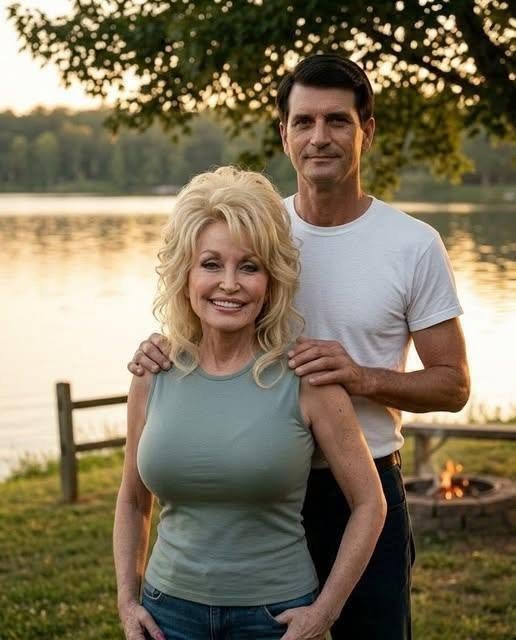
The Love Story of Dolly Parton and Carl Dean: A Quiet Romance That Lasted Nearly Six Decades
In 1964, before the rhinestones, sold-out concerts, movie roles, business empires, awards, and worldwide fame, Dolly Parton was simply an eighteen-year-old girl from East Tennessee with a dream.
She had just graduated from Sevier County High School and was determined to make a life for herself in Nashville, the city she believed could become the doorway to her musical future. The morning after graduation, she made the journey to Music City carrying little more than her ambition—and, famously, dirty clothes in a cardboard suitcase.
Her first day in Nashville would change her life in more ways than she could possibly have imagined.
Part of that day was spent at the Wishy Washy laundromat, where she was doing something wonderfully ordinary: washing her clothes. She had come to Nashville looking for a career, not romance. In fact, according to stories Parton told years later, love was about the last thing on her mind.
Then Carl Dean drove by.
Dean was twenty-one, quiet, reserved, and working in the asphalt-paving business. He saw the young woman outside the laundromat and called out to her. Dolly waved back. That simple exchange became the beginning of one of the most remarkable love stories in American entertainment.
Dean later recalled that his first thought was that he was going to marry her. His second thought, more simply, was that she was beautiful.
Dolly, however, wasn’t immediately ready to surrender her independence to a stranger in a pickup truck.
When Carl asked her out, she was cautious. Instead of going somewhere alone with him, she invited him to visit her where she was staying with her aunt and uncle.
That decision may seem like a tiny detail today, but it says something important about the young Dolly Parton. Even at eighteen, she knew what she wanted—and she knew what boundaries she wanted to keep.
Carl respected them.
He came back.
And he kept coming back.
For the next several days, the two young people spent time talking on the porch. There were no glamorous restaurants, no photographers, no red carpets, and certainly no expectation that their relationship would someday become part of music history.
There was simply a porch, two young people, and conversation.
Dolly later remembered that Carl came by every day that week and that she wouldn’t even let him into the house at first. Eventually, when circumstances allowed, they went on a proper outing, and Carl took Dolly to meet his parents.
Dolly had arrived in Nashville dreaming of becoming a singer.
Carl wasn’t interested in becoming famous.
That difference would define much of their future.
Dolly’s life would soon become increasingly public. Her voice, songwriting, personality, humor, and determination would take her from the stages of Nashville to national television, Hollywood, international concert halls, and eventually virtually every corner of popular culture.
Carl went in the opposite direction.
He wanted privacy.
And remarkably, Dolly respected that.
Their relationship worked partly because they never tried to turn each other into something they weren’t.
Dolly didn’t try to make Carl into a celebrity.
Carl didn’t try to make Dolly give up her dreams.
Instead, they created something unusual: a marriage in which two people could live different lives while still belonging to one another.
In May 1966, two years after their first meeting, Dolly and Carl quietly married in Ringgold, Georgia. The ceremony was deliberately small. Dolly’s record company had concerns that marriage might interfere with the career they were trying to build for their young artist, so the couple chose a private ceremony away from the attention of the Tennessee press.
Dolly’s mother helped with the wedding. Dolly wore a simple white dress, and the ceremony took place at a small Baptist church.
There were no elaborate celebrity festivities.
No giant guest list.
No media spectacle.
Just Dolly, Carl, family, and a promise.
That modest beginning would become the foundation for nearly sixty years of marriage.
And that is perhaps the most extraordinary part of their story.
When Dolly Parton’s career exploded, their marriage did not become a conventional celebrity marriage.
Carl rarely appeared at public events.
He didn’t chase interviews.
He didn’t seem interested in becoming famous simply because he had married one of the world’s most recognizable entertainers.
He remained Carl.
That was exactly what Dolly wanted.
Over the decades, the contrast between them became almost legendary.
Dolly loved performing.
Carl preferred staying home.
Dolly could walk onto a stage in front of thousands of people and command every eye in the room.
Carl preferred a quiet life away from cameras.
Dolly built a career around storytelling.
Carl told very few stories about himself.
Yet behind that contrast was something remarkably stable.
Respect.
Dolly understood that Carl hadn’t married a celebrity.
He had married a woman.
And Carl understood that Dolly’s enormous career was not something he needed to compete with or control.
He supported her while allowing her to remain herself.
That kind of independence became one of the secrets of their relationship.
Dolly often joked about the unconventional nature of their marriage. She traveled constantly for work, while Carl stayed largely outside the entertainment world. They had their own interests, their own routines, and their own space.
To outsiders, that might have looked strange.
But perhaps it was precisely what allowed their relationship to survive.
They didn’t need to be together every minute to know they belonged together.
They could be apart without being disconnected.
And when Dolly returned home, she wasn’t returning to another version of show business.
She was returning to Carl.
There was another important element to their marriage: humor.
Dolly has always been famous for her ability to laugh at herself, and she often spoke about Carl with the same playful warmth.
Their relationship was not presented as a perfect fairy tale.
It was presented as something more believable.
Two imperfect people who loved each other.
Two people who sometimes had different interests.
Two people who understood that marriage wasn’t about possessing another person.
It was about choosing them again and again.
Carl’s influence on Dolly’s music also appeared in unexpected ways.
Some of the songs associated with Dolly’s career were inspired by real experiences, emotions, and people around her. Her marriage gave her another well of emotion from which to draw as a songwriter.
But Carl himself remained largely outside the public narrative.
That privacy eventually became so unusual that some people jokingly wondered whether he even existed.
Dolly laughed at the rumors.
She explained that Carl simply didn’t like the spotlight.
And that was the truth.
He had not married fame.
He had married Dolly.
There is a profound difference.
As the years passed, Dolly became not merely a country singer but a cultural institution.
She became a songwriter whose compositions were recorded by artists across generations.
She became an actress.
A producer.
An entrepreneur.
A philanthropist.
A businesswoman.
A symbol of generosity, humor, resilience, and self-belief.
She created Dollywood.
She launched the Imagination Library, helping put books into the hands of children.
She continued writing and recording music.
She became one of the most recognizable women in the world.
And through all of it, Carl remained remarkably private.
Their marriage was never built around public appearances.
It was built around a private understanding.
In 2016, after fifty years of marriage, Dolly and Carl renewed their vows.
It was a beautiful reminder that although the world had changed dramatically since that little Georgia wedding in 1966, the commitment between them had endured.
Fifty years earlier, they had been two young people beginning adult life together.
Now they were celebrating half a century of memories.
The world knew Dolly as a superstar.
But Carl knew the woman behind the superstar.
He knew Dolly before the fame.
Before the millions of records.
Before the movie roles.
Before the awards.
Before the enormous business ventures.
Before she became a cultural icon.
He knew the eighteen-year-old who arrived in Nashville with dirty laundry and a suitcase.
And perhaps that was one of the greatest gifts their relationship gave her.
No matter how large Dolly’s public life became, there was someone who remembered the beginning.
Someone who knew the person underneath the costumes, wigs, makeup, songs, interviews, and applause.
Someone who knew Dolly simply as Dolly.
That kind of connection is difficult to measure.
Fame can surround a person with thousands of people and still leave them lonely.
Dolly’s marriage offered her something fame could not.
Normalcy.
Privacy.
Home.
Carl Dean died on March 3, 2025, at the age of eighty-two.
After nearly sixty years of marriage, Dolly suddenly had to face a world without the man who had been beside her since the earliest chapter of her Nashville story.
She continued to speak about him with love and gratitude.
His absence made something clear that perhaps had always been true: Carl’s importance in Dolly’s life had never depended on how often the public saw him.
He didn’t need to appear on television to matter.
He didn’t need to stand beside her at every awards ceremony.
He didn’t need to give interviews.
His presence existed in the private part of her life—the part the cameras could never fully capture.
Their story is especially moving because it challenges the idea that great love has to be loud.
It doesn’t.
Sometimes great love looks like someone respecting your boundaries.
Sometimes it looks like showing up every day.
Sometimes it means allowing the person you