
Part 1 — The Boy Everyone Warned Me About
Almost everyone told me adopting Luke was a mistake.
He was sixteen years old, nearly grown, and had already lived in ten different foster homes.
Ten.
Whenever his name came up, people used careful voices.
“He’s had a difficult history.”
“He struggles with attachment.”
“He doesn’t adjust well.”
“He’s complicated.”
But two weeks after his adoption became official, Luke sat across from me at our dinner table, his hands trembling so badly that his fork scraped against the plate.
Then he looked at me with tears filling his eyes.
“Mom,” he whispered, “I need to tell you why.”
At the time, I thought he was about to confess that he had done something terrible.
I had no idea he was actually about to explain the secret behind every family he had ever lost.
And I certainly didn’t know that his confession would change our family forever.
Three years earlier, I had lost both of my children in a car accident.
Grace was nineteen.
Noah was sixteen.
For months after their deaths, I couldn’t even open their bedroom doors.
Grace’s favorite sweatshirt still hung over the back of her desk chair.
Three library books remained stacked beside Noah’s bed because he had always been terrible about returning them on time.
His sneakers sat crooked beside the closet.
Her half-empty bottle of perfume remained on the dresser.
Everything looked as though my children had simply stepped outside and might come home at any moment.
People told me grief would become easier.
I hated hearing that.
Nothing about losing your children becomes “easy.”
But eventually, grief did change.
At first, it was an enormous weight that pinned me to the mattress every morning.
Later, it became something quieter—a stone I carried inside me wherever I went.
I learned how to grocery shop while grieving.
How to answer the phone.
How to smile politely when someone asked how I was doing.
How to sit through birthdays, holidays, and ordinary Tuesdays.
From the outside, I eventually appeared functional again.
Inside, I was simply learning how to survive the silence.
And the silence in my house was the worst part.
For a while, I kept Grace and Noah’s doors shut.
Then one morning, I opened them.
Closed doors somehow felt more final.
Months passed.
Then years.
One rainy Tuesday afternoon, I found myself sitting in my car outside a foster care agency.
I stayed there for nearly twenty minutes before gathering enough courage to walk inside.
That was where I met Denise.
“I want to talk about becoming a parent again,” I told her.
She studied me carefully.
She didn’t immediately smile or congratulate me.
Instead, she folded her hands over a folder.
“I need to ask you something difficult.”
“Okay.”
“Are you trying to replace your children?”
The question hurt more than I expected.
But I understood why she needed to ask.
“No.”
“Are you certain?”
I looked down at my hands.
“I don’t think anyone could replace them.”
For several seconds, Denise said nothing.
Then she nodded.
“That,” she said quietly, “is a good answer.”
Part 2 — The Teenager by the Window
Becoming an adoptive parent wasn’t something I could decide on Tuesday and accomplish by Friday.
There were interviews.
Training sessions.
Background checks.
Home studies.
References.
Conversations about childhood trauma, abandonment, behavioral issues, attachment, loss, and fear.
Sometimes I would leave those sessions and sit crying in my car because certain things reminded me too much of Noah after his father died.
Eventually, Denise invited me to an event where prospective parents could meet children in foster care.
When I arrived, most people naturally drifted toward the younger children.
Little kids were coloring, building towers, racing toy cars across tables.
Then I noticed a teenage boy sitting alone beside a window.
A paperback rested open across his knees.
He wasn’t trying to attract anyone’s attention.
He looked as though he had perfected the art of disappearing while sitting in plain sight.
Then a little girl nearby accidentally knocked a box of crayons onto the floor.
The crayons rolled everywhere.
Several adults looked over.
The teenager immediately closed his book.
Without anyone asking, he knelt beside the little girl and helped her collect them.
One blue crayon had rolled underneath a table.
He crawled halfway beneath it, retrieved the crayon, handed it to her, and returned to his seat.
I glanced at Denise.
“Who’s that?”
She followed my eyes.
Something in her expression changed.
“That’s Luke.”
“How old is he?”
“Sixteen.”
“Can I meet him?”
Denise hesitated.
“You should know that Luke has been through several placements.”
“How many?”
She paused.
“Ten.”
I stared at her.
“Was he violent?”
“No.”
“Did he hurt other children?”
“No.”
“Drugs?”
“No.”
“Then why ten?”
Denise sighed.
“It wasn’t one specific thing. Luke is… complicated.”
I immediately disliked the word.
Years earlier, after my husband died, Noah’s teachers had called him complicated because he stopped speaking much in class.
What they really meant was that a grieving eleven-year-old had become inconvenient.
“I’d still like to meet him,” I said.
Luke stood when I approached him.
“Hi,” I said. “I’m Caroline.”
He immediately gestured toward the empty chair beside him.
“Please, ma’am. You can sit here.”
I stared at him.
“Ma’am?”
His expression became cautious.
“I was being polite.”
“I’m forty-seven, Luke, not ninety.”
The corner of his mouth moved.
“I wasn’t implying anything.”
“You absolutely were.”
That made him smile.
A real smile.
I asked what he was reading.
That one question became nearly an hour of conversation.
We talked about books, school, terrible movie adaptations, favorite foods, and why he believed pineapple on pizza should probably be illegal.
When I finally left, Denise walked me toward the door.
“One good conversation doesn’t guarantee anything,” she warned me.
“I know.”
And I did know.
So I came back.
Again.
And again.

Part 3 — “What If I Mess It Up?”
For four months, Luke and I slowly got to know each other.
At first we met at the agency.
Then there were supervised outings.
Libraries.
Parks.
Diners.
A little café where Luke discovered I always ordered too much coffee.
I kept waiting for the terrible teenager people had warned me about.
Instead, I discovered a quiet boy who noticed everything.
Luke was guarded, yes.
He rarely volunteered information about his past.
Whenever conversations became too personal, he could retreat emotionally in seconds.
But he was also thoughtful.
Funny.
Gentle.
And observant in a way that sometimes broke my heart.
One afternoon, I casually mentioned that Grace had hated raisins.
It was hardly an important detail.
Three weeks later, Luke slid a cookie across the table toward me.
“Here.”
I looked at it.
“What’s this?”
“Cookie.”
“I can see that.”
He shrugged.
“No raisins. I checked.”
I stared at him.
He immediately looked uncomfortable.
“What?”
“Nothing.”
But it wasn’t nothing.
Grief had taught me something strange.
Huge gestures rarely broke me anymore.
Small ones did.
A sixteen-year-old boy remembering that my daughter hated raisins nearly made me cry in the middle of a café.
Eventually, the possibility of adoption became real.
Luke was the one who brought it up.
“You’d actually want to adopt me?”
“Yes.”
“Like… permanently?”
“That is generally the idea.”
He didn’t laugh.
Instead, his eyes dropped to the table.
“What if I mess everything up?”
“Then we deal with whatever you messed up.”
“What if you regret adopting me?”
“Then I would be an adult experiencing a feeling.”
He finally looked at me.
“And?”
“And you would still be my son.”
He frowned.
“You make everything sound easy.”
“No,” I said. “Commitment is simple. That doesn’t mean life is.”
He didn’t answer.
But something changed between us that day.
Eventually, Luke moved into my house.
At first, he behaved like a guest who was terrified of overstaying his welcome.
He made his bed before breakfast.
Washed every dish immediately.
Folded towels.
Never left shoes in the hallway.
Never took the last of anything without asking.
If he wanted a snack, he asked permission.
If he wanted to watch television, he asked permission.
If he needed shampoo, he waited until I noticed the bottle was empty.
One Saturday, I nearly stumbled over a loose porch step.
Luke looked horrified.
“How long has that been loose?”
“A couple of years.”
“You’ve been walking on this?”
“Yes.”
“Every day?”
“Pretty much.”
He stared at me as if I were the irresponsible teenager.
“I enjoy danger,” I said.
“You’re ridiculous.”
He disappeared into the garage and returned with a screwdriver.
Twenty minutes later, the step was fixed.
A month after he moved in, something happened neither of us expected.
He walked into the kitchen while looking for his phone charger.
“Mom, have you seen my—”
Silence.
Luke froze.
I froze.
His entire face turned red.
I immediately opened a drawer even though I knew perfectly well where his charger was.
“Kitchen counter,” I said.
“Right.”
He grabbed it.
Neither of us mentioned what he had called me.
But the next week, he said it again.
Then again.
Eventually, “Caroline” disappeared completely.
I became Mom.
And I treasured every single time he said it.
Part 4 — The Secret at the Dinner Table
By the time Luke’s adoption became final, I had stopped waiting for something to go wrong.
We celebrated quietly.
Cake.
Takeout.
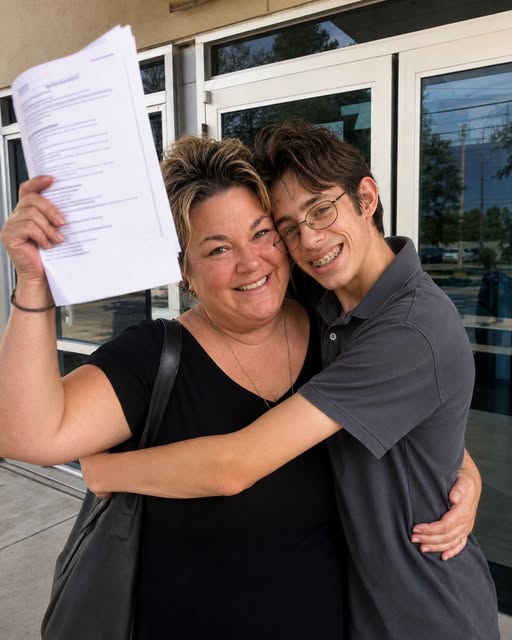
A photograph neither of us particularly liked but both of us secretly loved.
For the first time in years, my house felt alive again.
Then, exactly two weeks later, Luke came to dinner looking pale.
I had made meatloaf.
Luke loved meatloaf.
Normally he would have finished half his plate before I sat down.
That night, he barely touched it.
“Sweetheart?”
“I’m fine.”
“Terrible lie.”
His fork scraped against the plate.
Then I noticed his hand.
It was shaking.
“Luke?”
He stared at the table.
I reached across and touched his fingers.
He immediately pulled his hand away.
His eyes filled with tears.
“Mom, I need to tell you something.”
My stomach tightened.
“Okay.”
“You’re probably going to wish you never adopted me.”
That frightened me.
“Luke, what happened?”
His breathing became uneven.
For a moment, I thought he might run.
Instead, he whispered four words.
“I have a sister.”
I blinked.
“A sister?”
“Half-sister.”
I tried to process what he was saying.
“Your file said there weren’t any siblings placed with you.”
“She isn’t placed with me.”
“Where is she?”
He swallowed.
“She was adopted.”
Her name was Emma.
She was nine years old.
Luke explained that years earlier, when Emma was very young, they had entered foster care together.
He had practically raised her before that.
He made her breakfast.
Helped her dress.
Remembered school papers.
Checked homework.
Comforted her after nightmares.
When Emma woke frightened in the middle of the night, she didn’t search for an adult.
She searched for Luke.
Then, when Luke was fourteen, a family offered Emma a permanent home.
“They couldn’t take me too,” he said.
“Who told you that?”
“Everybody knew.”
My chest tightened.
“They said Emma needed stability.”
“And what did you say?”
Luke stared at his untouched dinner.
“They kept asking what I thought was best for her.”
His voice cracked.
“So I said she should go.”
“You were fourteen.”
“I know.”
“No, Luke. You were fourteen.”
Tears slid silently down his cheeks.
After Emma left, Luke changed.
That was when the placements began collapsing.
But not in the way I had assumed.
He never attacked anyone.
Never destroyed houses.
Never hurt younger children.
Instead, Luke discovered quieter ways to make families stop wanting him.
“I stopped talking.”
“On purpose?”
“Sometimes.”
“And the other times?”
He shrugged.
“Sometimes I really didn’t have anything left to say.”
He would stay in his room.
Refuse family outings.
Answer questions with one word.
And occasionally, he deliberately said things he knew would hurt.
“Why?” I asked.
Luke finally looked at me.
“Because if another family adopted me, Emma might think I chose them instead of her.”
Suddenly, those ten failed placements looked completely different.
Not ten families rejecting a difficult boy.
A grieving child repeatedly making certain no family could get close enough to keep him.
“How many families did you push away?”
Luke’s eyes dropped again.
“Most of them.”
One foster mother had even started talking about permanent guardianship.
Before she could finish the conversation, Luke packed his belongings.
“You wanted to leave before she could?”
He nodded.
“Why?”
His voice was barely audible.
“Leaving doesn’t hurt as much when you’re the one who decides when it happens.”
That sentence nearly shattered me.
But then he said something worse.
“I was going to do it to you too.”
I stared at him.
“What?”
“When I first moved in, I had a plan.”
“What kind of plan?”
“Stay a couple months. Be good. Then change.”
My throat tightened.
“You were going to make me send you away?”
He nodded.
“But you didn’t.”
His face crumpled.
“I messed up.”
For one terrified second, I thought I had misunderstood.
Then he covered his face with both hands.
“I started loving you.”
My heart broke completely.
“I liked living here,” he said through his tears. “Then I accidentally called you Mom. And then I kept doing it. And then the adoption became real.”
He wiped his face with his sleeve.
“Everybody was happy, but all I could think about was Emma.”
He looked at me like a child expecting punishment.
“She’ll think I forgot her.”
I stood, walked around the table, and sat beside him.
“You should have told me.”
“I know.”
“You should have told me months ago.”
“I know.”
“But listen to me.”
He looked up.
“You are not leaving.”
His mouth trembled.
“You’re my son, Luke. Adoption wasn’t a temporary arrangement. There’s no test period.”
He finally stopped holding himself upright.
His shoulders collapsed against me.
And for the first time, I understood the boy everyone had described as complicated.
He wasn’t afraid nobody would love him.
He was afraid that accepting love from one person meant betraying someone else.

Part 5 — The Letters That Never Arrived
The next morning, I called Denise.
“Why wasn’t Emma properly discussed during Luke’s adoption?”
There was a long pause.
“The sibling history was included in older records.”
“That isn’t what I asked.”
Denise sighed.
“Direct contact became restricted several years ago while Emma adjusted to her adoptive placement.”
“Restricted by whom?”
“There were decisions made among the adults involved.”
“What kind of decisions?”
“Letters were supposed to go through the adults. Contact was meant to be revisited later.”
“Meant to be?”
Another pause.
Finally Denise said, “It wasn’t handled well.”
That was the first thing anyone had said that sounded completely true.
Afterward, I asked Luke whether he had ever tried contacting Emma.
Without saying anything, he went to his bedroom.
A few minutes later he returned carrying an old shoebox.
Inside were copies of letters.
Dozens of them.
Birthday letters.
Christmas letters.
Letters asking whether she still liked drawing.
Letters wondering how school was going.
Letters mentioning books he thought she might enjoy.
Every letter ended almost the same way.
I’m still your brother.
“Did she ever answer?”
Luke shook his head.
“Not once.”
Something felt wrong.
Not because Emma necessarily owed Luke a response.
She had been a child too.
But the complete silence didn’t fit the story Luke had told me about the little girl who once searched for him whenever she was frightened.
Denise began making calls.
Several days later, she contacted me.
“Emma’s adoptive parents are willing to meet.”
My heart jumped.
“But,” Denise continued, “they want to move carefully.”
“Fine.”
“I think perhaps the adults should discuss the history before Luke and Emma are brought together.”
That sentence bothered me.
“The adults have been deciding what Luke and Emma can handle for years.”
“Caroline—”
“I’m not suggesting we throw two children into an emotional situation without support.”
“I know.”
“But don’t let ‘carefully’ become another word for waiting until they’re adults.”
Denise became quiet.
Finally, we agreed on a supervised meeting.
Only if Luke wanted it.
And only if Emma wanted it too.
When I told Luke, he nearly refused.
“What if she doesn’t want to see me?”
“Then we respect that.”
“What if she hates me?”
“Then we listen.”
“What if she forgot me?”
That question stopped me.
I wanted to promise she hadn’t.
But I couldn’t lie.
So instead I said, “Whatever happens, you won’t face it alone.”
Part 6 — The Box in the Living Room
Emma lived with her adoptive parents, Rachel and David.
They invited us to their home.
Luke barely spoke during the drive.
He stared through the passenger window and rubbed his thumb repeatedly against the edge of his seat belt.
When we arrived, Rachel opened the door.
She looked nervous.
David looked worse.
Almost ashamed.
We sat in their living room for perhaps ten minutes, exchanging the kind of polite conversation people use when everyone is desperately avoiding the reason they are actually together.
Finally, Rachel stood.
“There’s something you need to see.”
She went upstairs.
When she returned, she was carrying a large plastic storage bin.
She placed it in front of Luke.
He looked confused.
“What’s that?”
Rachel opened the lid.
The box was filled with envelopes.
Hundreds of pages.
Different sizes.
Different colors.
Different kinds of paper.
But almost every envelope had the same name written across the front.
LUKE.
Luke reached inside and picked one up.
The handwriting was uneven and childish.
His face changed.
“She wrote back?”
Rachel nodded.
His voice became smaller.
“All this time?”
Rachel’s eyes filled with tears.
“Your letters came to us.”
Luke stared at her.
“At first, we were told that limiting direct contact might make the transition easier for Emma.”
“But she wrote to me.”
“Yes.”
“Then why didn’t you send these?”
Rachel began crying openly.
“We kept telling ourselves we would.”
Luke said nothing.
“We thought we’d wait until she felt more settled. Then another month passed. Then another. Eventually so much time had passed that admitting what we’d done became harder.”
David stared at the floor.
“We should have corrected it years ago.”
Luke slowly opened one letter.
Then another.
Then another.
His hands shook as he read.
Emma had remembered birthdays.
Asked questions.
Drawn pictures.
Written about school.
Written about dreams.
Written about missing him.
All those years Luke had believed he was writing into silence.
And all those years, Emma had been writing back.
Then we heard something upstairs.
A door opened.
Footsteps.
Luke turned.
A little girl appeared at the top of the staircase.
She had long brown hair and wide eyes.
She stared at him.
Luke rose slowly.
Nobody spoke.
For several seconds, brother and sister simply looked at one another.
Then Emma suddenly turned and ran upstairs.
Luke’s face collapsed.
“I knew it.”
My heart twisted.
But before anyone could respond, footsteps thundered across the floor above us.
Emma came running back down.
Something was tucked beneath her arm.
A battered stuffed rabbit.
One ear drooped lower than the other.
Its fur had been loved nearly bare.
She stopped in front of Luke and held it toward him.
“You gave me Mr. Buttons.”
Luke stopped breathing.
His hand flew to his mouth.
Emma took another step.
Then she ran straight into him.
Luke dropped to his knees.
He wrapped both arms around her.
She buried her face against his shoulder.
Neither of them seemed able to speak.
I turned my face away.
Not because I didn’t want to see.
Because that moment belonged to them.
A brother who had spent years believing his sister had forgotten him.
A little girl who had been carrying the stuffed rabbit he gave her all along.

Part 7 — Learning That Love Doesn’t Run Out
Nothing magically became perfect that afternoon.
Years of separation could not disappear in a single hug.
Luke and Emma had grown up.
They had memories the other hadn’t shared.
Inside jokes were gone.
Birthdays had been missed.
There were questions.
Awkward silences.
Anger.
Confusion.
But their relationship began again.
First came supervised visits.
Then phone calls.
Then birthdays together.
Eventually, weekend visits became possible.
During those months, I learned something too.
I made sure Luke understood that Emma wasn’t a threat to me.
I wasn’t replacing her.
She wasn’t replacing me.
No one had to earn a larger piece of Luke’s heart by taking space away from someone else.
That had been the lie controlling his life for years.
He believed love worked like a room with only one chair.
If someone new sat down, someone else had to stand.
Maybe that was why he had sabotaged all those placements.
Maybe in his fourteen-year-old mind, refusing a new family was the only way to remain loyal to the sister he had lost.
But families weren’t supposed to work that way.
Love could expand.
One relationship didn’t erase another.
And slowly, Luke began believing that.
Several months later, I stepped onto the porch and found Luke repairing the same troublesome step again.
Emma sat beside him offering completely unwanted advice.
“You’re holding it wrong.”
Luke looked at her.
“You’ve never held a hammer.”
“I’ve seen people use one.”
“Where?”
“Television.”
“That definitely qualifies you.”
“I’m serious.”
“So am I.”
I walked outside carrying lemonade.
Emma immediately reached for the hammer.
I pointed at Luke.
“Do not let her touch that.”
Emma gasped.
“Why?”
“Because I enjoy having all ten of your fingers attached.”
“I know how to use a hammer.”
“No, you don’t.”
She turned dramatically toward Luke.
“Tell her.”
Luke shook his head.
“No chance.”
“Luke!”
He laughed.
Then he looked toward me.
“Mom, please tell her she’s not touching this.”
Everything inside me went still.
Luke seemed to realize it too.
His smile faded.
His eyes moved from me…
to Emma…
and back again.
For one brief moment, I saw that old fear return.
The question he didn’t say aloud was written clearly across his face.
Did calling you Mom in front of Emma betray her?
Did choosing you mean losing her?
Before either of us could speak, Emma rolled her eyes.
“Fine. Ask your mom. You’re both annoying.”
Luke blinked.
Once.
Twice.
Then he started laughing.
Really laughing.
Emma grabbed her lemonade.
Luke told her again she wasn’t touching the hammer.
She told him he was bossy.
He told her she had been bossy since kindergarten.
Their argument continued across the porch.
And I simply stood there watching them.
Three years earlier, silence had filled every corner of my home.
I once believed that silence was permanent.
Now there was laughter.
There were tools scattered across the porch.
A stubborn nine-year-old demanding a hammer.
A sixteen-year-old boy pretending she irritated him while watching every movement she made.
And somewhere inside all that noise was something I had once thought I would never have again.
Family.
Not the family I had lost.
Nothing could replace Grace and Noah.
Luke had never been asked to do that.
He had simply brought a new chapter into a house I thought had reached its final page.
And perhaps Luke had needed to learn the same lesson I had.
Loving someone new does not erase the people we loved before.
A heart is not a house with limited bedrooms.
Nobody has to be pushed outside so somebody else can come in.
I watched Luke and Emma arguing over the hammer and smiled.
The house wasn’t silent anymore.
And this time, nobody had to leave to make room for somebody else.
Note: This story is a work of fiction inspired by real events. Names, characters, and details have been altered. Any resemblance is coincidental. The author and publisher disclaim accuracy, liability, and responsibility for interpretations or reliance. All images are for illustration purposes only.