
Part 1 — Seven Babysitters, One Strange Excuse
Finding someone to watch our five-year-old daughter should have been simple.
Sophie was the kind of child babysitters usually loved. She said please and thank you without being reminded, could spend an hour coloring quietly at the kitchen table, and thought helping fold towels was an exciting grown-up responsibility.
Ben and I also paid well.
We had a comfortable home in a quiet neighborhood, and because both of us sometimes worked late, we had installed security cameras in nearly every common area.
There was no obvious reason anyone should have been uncomfortable in our house.
And yet every babysitter we hired quit.
All seven of them.
We found each one through the same highly rated childcare agency. Their profiles were impressive. Their references were excellent. Some had years of experience.
The first sitter lasted three days.
The second walked away before the end of her first week.
The third called me in the middle of an afternoon shift, her voice shaking.
“I’m sorry, Emma,” she said. “I just can’t keep doing this.”
“Did Sophie do something?”
“No.”
“Did something happen in the house?”
A long silence followed.
Then she repeated, “I’m sorry. I just can’t.”
And she hung up.
The others were almost identical.
Some sounded frightened.
Some sounded guilty.
One refused to answer our calls after leaving.
Another sent a single text saying she appreciated the opportunity but would not be returning.
None of them would tell us what was wrong.
After the seventh sitter resigned, I sat at our kitchen table staring at the agency’s website.
“This is ridiculous,” I said.
Ben leaned against the counter.
“Maybe I should apply.”
I looked at him.
He grinned.
I laughed.
Then neither of us laughed anymore.
“What if you actually did?” I asked.
Ben raised an eyebrow.
“You mean pretend to be a babysitter?”
“I mean find out what this agency is doing.”
The idea sounded absurd.
Which was probably why we kept discussing it.
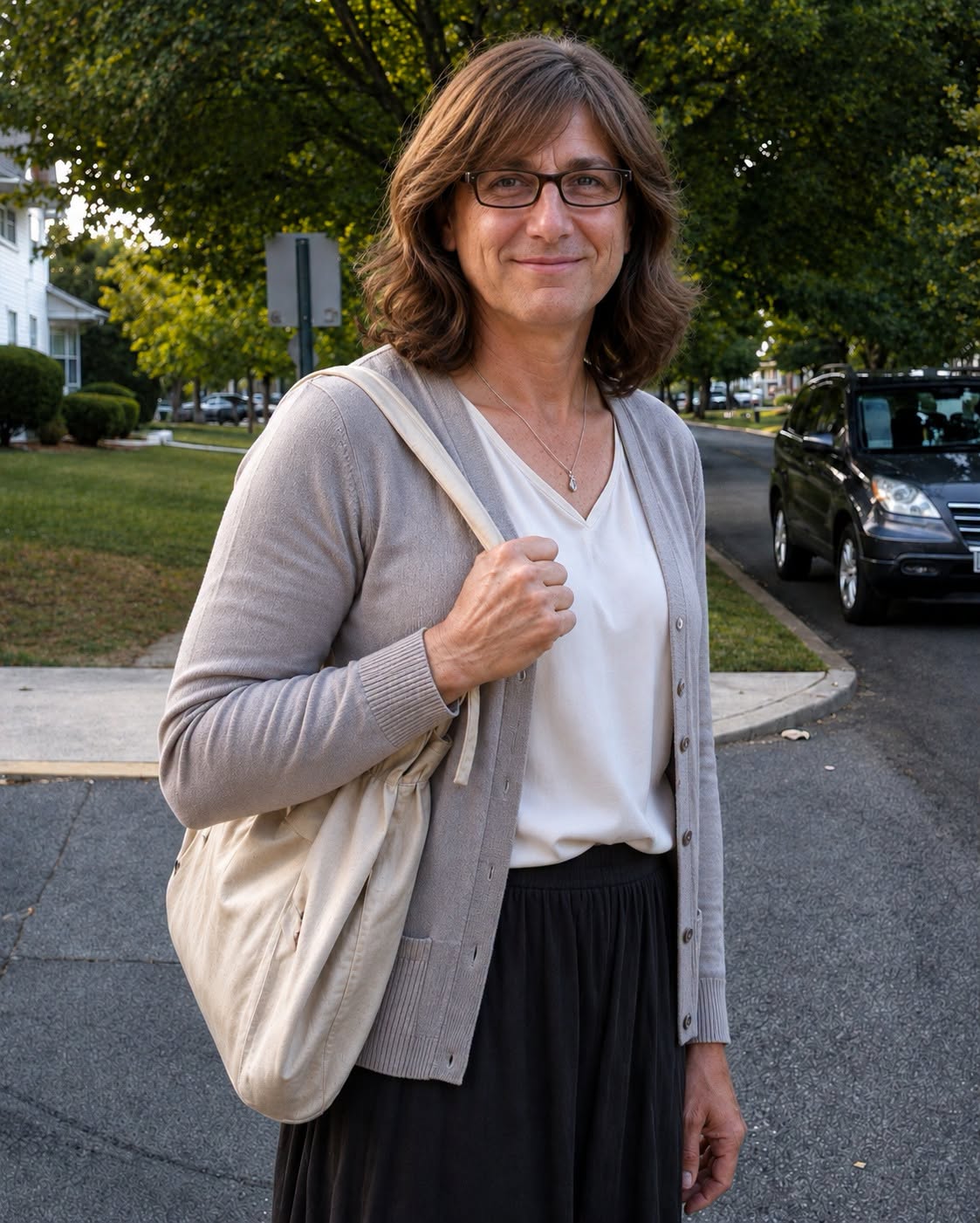
A week later, my thirty-seven-year-old husband was standing in front of our bedroom mirror wearing a shoulder-length brown wig, oversized glasses, a loose cardigan, and an expression of complete humiliation.
“I want it officially documented,” he said, “that marriage has brought me to a very strange place.”
I tried not to laugh.
“You look convincing.”
“I look like my aunt Linda.”
“You look like Megan.”
That was the name he had chosen for the application.
He had created a believable résumé, altered enough personal details to avoid connecting him to our family, and responded to one of the agency’s public advertisements.
To our astonishment, they invited “Megan” for an interview.
Then they hired him.
Not to work for us.
They assigned him to another family across town.
The plan was simple: Ben would remain inside the agency’s system long enough to see whether something unusual happened.
For the first several days, nothing did.
The agency office was bright and professional. The employees were friendly. Families came and went. Babysitters signed paperwork and received schedules.
Everything looked perfectly ordinary.
Then, on Ben’s fifth day, the director stopped him as he was preparing to leave.
“Megan,” she said pleasantly, “I need you to make a delivery.”
She handed him a sealed envelope.
“Where?”
“The address is written on the front.”
Ben looked at it.
His heart nearly stopped.
He recognized the address.
It belonged to Carla.
Our fourth babysitter.
The woman who had disappeared halfway through her fourth day with Sophie and blocked both our numbers.
The director’s smile never changed.
“Just leave it on the doorstep,” she said.
“Should I wait for someone to answer?”
“No.”
Her tone suddenly sharpened.
“Leave it there and walk away. No questions.”
Ben nodded.
But once he reached his car, he did exactly what she had told him not to do.
He opened the envelope.
Inside was a cashier’s check for fifteen thousand dollars.
There was also a confidentiality agreement.
And a letter thanking Carla for agreeing not to discuss certain “events witnessed during placement.”
The language went further.
It warned her against contacting the family, other employees, or law enforcement regarding the matter.
My phone rang less than a minute later.
When I answered, Ben’s breathing was uneven.
“Emma,” he said, “they’re paying them.”
“Paying who?”
“The babysitters.”
I slowly sat down.
“For what?”
“To stay quiet.”
A chill moved through me.
“Quiet about what?”
“That,” Ben said, “is what we need to find out.”

Part 2 — Carla Finally Talks
Ben photographed every page before carefully resealing the envelope.
“Is Sophie’s name mentioned anywhere?” I asked.
“No.”
“Our address?”
“No. Just the agency and Carla.”
I remembered Carla better than most of the others.
She had been confident and warm from the moment she arrived. On her second afternoon, she and Sophie had made homemade purple play dough at the kitchen counter.
Sophie adored her.
Then, two days later, Carla left in the middle of her shift.
No goodbye.
No explanation.
Nothing.
Ben delivered the envelope as instructed, placed it on Carla’s doorstep, and parked far enough away to watch without being obvious.
Within minutes, the door opened.
Carla stepped outside, glanced anxiously in both directions, grabbed the envelope, and disappeared into the house.
Ben waited nearly an hour.
Finally, he walked to her door and knocked.
No answer.
He knocked again.
Nothing.
So he slipped a short note beneath the door.
I know about the agency. I’m not here to hurt you. Please call me.
The call came the next afternoon from an unknown number.
“You shouldn’t have opened that envelope.”
The woman’s voice was low and tense.
Ben put the phone on speaker.
“Carla?”
“Who are you?”
“My name is Ben.”
Silence.
“My wife and I hired you to babysit our daughter.”
Another pause.
Then Carla whispered one word.
“Sophie?”
“Yes.”
Her next sentence came quickly.
“You need to stop using that agency.”
“Why?”
“I can’t discuss it.”
“Because of the agreement?”
Carla inhaled sharply.
“You saw it?”
“Yes.”
“You had no right to open it.”
“Maybe not,” Ben said. “But neither did they have the right to frighten seven people into leaving our home without telling us why.”
She refused to explain anything over the phone.
Eventually, she agreed to meet us at a diner outside town.
Carla arrived wearing a baseball cap and sunglasses large enough to hide half her face. She chose the booth farthest from the entrance and checked the door every few minutes.
“I should never have accepted your placement,” she said.
“Our house?” I asked.
She nodded.
“What happened there?”
“At first? Nothing.”
She wrapped both hands around her coffee mug.
“Sophie was wonderful. You were nice. Ben was nice. Honestly, I thought I had finally been given an easy family.”
“Then why did you leave?”
Carla looked at me.
“Because of your mother.”
For several seconds, I could only stare at her.
“My mother died when Sophie was a baby.”
Carla froze.
Ben and I exchanged a look.
Then he said quietly, “My mother.”
Carla’s face confirmed it before she spoke.
“Diane.”
My stomach tightened.
Ben’s mother lived twenty minutes away.
She loved Sophie fiercely.
She visited often.
But as far as we knew, she had never come to our house while a babysitter was working.
“She came every afternoon,” Carla told us.
“That’s impossible,” I said. “We have cameras.”
“She knew.”
“Knew what?”
“Where the cameras were.”
Carla explained that Diane entered through the side door, carefully staying within the few blind spots near the laundry room.
Then she invited the sitter into our guest bedroom.
It was the only room without a camera.
No one used it regularly, so we had never thought installing one there was necessary.
“What did she say to you?” Ben asked.
Carla stared down at her coffee.
“She showed me a folder.”
I felt something cold settle inside my chest.
“What kind of folder?”
“Medical documents. Therapy notes. Photographs.”
Her voice dropped.
“And recordings of Emma.”
My throat tightened.
“Recordings of me doing what?”
“Crying. Shouting. Saying you couldn’t handle being a mother.”
Suddenly, I could barely hear the sounds of the diner around us.
Because I knew exactly when those recordings had been made.
Five years earlier, after Sophie was born, I had gone through the darkest period of my life.
I had suffered severe postpartum depression.
There were days when getting out of bed felt impossible.
Days when I cried for reasons I could not explain.
Days when I was frightened by my own thoughts.
Eventually, I did the most difficult thing I had ever done.
I admitted I needed help.
I entered therapy.
For a short period, I received inpatient treatment.
Then, slowly, painfully, I recovered.
Ben knew everything.
Our close family knew.
But those months were private.
They belonged to a version of me who had been ill and fighting to survive.
And Diane had apparently preserved them like evidence.
“She told me you’d stopped taking your medication,” Carla continued.
“That’s not true.”
“I know that now.”
“But you believed her?”
“She had dates, doctors’ names, documents. She knew things no stranger should have known.”
Carla looked ashamed.
“She said you could seem completely fine and then suddenly become unstable.”
Ben’s jaw tightened.
“What did my mother want from you?”
“To watch Emma.”
I stared at Carla.
“She wanted me to record anything unusual. If you came home unexpectedly, I was supposed to call Diane.”
“Did you?”
Carla’s eyes filled with tears.
“Once.”
I swallowed.
“When?”
“You came home early, laughing while you were talking on your phone. Diane had told me sudden changes in mood could mean something was wrong.”
I remembered the day instantly.
My sister had called to tell me she was engaged.
I had been happy.
That was all.
And someone had secretly recorded me because I was happy.
Part 3 — The Photograph
“What finally made you quit?” I asked.
Carla’s expression changed.
“On my fourth day, Diane told me you had tried to hurt Sophie.”
Ben sat straighter.
“That is a lie.”
“I know.”
“What did she show you?”
“A photograph.”
My pulse quickened.
Carla described it.
Sophie was near the staircase.
I was behind her.
One of my hands was raised.
I knew the image immediately.
Sophie had been two years old.
She had tried to climb the stairs by herself, slipped backward, and I had grabbed the back of her dress before she fell.
Diane had been standing in the hallway and snapped a photograph moments afterward.
“She cropped it,” I whispered.
Carla nodded.
“The version she showed me looked terrible.”
“But you figured it out?”
“Your digital picture frame was playing old family photos. I saw the original.”
Carla’s voice broke slightly.
“The full picture showed Sophie smiling. You were holding her upright. Diane had removed the part that made the situation obvious.”
“What happened when you confronted her?” Ben asked.
“She told me I was naive.”
Carla rubbed her hands together nervously.
“She said I didn’t understand how dangerous it was to underestimate someone with your history.”
Then Diane issued a warning of her own.
If Carla accused a respected family member without proof, she said, the agency could make sure Carla never received another childcare placement.
Terrified, Carla called the agency.
Instead of investigating, the director suggested she quietly resign.
Weeks later came the settlement offer.
“Fifteen thousand dollars is a lot of money when you’ve suddenly lost your income,” Carla said. “I had student loans. Rent. Bills.”
“You thought the agreement only meant you couldn’t speak publicly?” I asked.
“Yes.”
“And then you saw the section about law enforcement.”
She lowered her eyes.
“I saw it.”
“Why sign?”
“Because I was scared.”
Her answer hurt, but I understood it.
“What about the other sitters?”
“I talked to two before the agency told us not to communicate with one another.”
She met my eyes.
“Diane approached all of us.”
Suddenly, everything that had confused us for months made perfect sense.
The babysitters lasted only a few days because Diane needed time to gain access to them.
Our cameras had shown nothing because she already knew their positions.
Sophie had never mentioned Grandma’s visits because seeing her grandmother did not seem unusual.
And whenever a sitter questioned Diane, the agency made the problem disappear.
When we got home that evening, Ben called his mother.
“Can you come over tomorrow?” he asked.
Diane sounded delighted.
“Of course. Is everything okay?”
“We could use some help with Sophie.”
“I knew those babysitters were unreliable,” she replied. “That agency really needs to screen people better.”
After the call ended, Ben stared at the phone.
“She genuinely thinks she’s done nothing wrong.”
That was exactly what frightened me.
The next morning, we contacted two more former babysitters.
One refused to speak.
The other, Julia, agreed only after Carla assured her we already knew most of the truth.
Julia’s story was nearly identical.
The folder.
The medical records.
The recordings.
The altered photographs.
“Diane said Ben gave her the recordings,” Julia told us.
Ben went pale.
“I never gave her anything.”
Then his expression changed.
Years earlier, when Sophie was an infant, we had used an old tablet as a makeshift baby monitor.
Diane had borrowed it for several weeks.
The recordings must have remained stored on the device.
She had kept them.
For five years.
But Julia revealed something else.
The agency’s behavior was bigger than our family.
“They’ve had complaints from other placements,” she said.
“About Diane?” I asked.
“No. Other situations.”
The agency had built its reputation on discretion.
Instead of fully investigating disputes that could damage its ratings, it sometimes persuaded employees to quietly walk away.
“They told us families pay for privacy,” Julia said bitterly. “They also made it clear that babysitters who created public scandals didn’t get good references.”
“So everyone became afraid to speak,” Ben said.
“Exactly.”
That was when we decided guessing was no longer enough.
We wanted Diane to tell us the truth herself.

Part 4 — Megan Returns
The next afternoon, Sophie spent the day at my sister’s house.
My car was parked several blocks away.
And Ben transformed himself into Megan one more time.
Watching him put on the wig was almost surreal.
Nothing about the situation was funny anymore.
The loose cardigan hid his shoulders. The glasses changed the shape of his face. He softened his voice and altered the way he stood.
From across a room, he looked surprisingly convincing.
I hid inside the guest bedroom closet with my phone recording.
Then we waited.
Diane arrived through the side door.
She didn’t knock.
She simply entered.
“Hello?”
Ben stepped into the hallway.
“You must be Megan.”
Diane smiled warmly.
“I’m Sophie’s grandmother.”
She did not recognize her own son.
Her gaze immediately drifted toward the camera in the living room.
“Would you mind if we spoke somewhere private?”
My heart began pounding.
Ben followed her directly into the guest room.
From the narrow opening in the closet door, I watched Diane remove a thick folder from her handbag.
The folder.
She sat down.
“I imagine the agency told you this was an easy placement.”
“They did,” Ben replied in Megan’s softer voice.
“They don’t know everything.”
Diane opened the folder.
“My daughter-in-law loves Sophie very much.”
Ben nodded.
“But sometimes love isn’t enough.”
She placed copies of my old treatment records on the bed.
“Emma has a serious history.”
“Is she dangerous?” Ben asked.
Diane paused.
A perfectly measured pause.
As though she hated saying what came next.
“She can be.”
My nails dug into my palms.
“Has she ever hurt Sophie?”
“Not in any way anyone could prove.”
Then she produced the cropped staircase photograph.
Ben studied it.
“What happened here?”
“Emma losing control.”
“Were you there?”
“Yes.”
“You took the picture?”
“I did.”
“So you watched her hurt Sophie and took a photograph?”
Diane stiffened.
“It happened very quickly.”
Ben picked up another document.
“This says Emma successfully completed treatment five years ago.”
“People relapse.”
“Has she?”
“Not officially.”
Ben set the paper down.
“Then what evidence do you have that she is currently dangerous?”
Diane lowered her voice.
“Every nanny before you became too comfortable with her.”
“What do you mean?”
“They liked Emma. They trusted her. They stopped watching carefully.”
“What happened to them?”
“They quit.”
“Did you make them quit?”
“I encouraged them to protect themselves.”
Ben waited.
Then asked the question we had prepared.
“And the agency paid them afterward?”
For the first time, Diane’s confidence cracked.
Her eyes narrowed.
“What do you know about that?”
Ben reached up.
He removed his glasses.
Then he pulled off the wig.
Diane stared at him.
Her face lost all color.
“Ben?”
His normal voice returned.
“Good thing Emma recovered years ago.”
Diane shot to her feet so quickly that the folder slipped from her lap.
“What is this?”
“The truth.”
“You tricked me.”
“You lied to seven women.”
“I was protecting Sophie!”
“From my wife?”
“From what might happen!”
That was when I opened the closet door.
Diane turned.
Her face crumpled.
“Emma…”
“You told strangers I was dangerous.”
“I was afraid.”
“You showed them my medical records.”
“I needed them to understand.”
“Understand what?”
Her eyes flicked toward Ben, almost as if she expected him to rescue her.
He didn’t.
Finally, Diane sat back down.
“When Sophie was born, you were sick.”
“Yes.”
“You said frightening things.”
“I was ill.”
“You said you wanted to disappear.”
“And I got help.”
Her voice cracked.
“But what if it happens again?”
There it was.
The fear beneath everything.
“What if everybody relaxes?” she whispered. “What if everyone decides you’re fine and then something happens to Sophie?”
Ben shook his head slowly.
“Then we respond to what is happening now. We don’t spend five years punishing Emma for being sick once.”
Diane began to cry.
“I couldn’t lose Sophie.”
And suddenly, the rest of the truth became obvious.
Part 5 — What Diane Was Really Afraid Of
During the darkest months after Sophie’s birth, Diane had stepped in when I could not function normally.
She fed Sophie.
Rocked her to sleep.
Changed diapers at three in the morning.
She sat beside the crib while I received treatment.
At the time, I had been grateful.
I was still grateful.
But when I recovered, something changed.
Sophie became my responsibility again.
Our home became ours again.
And Diane had to step backward.
Only she never truly did.
“You thought those babysitters were replacing you,” I said.
“No.”
“Then why did you need every sitter to report to you?”
“I wanted someone responsible.”
“You wanted someone loyal to you.”
She didn’t answer.
Ben lifted the folder.
“You’ve kept documents about my wife for five years.”
“I kept proof.”
“Proof of what? She recovered.”
Diane’s expression hardened through her tears.
“Proof that there was a risk.”
For years, I had carried shame about those early months of motherhood.
I knew I had been ill.
I knew there had been moments I did not recognize myself.
But I had also done what people always tell struggling mothers to do.
I asked for help.
I accepted treatment.
I fought my way back.
And somehow Diane had turned the bravest choice I ever made into evidence that I could never be trusted again.
Something inside me became very calm.
“You are not coming into our house without permission anymore,” I said.
“Emma—”
“You will return every copy of my records, every recording, and every photograph.”
“I was only trying to help.”
“No.”
I looked directly at her.
“You were trying to control us.”
Ben stepped beside me.
“And if you contact another babysitter, Sophie’s school, or anyone else to spread these accusations, we will speak to an attorney about getting a protective order.”
Diane stared at him in disbelief.
“You would do that to your own mother?”
Ben didn’t raise his voice.
“You did this to my wife.”
Diane left without saying goodbye.
The house felt impossibly quiet after the door closed.
I expected to feel triumphant.
Instead, I felt exhausted.
Ben wrapped his arms around me.
“I’m sorry.”
“You didn’t do this.”
“She’s my mother.”
“And I’m your wife.”
He held me tighter.
“Exactly.”

Part 6 — The Agency’s Secret
The following morning, we walked into the agency carrying everything we had collected.
Copies of Carla’s agreement.
Her statement.
Julia’s statement.
The recording from our guest bedroom.
And the photographs showing how Diane had manipulated the original image.
The director welcomed us with the same polished smile she had worn when hiring “Megan.”
Then Ben placed the documents on her desk.
The smile disappeared.
“We had no knowledge of this specific conduct,” she said.
“You had seven complaints connected to one address,” I replied.
“They were not identical complaints.”
“Because no one investigated them.”
Her posture became defensive.
“Our organization handles disputes according to established procedures.”
“You paid people not to talk,” Ben said.
“They were standard settlement agreements.”
“Standard settlements that discouraged former employees from contacting anyone involved?”
The director said nothing.
“We’ll let our attorney decide whether that is standard,” I said.
That changed the conversation.
Within two weeks, the agency released the babysitters connected to our case from their confidentiality agreements and announced an independent review of its complaint procedures.
The director resigned not long afterward.
Carla came back to our house once.
When I opened the door, she looked as nervous as she had at the diner.
“I should’ve told you,” she said.
“You were scared.”
“I still left you believing Sophie was the reason I quit.”
I looked toward the living room.
Sophie was sitting on the rug, carefully constructing a tower from wooden blocks.
“She never was.”
Carla’s eyes filled.
Sophie looked up.
For a moment, she simply stared.
Then recognition spread across her face.
“Carla!”
Carla laughed.
Sophie ran toward her.
“Do you still know how to make purple play dough?”
Carla covered her mouth, trying not to cry.
“I think I remember.”
We drank coffee together that afternoon while Sophie covered the kitchen table in purple dough.
We never asked Carla to babysit again.
Too much had happened.
But I was glad that the last memory between us was no longer a slammed door and unanswered phone calls.
Part 7 — Learning to Trust Again
Eventually, we hired another sitter through an entirely different agency.
This time, Ben and I interviewed her ourselves.
Her name was Lacey.
Before she began, we told her everything.
Not every private detail of my medical history, but enough for her to understand why boundaries mattered so much to us.
On Lacey’s first day, I went to work with a knot in my stomach.
At five o’clock, I drove home almost expecting to find another resignation message.
Instead, Lacey was sitting on the floor with Sophie, building a cardboard castle.
“See you tomorrow,” she said as she left.
The following day, she returned.
And the next day.
And the next.
After the first week, I realized something strange.
Every afternoon, just before walking through our front door, I had been holding my breath.
Waiting for another babysitter to disappear.
But Lacey stayed.
Nothing terrible happened.
No secret visitor entered through the side door.
No frightened woman quit without explanation.
Our home slowly began to feel like ours again.
Diane did not see Sophie for three months.
Ben supported that decision completely.
When we finally agreed to meet her again, we did it in a counselor’s office.
For once, Diane did not arrive carrying explanations.
She did not say she had only been helping.
She did not remind us of everything she had done when Sophie was a baby.
She simply sat across from us and said, “I was wrong.”
I waited.
She swallowed.
“I convinced myself that fear was the same thing as instinct.”
Her eyes filled.
“It wasn’t.”
I did not forgive her that afternoon.
Real forgiveness is not a switch.
Ben never pressured me to offer it.
Instead, trust returned in small pieces.
Diane called before visiting.
She respected every no.
She never contacted a sitter behind our backs again.
She returned the records and recordings she had kept.
And over time, her changed behavior meant more than any apology could have.
Part 8 — The Wig in the Closet
Months later, Sophie wandered into our bedroom while I was putting away laundry.
A minute later, she emerged holding something brown and tangled.
Ben’s wig.
She carried it downstairs like she had discovered buried treasure.
“Daddy!”
Ben looked up from the couch.
Sophie dropped the wig onto his head.
The bangs hung crookedly across his forehead.
She studied him.
“Who are you supposed to be?”
Ben adjusted the wig with exaggerated dignity.
“My name is Megan.”
Sophie burst into giggles.
“She looks weird.”
“Megan had a difficult job,” Ben said solemnly.
I laughed.
Really laughed.
For the first time since all of it began, the disguise seemed funny again.
Sophie climbed onto the couch beside him, still giggling as she tried to straighten the wig.
And I stood there watching them, thinking about how strange the truth had been.
Seven babysitters had walked out of our home because Diane convinced them they were protecting my daughter from me.
She showed them the worst moments of my life without showing them what came afterward.
She showed them illness without recovery.
Fear without context.
A photograph without the rest of the picture.
For years, I had felt ashamed of the mother I had been during those first terrible months.
But eventually, I understood something.
The woman Diane wanted everyone to fear was also the woman who had done one of the hardest things a frightened new mother can do.
I had admitted that I was struggling.
I had asked for help.
I had accepted treatment.
And then I had come home and rebuilt my life.
Recovery did not erase what happened.
But what happened did not erase who I became afterward.
Diane had watched me heal.
She had seen me become Sophie’s mother again.
She had watched our daughter grow into a happy, loved little girl.
Yet for years, she trusted an old fear more than she trusted the woman standing right in front of her.
I no longer carried her fear for her.
That belonged to Diane.
My recovery belonged to me.
And as I watched Sophie laughing while Ben dramatically introduced himself as “Megan” one more time, I realized something else.
For months, I had believed the mystery was why seven babysitters kept leaving.
But that was never the real question.
The real question was why so many people had been willing to believe that a woman’s worst chapter had to define the rest of her life.
I finally knew the answer that mattered.
It didn’t.
And it never would again.
Note: This story is a work of fiction inspired by real events. Names, characters, and details have been altered. Any resemblance is coincidental. The author and publisher disclaim accuracy, liability, and responsibility for interpretations or reliance. All images are for illustration purposes only.