
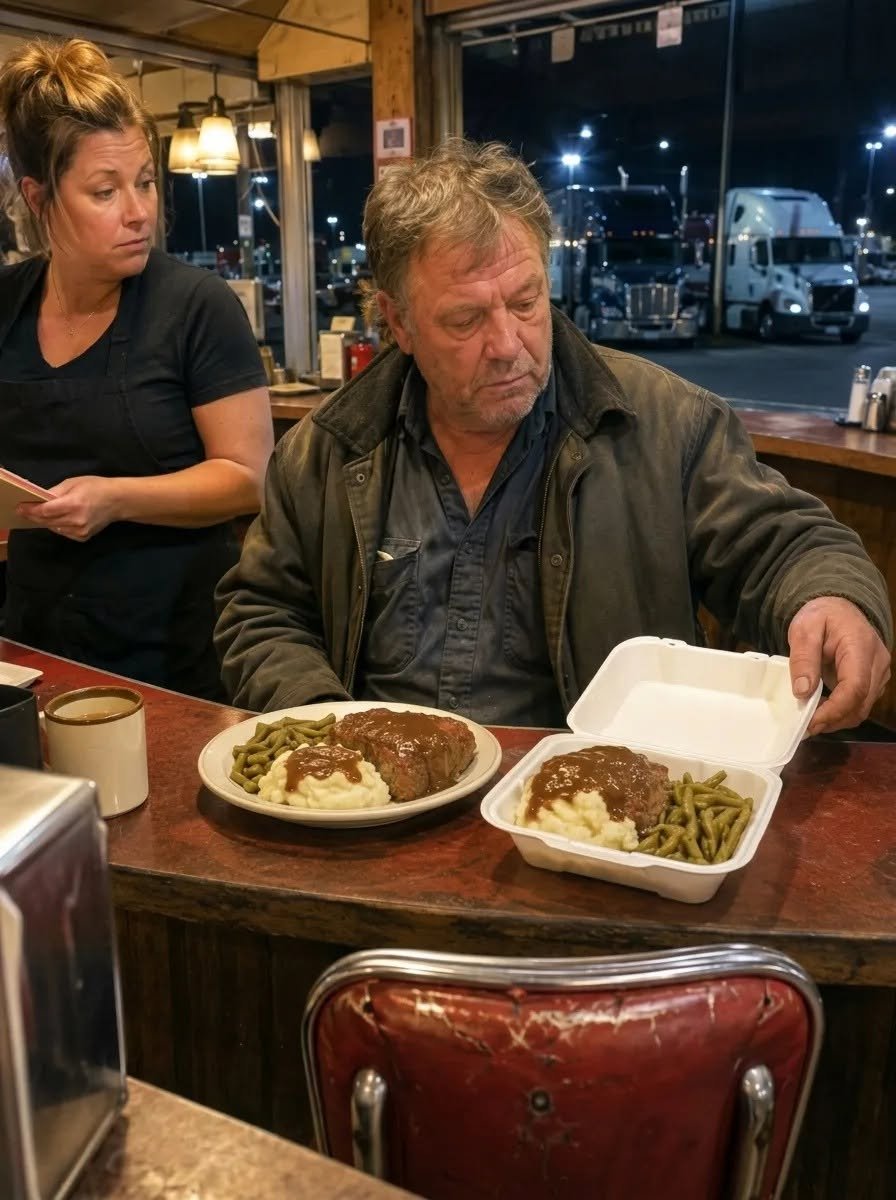
“Two meatloaf dinners,” Wesley Boone said, sliding onto the same cracked vinyl stool he occupied every Tuesday night like clockwork.
The diner waitress, wiping down the counter, looked over his broad shoulders. “Your buddy coming in tonight?”
Wesley simply shook his head. “Just me.”
Moments later, one dinner arrived on a thick, chipped white diner plate. The other was boxed up securely in a cardboard takeout container. At first, no one in the bustling Iowa truck stop paid much mind to this weekly ritual. Wesley, a 57-year-old long-haul driver who carried the faint, permanent scent of diesel fuel and bitter winter air, wasn’t a man who broadcasted his life story.
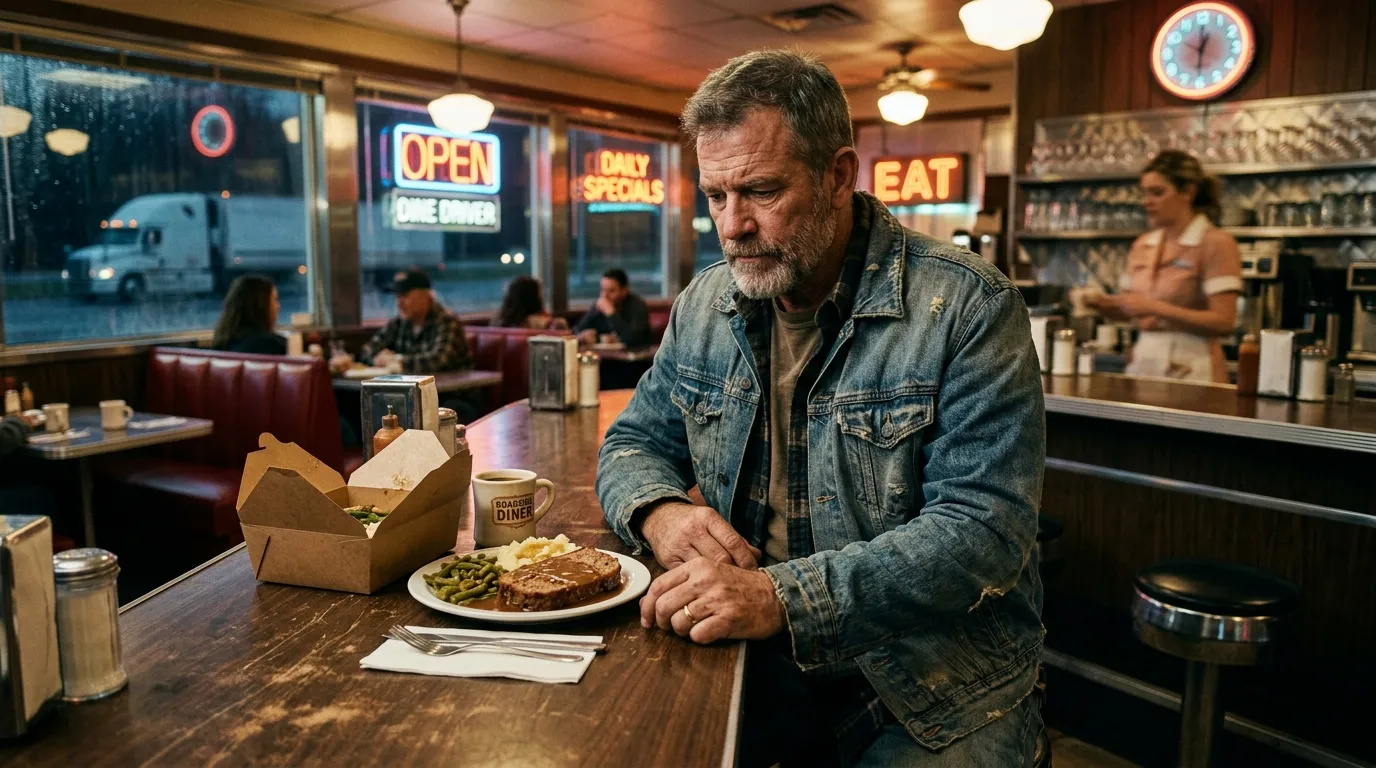
Wesley’s quiet Tuesday night ritual begins.
The Weight of Hidden Struggles
What the diner staff didn’t know was how precariously close Wesley was to the edge of ruin. Just a year prior, he was the proud owner of three trucks. He had spent two decades sacrificing sleep and comfort to build a small hauling company, dreaming of leaving something substantial behind for his daughter.
But life has a way of testing our foundations. A failed transmission here, a delinquent customer there, and skyrocketing fuel bills created a perfect storm. Within months, his savings were decimated, the company folded, and Wesley found himself navigating bankruptcy. Stripped of his fleet, he kept only his oldest rig, returning to the lonely miles he thought he had left behind decades ago.
Yet, no matter how tight money got, every Tuesday at 8:30 p.m., Wesley stopped at that roadside diner and ordered two dinners.
The Man in the Rust-Colored Pickup
The mystery of the second dinner was eventually unraveled by a young dishwasher named Cody. Peering through the kitchen window, Cody watched Wesley carry the steaming takeout box past the brightly lit fuel pumps to the dark periphery of the lot. There, a rusted old pickup truck had sat unmoving for weeks.
Inside that freezing cab lived Harold.
Harold was 71 years old. For thirty-six years, he had worked the night shift at a local factory. He had done everything right: raised two children, paid his taxes, mowed his lawn, and loved his wife, Elaine, for forty-four beautiful years. But when Elaine passed away, Harold’s world unspooled. Medical debts cannibalized his meager retirement, forcing the sale of his home. Too proud to burden his struggling children, Harold made his pickup truck his permanent address.
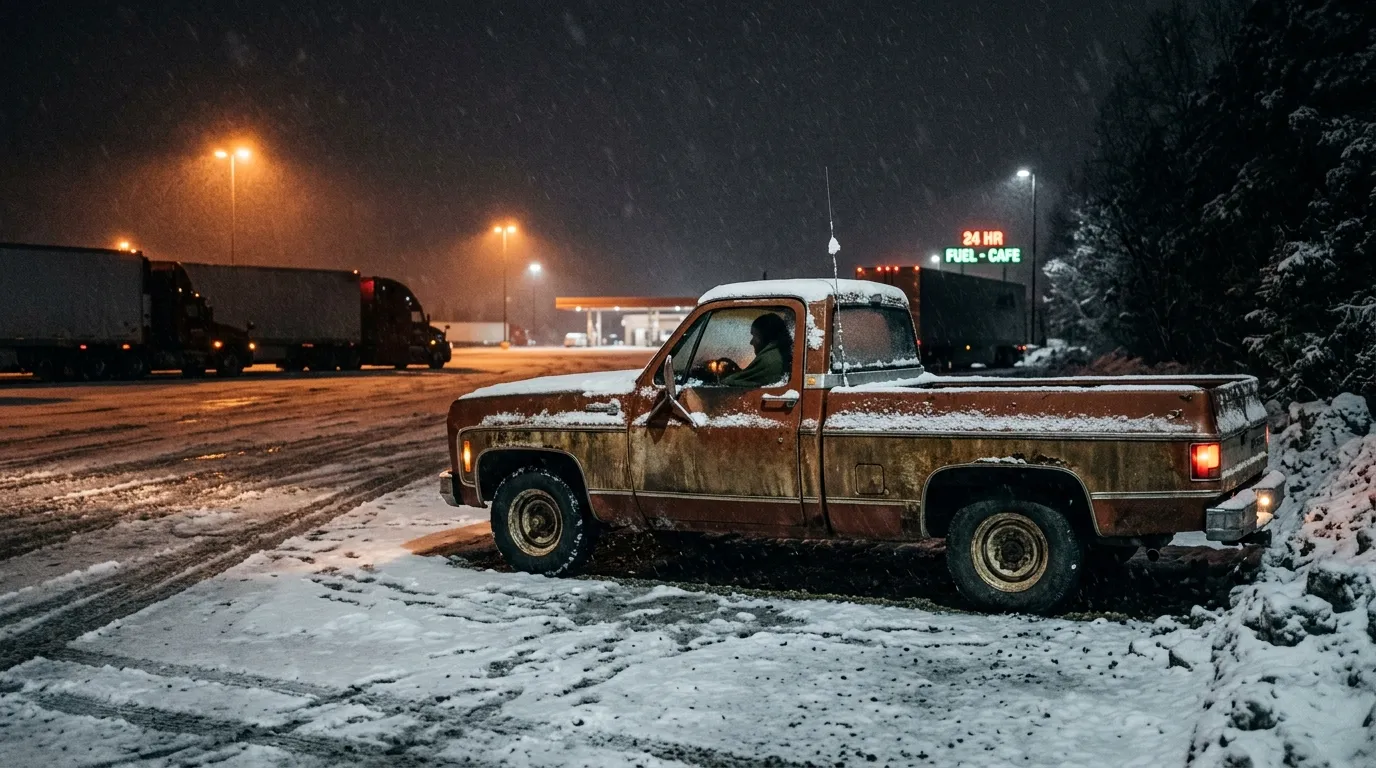
Harold’s temporary home on the edge of the freezing parking lot.
While the diner staff occasionally offered Harold free coffee or swept up around his truck, Wesley’s approach was completely different. There was no pity. No grand speeches. Wesley simply placed the warm box on the hood of the truck, tapped twice on the frosted glass, and walked away.
A Masterclass in Preserving Dignity
The silent deliveries continued. Chicken-fried steak. Pot roast. Sometimes a slice of pie. Eventually, Harold figured out the schedule and ambushed Wesley before he could retreat.
“You don’t have to keep doing this,” Harold said one freezing November evening, looking deeply embarrassed. “I can pay you something.”
Wesley recognized the look of a proud man cornered by charity. So, he lied.
“They give me too much food anyway,” Wesley nodded toward the neon diner sign. “Big portions.”
It was a transparent, ridiculous excuse, but it provided exactly what Harold needed: a way out. Harold smiled knowingly. “Then I suppose it’d be wasteful not to help you out.”
That became their unspoken pact. Wesley wasn’t saving Harold; Harold was doing Wesley a favor by eating his “extra food.” As winter tightened its grip on the Midwest, Wesley’s finances dwindled to less than $100 some weeks, but the Tuesday dinner never ceased.
When the Road Goes Dark
Spring finally arrived, but it brought disaster. While hauling machinery through northern Missouri, Wesley’s rig let out a catastrophic metallic grind—the sound every owner-operator fears. Pulling over to the shoulder, steam hissing into the twilight, Wesley realized his journey was over.
A mobile mechanic quoted a repair cost that made the blood drain from Wesley’s face. He was broke, his credit was nonexistent, and this delay would cost him the load. The reality he had been fighting off for a year had finally caught him. Sitting on the aluminum step of his cab, Wesley buried his face in his calloused hands.
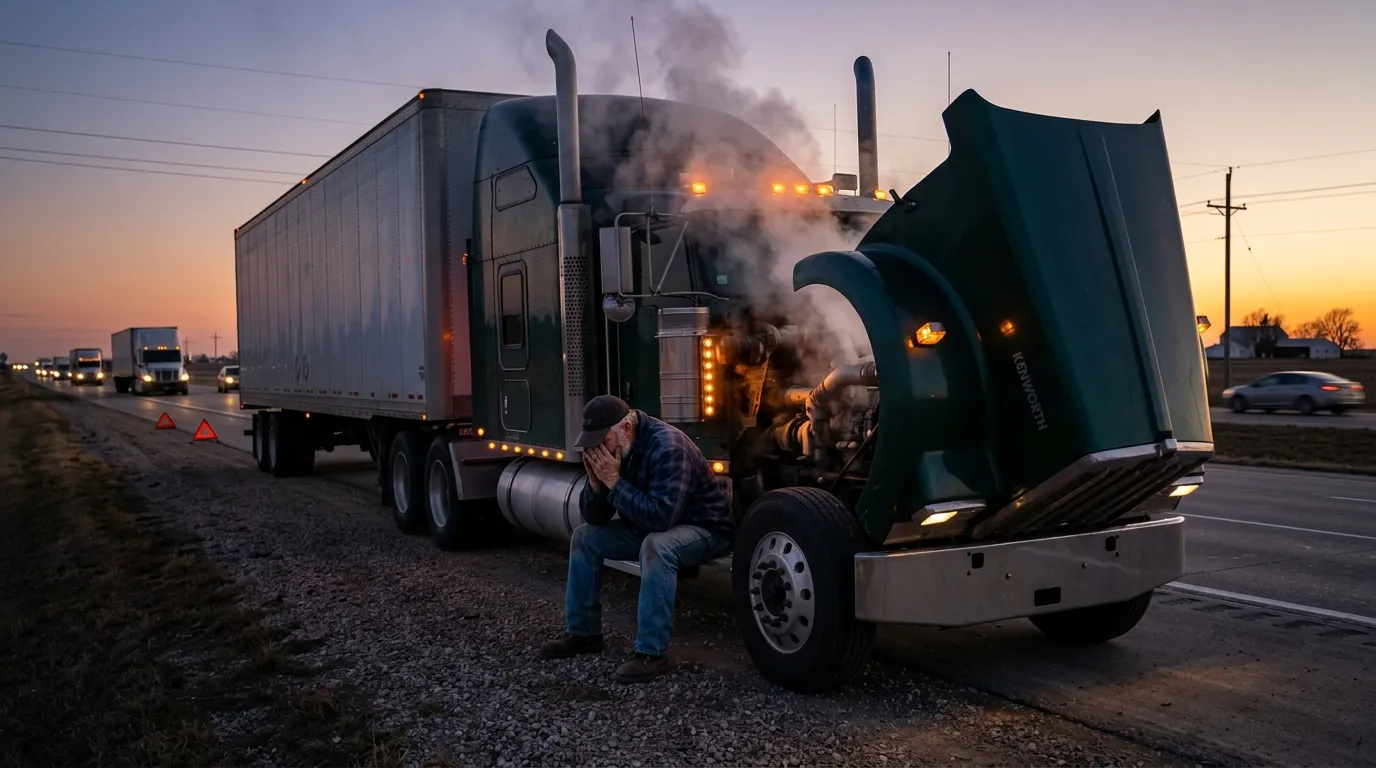
The moment Wesley thought he had finally lost everything.
An hour passed. Then, flashing amber lights appeared in his mirrors. A heavy-duty tow truck pulled in front of him. When the passenger door swung open, Wesley couldn’t believe his eyes. It was Harold.
The Harvest of Kindness
“What in the world are you doing here?” Wesley stammered, bewildered.
Harold offered a familiar, crooked smile. “Helping with some extra food.”
The story unraveled quickly. Harold had recently found part-time work at a local towing garage. When word reached the diner through the trucking grapevine that Wesley was broken down and stranded, Cody the dishwasher had mobilized the community. The waitress threw in fifty bucks. Truckers who only knew Wesley by sight tossed in hundreds. Retirees passed around a coffee can. Harold emptied his brand-new, hard-earned savings into the pot.
By the time they reached Missouri, they had enough to tow the rig and cover the lion’s share of the engine repair.
Overwhelmed, Wesley wiped his face with his grease-stained sleeve. “I can’t take that.”
Harold just nodded softly. “Funny. I used to say the exact same thing.”
A Legacy of Big Portions
Three days later, Wesley’s repaired rig rumbled back into the Iowa truck stop lot at precisely 8:30 p.m. on a Tuesday. The diner was packed. Harold, Cody, the waitress—they were all waiting.
When asked if he wanted the “usual,” Wesley looked around the room, a wide smile breaking across his tired face. “No. Tonight, I’m buying as many dinners as I’ve got money for. Big portions.”
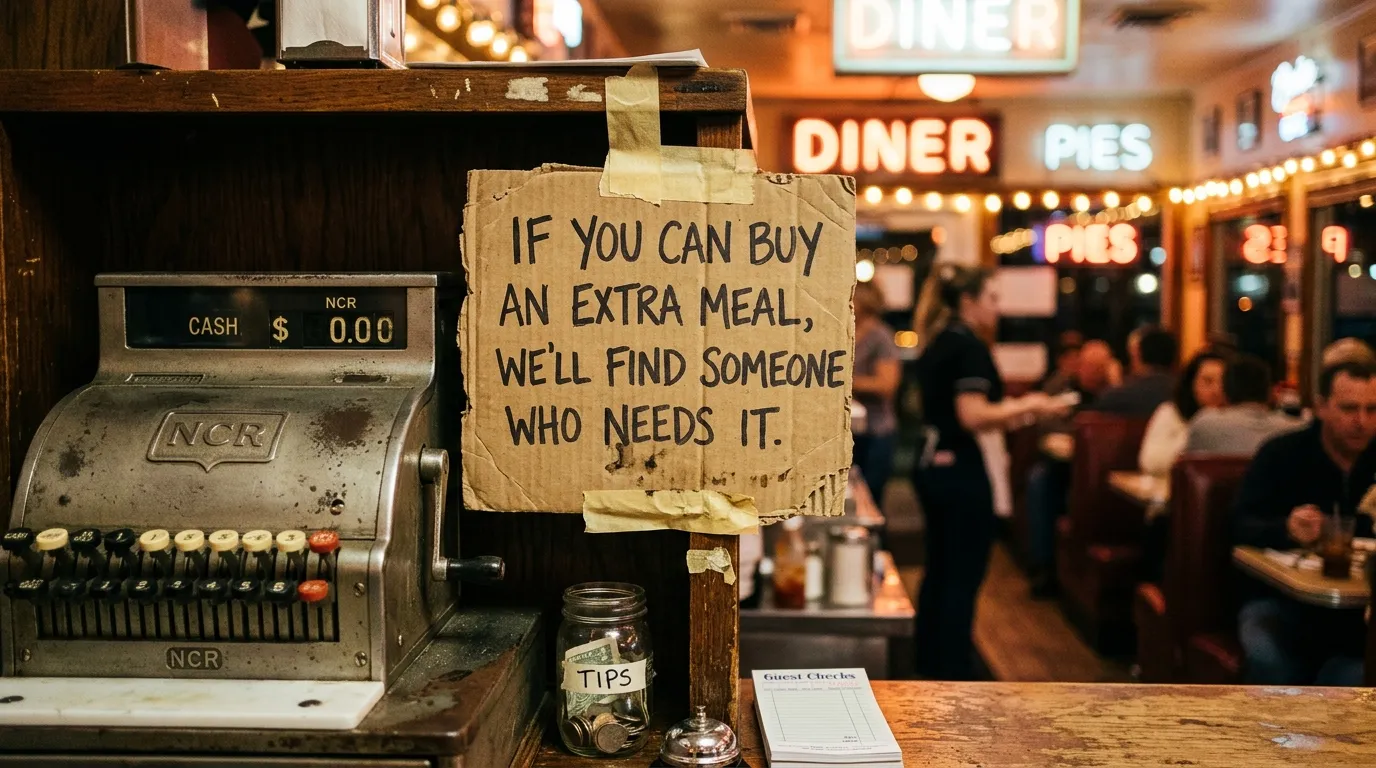
The quiet ripple effect of a single act of generosity.
Wesley never became a trucking magnate again, but he stayed on the road. And the diner? It changed forever. A permanent, handwritten cardboard sign was taped near the register, sparking a tradition of strangers buying meals for travelers who had hit hard times.
True kindness is rarely a transaction. It is a lantern passed silently from hand to hand in the dark. And if you keep passing it forward, eventually, when your own road turns black, you’ll find an entire community standing there, holding the light for you.
Note:This work is inspired by real events and people, but it has been fictionalized for creative purposes. Names, characters, and details have been changed to protect privacy and enhance the narrative. Any resemblance to actual persons, living or dead, or actual events is purely coincidental and not intended by the author.
All images used in this article are AI-generated and intended for illustrative purposes only.