

For years, I ignored the small, seemingly harmless charge that quietly appeared on our joint bank statement every single month. My husband, Mark, always brushed it off with a casual wave of his hand, dismissing it as an old billing mistake that he just hadn’t gotten around to fixing. It was easy to believe him. We had built a comfortable, trusting life together.
Then, one quiet afternoon while he was away on a business trip, I used a key I was never supposed to find. What I uncovered behind a rusted metal door on the outskirts of town didn’t just break my heart—it completely dismantled the reality of our fifteen-year marriage.
The $87 Question
My husband and I had been married for almost fifteen years when I finally decided to question the recurring charge. It really wasn’t much money. Just $87 a month. But when you do the math, that small fee had been draining from our account for over a decade.
One typical Tuesday evening, I was sitting at the kitchen table sorting through the mail and balancing our budget. Mark stood by the sink, the blue light of his phone illuminating his face as he scrolled through emails. The house was quiet, save for the hum of the refrigerator.
“Mark?” I asked, tapping my pen against the bank statement. “What’s Silver Ridge Storage?”
His thumb immediately stopped scrolling.
“What?” he asked, his voice tight.
“This charge right here. Eighty-seven dollars. It hits on the 4th of every month.”
He barely glanced up from his screen, shifting his weight. “Oh, that. That’s just an old storage unit. It’s totally empty. I’ve just been meaning to call and cancel it.”
In a normal marriage, that explanation should have been enough. But something about the forced casualness of his answer bothered me. A nagging voice in my head whispered a simple, undeniable logic: If the unit was truly empty, why on earth had he kept paying for it for fourteen years?
“Fourteen years, Mark?” I pressed, leaning back in my chair.
He finally looked at me, his jaw set. “Lena, it’s nothing.”
“You’ve been paying almost $90 a month for absolute nothing?”
“I said I forgot about it.”
“You don’t forget anything, Mark. You remember the exact mileage on my car for oil changes.”
He sighed heavily, rubbing the bridge of his nose. “Can we not do this tonight, Lena?”
I waited for him to elaborate, to give me something that made sense. He didn’t. He simply turned around and walked out of the kitchen as though I had nagged him about replacing a lightbulb. But the seed of doubt had been planted, and it was growing fast.
The Key to Unit 214
A few weeks later, the $87 charge appeared on our statement again. This time, I couldn’t just let it slide. The silence around it had grown too loud.
While Mark was flying across the country for a business trip, I went into his home office. I felt a pang of guilt as I opened his filing cabinet, but I pushed it down. I searched through old tax documents, warranties, and folders until I finally found what I was looking for: a weathered, folded receipt from the storage facility.
It included an address on the edge of town and a specific unit number: Unit 214.
Carefully taped to the back of the receipt was a small, silver key. The moment my fingers brushed against the metal, my hands began to shake. I knew I was crossing a line, but I couldn’t stop myself.
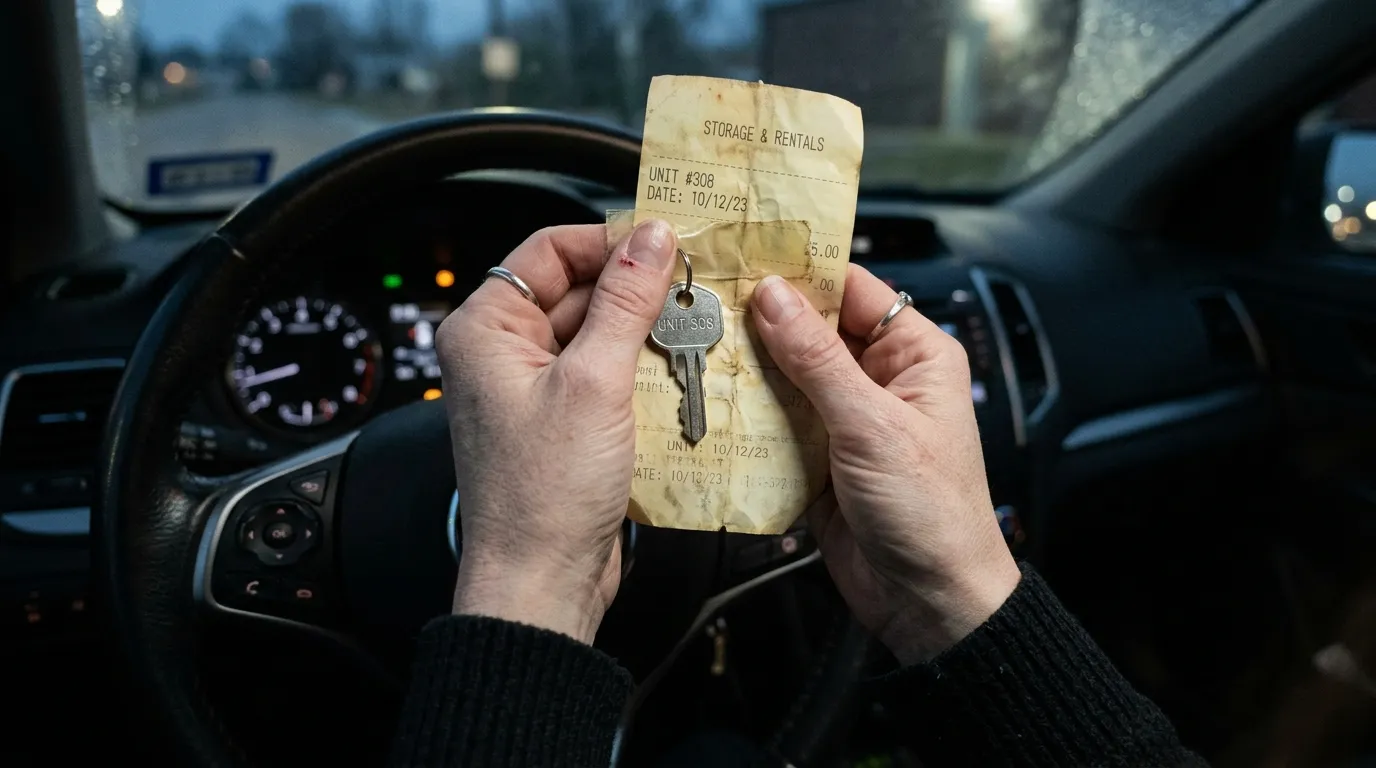
The key that would unlock a fourteen-year-old secret.
The storage facility sat on the desolate outskirts of town, surrounded by chain-link fences and endless rows of identical, faded orange metal doors. I parked my car near the small front office and just sat there for a moment, gripping the steering wheel, staring through the windshield.
Part of me wanted to put the car in reverse, go home, and pretend I had never found the receipt. But the unknown was suffocating me. I forced myself out of the driver’s seat, the gravel crunching beneath my shoes, and walked inside the office.
A gray-haired man in a faded polo shirt sat behind the reception desk, reading a magazine.
“Can I help you, ma’am?” he asked.
I cleared my throat, trying to sound confident. I explained that I was trying to locate a unit rented by my husband and showed him the paperwork with Mark’s name on it.
The manager adjusted his glasses and clicked away on his outdated computer. Then, he smiled warmly. “Wow. Unit 214. Yes, your husband has had that one for a very long time. Never misses a payment.”
“How long?” I managed to ask, my throat dry.
He squinted at the glowing screen. “Looks like… since March 2011.”
My stomach plummeted, tightening into a painful knot. March 2011. That was exactly two months before Mark and I stood at an altar and promised to share our lives together.
Opening the Door
The manager kindly opened the security gate and pointed me toward the correct row of units. The walk to Unit 214 felt entirely surreal, like I was moving underwater. With every step, my mind raced, desperately trying to explain away what I might find.
It’s just old furniture, I told myself. Boxes from college. Embarrassing hobbies. Things Mark had boxed up and genuinely forgotten years ago.
But deep down, in the pit of my stomach, I already knew that forgotten belongings weren’t the reason he had lied to my face. You don’t hide junk for fourteen years.
When I finally reached the orange door marked “214”, my hands were trembling uncontrollably. The padlock looked weathered and old, but it certainly didn’t look abandoned. It was free of rust, well-oiled. I stood there for what felt like an eternity before finally sliding the key into the lock.
It turned with a heavy click. The metal door rattled loudly, echoing through the empty rows of storage units, as I heaved it upward.
At first, the darkness inside was disorienting. I couldn’t understand what I was seeing. The smell of stale air and old paper hit my nose. Slowly, my eyes adjusted to the dim light spilling in from the outside.
And when I finally realized what was sitting inside, my knees nearly gave out.
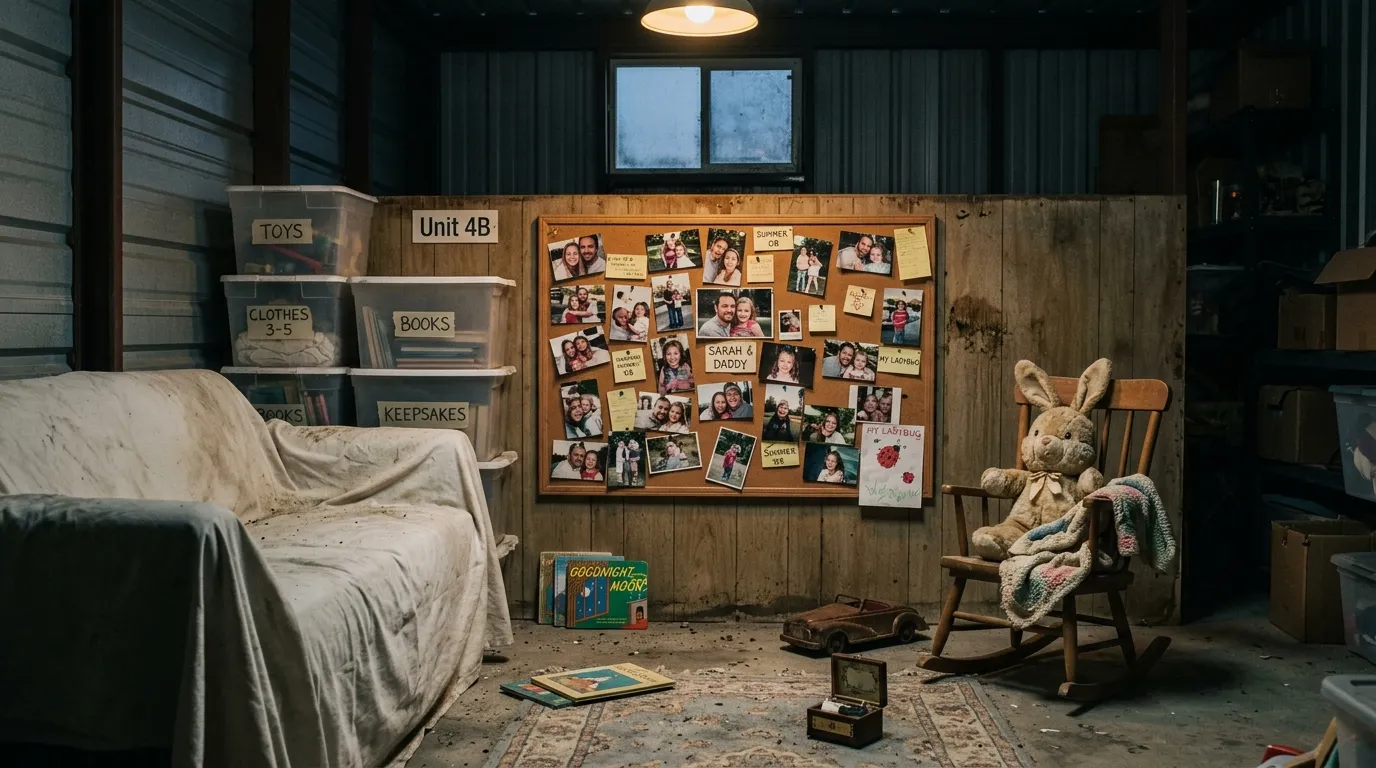
The unit wasn’t filled with junk; it was a memorial to a life I knew nothing about.
The concrete storage unit hadn’t been used as a dumping ground; it had been arranged almost like a small, sad living room. There was a sofa covered in a plastic drop cloth. A small, white wooden bookshelf. Plastic containers were stacked neatly and obsessively against one wall. In the center of the space sat a small wooden rocking chair, holding a faded stuffed rabbit.
But it was the photographs that stopped my heart.
Dozens of them were pinned to a large corkboard at the back of the unit. I stepped closer, the air catching in my lungs. There was Mark, looking impossibly young, holding a newborn baby wrapped in a pink blanket. Mark sitting on a porch beside a dark-haired woman. Mark kneeling in the grass beside a little girl in a purple party dress.
The same beautiful little girl appeared over and over in the photos as she grew from a baby into a toddler, and then into a young child.
Then I noticed the colorful, hand-drawn cards pinned meticulously between the pictures.
Dad, you’re my hero.
Dad, thanks for coming to my recital.
Dad, I love you.
Dad.
My husband had a daughter. A whole other life. And for fifteen years, I had known absolutely nothing about her.
I pressed a trembling hand tightly over my mouth, stifling a sob, and stumbled backward until I hit the cold metal wall of the unit.
On a nearby plastic folding table sat a pristine cardboard box. Written across the top in Mark’s distinct, neat handwriting were the words: For Emily — when she’s ready.
I wasn’t sure whether I should open it. I felt like an intruder in a sacred space. My heart was pounding so hard against my ribs that I could hear the blood rushing in my ears. But I had come this far. Eventually, I reached out and lifted the lid.
Inside were dozens of envelopes. Every single one was addressed in Mark’s handwriting. I pulled out the one resting on top and unfolded the paper.
If you’re reading this someday, it means your mother finally decided you should know the truth about me…
The Confrontation
My phone rang, shattering the heavy silence of the unit.
The caller ID flashed: Mark.
I stared at the screen, a mix of pure rage and profound sorrow washing over me. I answered the phone with shaking fingers and pressed it to my ear.
He didn’t even say hello. He must have gotten a notification from the storage facility gate code.
“You’re in Unit 214, aren’t you?” he asked. His voice was completely hollow.
“Who is Emily?” I whispered into the receiver.
Dead silence on the other end.
“Mark?” I yelled, my voice breaking. “Who is Emily?!”
His voice cracked, sounding like a man who had just been shattered. “My daughter.”
I could barely process the words coming out of his mouth. “You… you have a daughter?”
“Yes.”
“And you never told me? Not once in fifteen years?”
“Lena, please. Please just listen to me. I can explain.”
“Explain?!” I cried out. “I’m standing in a damp storage unit full of photographs of your child! You had fourteen years to explain this to me, Mark. Fourteen years of lying to my face every time that bill came due!”
“She wasn’t a secret, Lena,” he pleaded.
“Then what was she?!”
His breathing became rough, frantic. “The child I lost.”
I squeezed my eyes shut, tears finally spilling over my cheeks. “Come home.”
“I can get an earlier flight. I’ll head to the airport right now.”
“Do that,” I said coldly. Then I hung up.
I don’t know how long I stayed inside that unit afterward. I moved through it like a ghost, feeling as though I was trespassing inside the darkest corners of my own marriage. I tracked the timeline through the photos. There were pictures of Emily until she was about seven years old. After that, the pictures stopped. There were only letters.
Letters for birthdays. Letters for Christmases. Letters for every major milestone a father should witness but Mark never did.
One beautifully wrapped gift said: For your tenth birthday.
Another, wrapped in silver paper, read: For 16.
Doing the math in my head, looking at the dates on the envelopes, I realized Emily had to be in her early twenties now. By the time I finally pulled the metal door down and locked it, I felt completely hollowed out.
The Heartbreaking Truth
Mark returned home shortly after midnight. The house was pitch black except for a single lamp in the living room.
I was sitting stiffly on the couch. The silver storage key rested perfectly in the center of the glass coffee table.
Mark stopped dead in his tracks the moment he walked in and saw me. He looked ten years older than when he had left.
“Lena,” he said quietly, his voice raspy.
“Sit down,” I commanded.
He didn’t argue. He sat on the edge of the armchair.
“Start talking. From the beginning.”
Mark clasped his hands together, staring at the floor. “Emily was born when I was twenty-six. Her mother’s name was Claire. We were together for a few years before I ever met you.”
“Were you married?” I asked, my tone sharp.
“No.”
“Engaged?”
“For a while. It didn’t last.”
My throat tightened painfully. “And you never, at any point, thought your wife should know that you were a father?”
“I wanted to tell you,” he whispered.
I let out a bitter, humorless laugh. “Wanted to tell me… right. For over a decade.”
He lowered his head, tears dripping onto his hands. “Claire and I split when Emily was little. We fought about everything, constantly. It was toxic. But God, Lena, I loved my daughter. I had visitation. I was in her life. Then Claire met someone else and moved away.”
“With Emily?”
He nodded slowly. “Without telling me. I just went to pick her up one weekend, and the apartment was empty.”
I crossed my arms, trying to shield myself from his pain. “Couldn’t you go to court? That’s kidnapping.”
“I did,” he said, his voice rising with ancient frustration. “I spent two years and almost every cent I had in family court. I hired private investigators. By the time I finally tracked them down, Claire had remarried. Her new husband had money, lawyers. Emily had been brainwashed. She had been told that I abandoned her. That I didn’t want her anymore.”
“Did you?” I asked softly.
His head snapped up, his eyes flashing with fierce indignation. “No. Never. I would never do that to my little girl.”
“Then why would she believe it?”
“Because she was seven years old, Lena!” he broke down. “Her mother told her a story, and she believed it.”
That answer hit me harder than I expected. The sheer helplessness of his situation was agonizing. Mark rubbed his tired eyes.
“The last time I saw her… she asked why I wasn’t coming to her piano recital. I didn’t even know she had one. Claire never told me. I hugged Emily, and I promised her I’d make the next one.” He swallowed hard, a sob escaping his lips. “But I never saw her again. Claire blocked my calls. The courts dragged it out until I was broken.”
For a long while, the room was absolutely silent.
I was still furious. My trust was shattered. But after standing in that storage unit, after seeing the agony poured into those letters, my anger no longer felt simple. It was tangled in a deep, profound tragedy.
“Why keep the unit?” I asked.
“When Claire started returning all the birthday and Christmas gifts I sent, stamped ‘Return to Sender,’ I couldn’t just throw them in the trash. I rented the unit. I put everything there because seeing it at home… it would have literally destroyed me.”
“And then you married me two months later?” I asked, feeling sick. “Did you love me, Mark? Or did I just help you pretend she never existed?”
His eyes filled with fresh tears as he looked at me. “I loved you. I still love you more than anything. But I was so ashamed.”
“Ashamed of having a daughter?”
“Ashamed of losing her. Ashamed that I wasn’t strong enough to fight a millionaire stepfather and a bitter ex-wife. I felt like a complete failure of a man.”
I looked at the silver key lying between us on the glass.
“You lied to me every single month for fourteen years, Mark.”
“I know.”
“You let me build my entire life with a version of you that wasn’t even real.”
He nodded, the tears running freely down his face now. Then he whispered a sentence that will stay with me forever: “I didn’t hide another family from you, Lena. I hid the family I lost.”
I hated that a small part of me believed him. But I did.
The Red Boots
The next morning, while Mark was still asleep from exhaustion, I drove back to the storage facility. I unlocked the metal door and brought one of the cardboard boxes home with me.
When Mark walked into the living room, he froze.
Sitting on the floor was the open box. Inside, resting on top of a pile of baby clothes, were Emily’s little red rain boots. They were scuffed at the toes from where she had likely dragged her feet on the pavement.
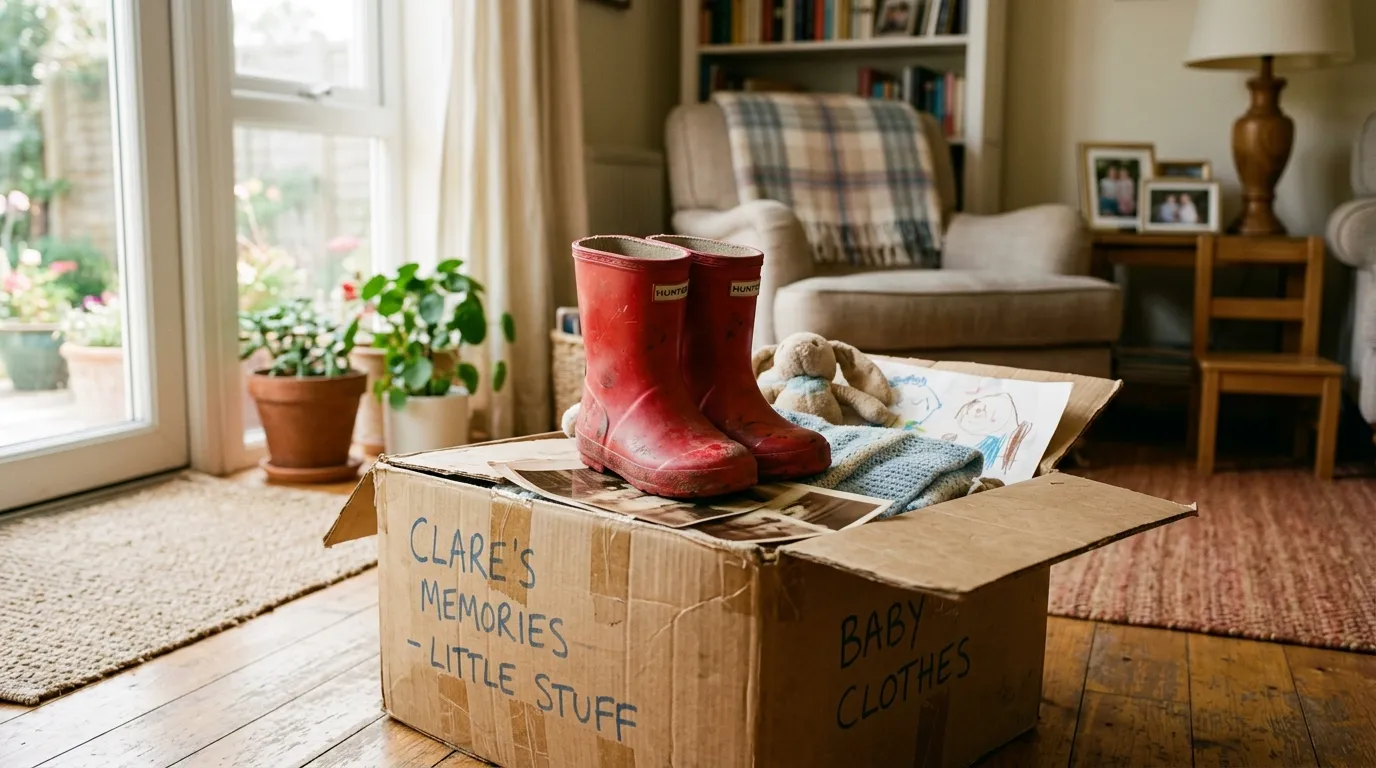
The red boots were a tangible piece of a past he couldn’t let go of.
The moment he saw them, he broke. Completely and utterly broke.
He dropped to his knees on the rug, picked up the tiny rubber boots, and bent over them. He sobbed with such raw, primal grief that eventually, I had to look away. I had never seen my husband cry like that in fifteen years.
When the tears finally slowed, I sat down next to him.
“I am still furious with you,” I told him honestly.
“I know,” he sniffled.
“I don’t know what happens to us after this. I don’t know how we fix this trust.”
“I know.”
“But,” I said, reaching out to touch his arm, “Emily deserves the truth. And you deserve peace.”
Mark looked up in panic, fear filling his bloodshot eyes. “What if she hates me, Lena?”
“She might. She probably will at first.”
He shut his eyes, shaking his head. “I can’t take that.”
“But that choice belongs to her,” I said firmly. “Not to you. Not to Claire. And not anymore. You have to give her the truth.”
The Search for Emily
Over the next several days, we turned our dining room table into an investigative hub. We gathered every scrap of paper from the storage unit: old court documents, previous addresses, the postmarks on the returned envelopes.
I had to push the search forward because Mark kept freezing up. Every time we found a promising lead, fear would give him another excuse to quit.
“What if she has a really good life now?” he asked one night, staring at a search engine result.
“Then she still deserves to know that her biological father didn’t throw her away.”
“What if Claire told her I was dangerous?”
“Then show her the thousands of dollars in legal bills and the letters. Prove her wrong.”
“What if she just… doesn’t answer?”
I looked at him, unwavering. “Then at least you can sleep at night knowing you finally tried as the man you are now, not the broken twenty-something you were then.”
It took us three weeks and a bit of online sleuthing to find Emily.
The irony was heartbreaking. She lived only two towns away. For years, Mark had been writing letters to a daughter who lived less than a forty-five-minute drive from our front door.
She was twenty-two years old now. A nursing student. We found a public profile picture of her standing outside a local hospital. She was wearing blue scrubs, her dark hair pulled back, smiling brightly at the camera.
Mark stared at the picture on the laptop screen as though blinking might make her disappear.
“Write to her,” I said, placing a pen on the table.
“I don’t know how. I don’t know what to say.”
“Yes, you do. You’ve been writing to her for fourteen years. Just start with the truth.”
It took him an entire afternoon to write a single page. He drafted and re-drafted. He didn’t blame Claire. He didn’t demand forgiveness or a relationship. He simply told Emily that he was her father, that he had loved her every single day, that he had tried to find her, and that if she ever wanted answers, he would give her every single one he had. He included his phone number and our address.
Ten agonizing days after he dropped the letter in the mail, Emily finally responded.
It was a text message. It was incredibly short.
I got your letter. I don’t know what to believe. My mom said you left. But… I remember my red boots. Do you still have them?
Mark covered his mouth, letting out a choked gasp.
I put a steadying hand on his shoulder. “Tell her yes.”
A Fragile Reunion
Their first meeting took place at a neutral, public park on a chilly Saturday afternoon.
I drove Mark because his hands were shaking too badly for him to safely grip the steering wheel. When we pulled up, we saw her immediately. Emily stood near a wooden bench beneath a large oak tree, holding her phone tightly in both hands. She looked nervous, ready to bolt at the slightest provocation.
Mark got out of the car, carrying the red boots safely tucked inside a plain brown paper bag.
She stared at him for a long, heavy moment as he approached.
“You look older than I remember,” she said, her voice defensive but trembling.
He gave her a sad, broken smile. “I am.”

The distance between them was fourteen years wide, but they were finally face to face.
I remained in the car, watching from a distance, giving them privacy. They stood on that path and talked for nearly two hours. When Mark finally walked back to the car, the paper bag was gone, and his face was red and swollen from crying.
He got into the passenger seat and took a deep, shuddering breath.
“She wants to see the letters,” he said simply.
A week later, Emily drove to Unit 214. She specifically asked me to be there, too.
When she arrived, she looked at me with guarded eyes. “I want to know who knew about this,” she told me, her tone demanding honesty.
“I didn’t,” I swore to her. “I found the key three weeks ago. It turned my life upside down, too.”
She studied my face for several long seconds, looking for the lie. Then, her shoulders dropped slightly. She nodded. “I believe you.”
Mark stepped forward and lifted the heavy metal door.
Emily stepped inside the dim unit and completely froze. Her gaze moved slowly, taking in the magnitude of what her father had saved. She looked at the corkboard of photographs, the handmade cards, the neatly wrapped presents that had gone unopened, and the stacked boxes filled with hundreds of letters.
She walked over to the corkboard and reached out, gently tracing her finger over one of the old cards.
Dad, I love you.
“I made this,” she whispered, her voice thick with emotion.
Mark nodded, standing respectfully near the door. “After your kindergarten picnic.”
“I thought you threw everything away. Mom told me you started a new life and didn’t want any reminders.”
“Never,” Mark said fiercely. “Never.”
She turned toward him, angry tears suddenly filling her eyes. “Then why didn’t you come for me? Why didn’t you try harder?!”
The question nearly broke him in half. But this time, he didn’t defend himself. He didn’t make excuses or blame Claire.
“I tried,” he said, his voice raw. “But then I got tired, and I got scared, and I ran out of money. I let my grief become an excuse to stop fighting. I should have fought harder for you. I am so, so sorry.”
Emily started crying. So did Mark.
I quietly stepped outside into the crisp afternoon air, pulling the metal door down halfway to give them the sacred moment alone.
By sunset, Emily emerged from the unit. In her arms, she carried the large cardboard box that had been meticulously labeled for her.
She stopped and looked at me before heading to her car.
“You stayed with him after finding all this out?” she asked.
I sighed, looking at my husband standing in the shadows of the storage unit. “I’m still deciding what staying actually means for us right now.”
She nodded, a look of mutual understanding passing between us. “Fair.”
The Door Left Open
That afternoon at the storage facility was only the beginning. There was no movie-magic, perfect reunion. There was no instant miracle that healed a decade and a half of trauma.
Emily still carried a lot of valid anger toward her mother, and toward Mark for giving up. Mark still carried mountains of debilitating guilt. And I still had a deeply fractured marriage to reconsider and rebuild.
But at the very least, the toxic secret was finally out in the open air, where it couldn’t grow in the dark anymore.
Mark and I immediately began couples counseling. He stopped shutting down. He answered every single question I asked, including the brutally painful ones about our early years and his lingering emotional baggage. Slowly, we are finding a new baseline of honesty.
Emily visits us now, slowly and cautiously. She comes entirely on her own terms, and we respect her boundaries. Last week, she came over just to drink coffee on the porch with Mark.
By the end of that summer, Unit 214 was completely empty.
Emily took all the letters, the childhood photos, and those little red rain boots. Mark kept just one photograph to put on his desk at home—a picture of them together from her kindergarten picnic.
And I kept the small silver key.
I didn’t keep it because I wanted to remember the lie or the betrayal. I kept it because it serves as a permanent, physical reminder that secrets do not protect families. They don’t keep you safe. They only lock everyone you love inside the same dark room.
And sometimes, the door you are most terrified to open is the only one that can finally let the truth—and the healing—in.
Note:This work is inspired by real events and people, but it has been fictionalized for creative purposes. Names, characters, and details have been changed to protect privacy and enhance the narrative. Any resemblance to actual persons, living or dead, or actual events is purely coincidental and not intended by the author.
All images used in this article are AI-generated and intended for illustrative purposes only.