
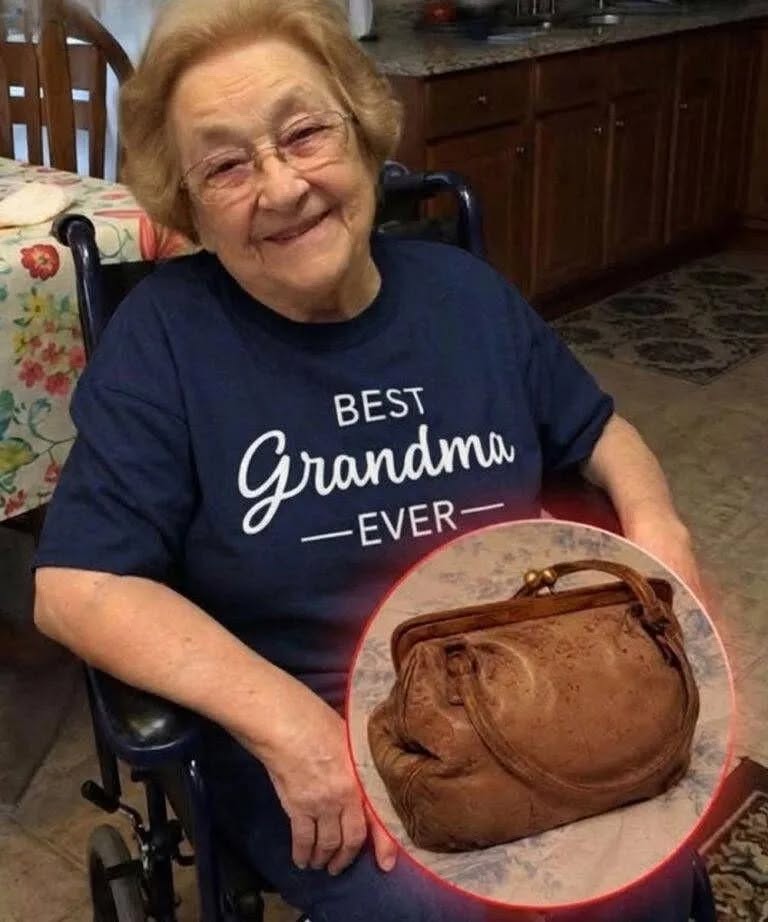
For as long as I could remember, my grandmother Nancy made me repeat the exact same solemn promise. She would look me dead in the eye, her voice dropping to a serious hush.
“Emily, don’t open that handbag until I’m gone.”
The object of her obsession was an old, brown, and heavily faded leather bag. It was permanently perched on the highest shelf of her bedroom closet, collecting dust like a forgotten relic. Absolutely nobody in the family was allowed to lay a finger on it. I learned the severity of this rule when I was just fifteen years old.
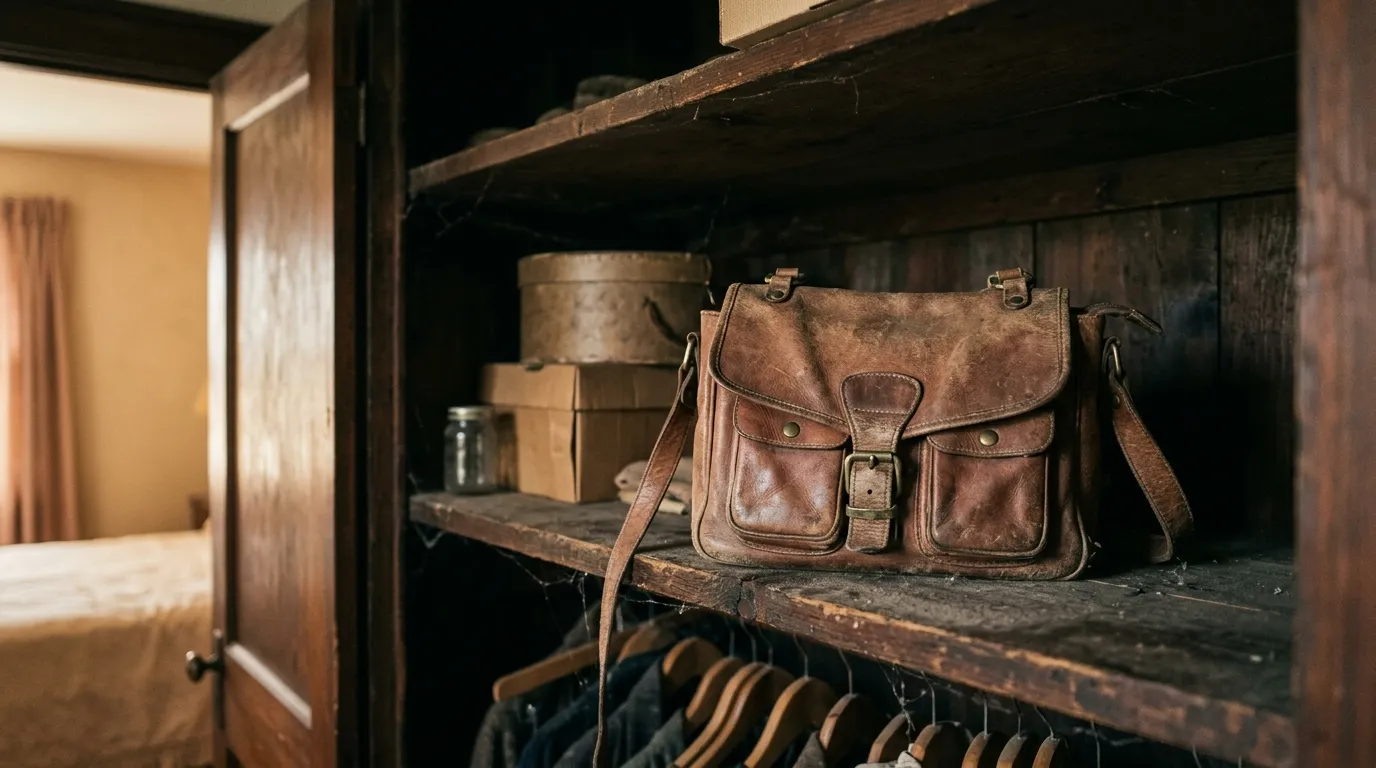
The faded brown bag that held our family’s darkest secrets.
One lazy Sunday afternoon, my Uncle Robert jokingly reached for it, a playful smirk on his face. “Come on, Mom. What are you hiding in there? Crown jewels?”
Before his fingers could even graze the worn leather strap, Grandma Nancy slapped his hand away with a ferocity that shocked us all. “I said don’t touch it!” she snapped. The entire room went completely, uncomfortably silent. Robert laughed awkwardly to brush off the tension, but the message was clear: none of us ever joked about the handbag again.
After that peculiar incident, Grandma would occasionally pull me aside when the house was empty. She would grip both of my hands with her fragile fingers and whisper the same heavy directive.
“Promise me you’ll wait until I’m gone.”
“Why me, Grandma?” I would ask, bewildered.
“You’ll understand when you open it. And after you take out what’s inside, I want you to put the handbag back with me.”
I always promised. Years bled into decades, and then, inevitably, the day came. Grandma Nancy passed away.
The Funeral and the Forgotten Promise
I was twenty-eight when I found myself sitting in the front pew of our local church, surrounded by an ocean of relatives I had barely seen in years. Grandma had eleven grandchildren, three daughters, two sons, and somehow, through her unique charm, she had made every single one of us believe we were her absolute favorite.
My mother, Carol, sat near the very back of the church. Alone. Nobody spoke to her, and nobody offered a comforting shoulder. Sadly, that frosty treatment had been normal for most of my life. Twenty-five years earlier, a devastating event had caused my mother to be exiled from the family fold.
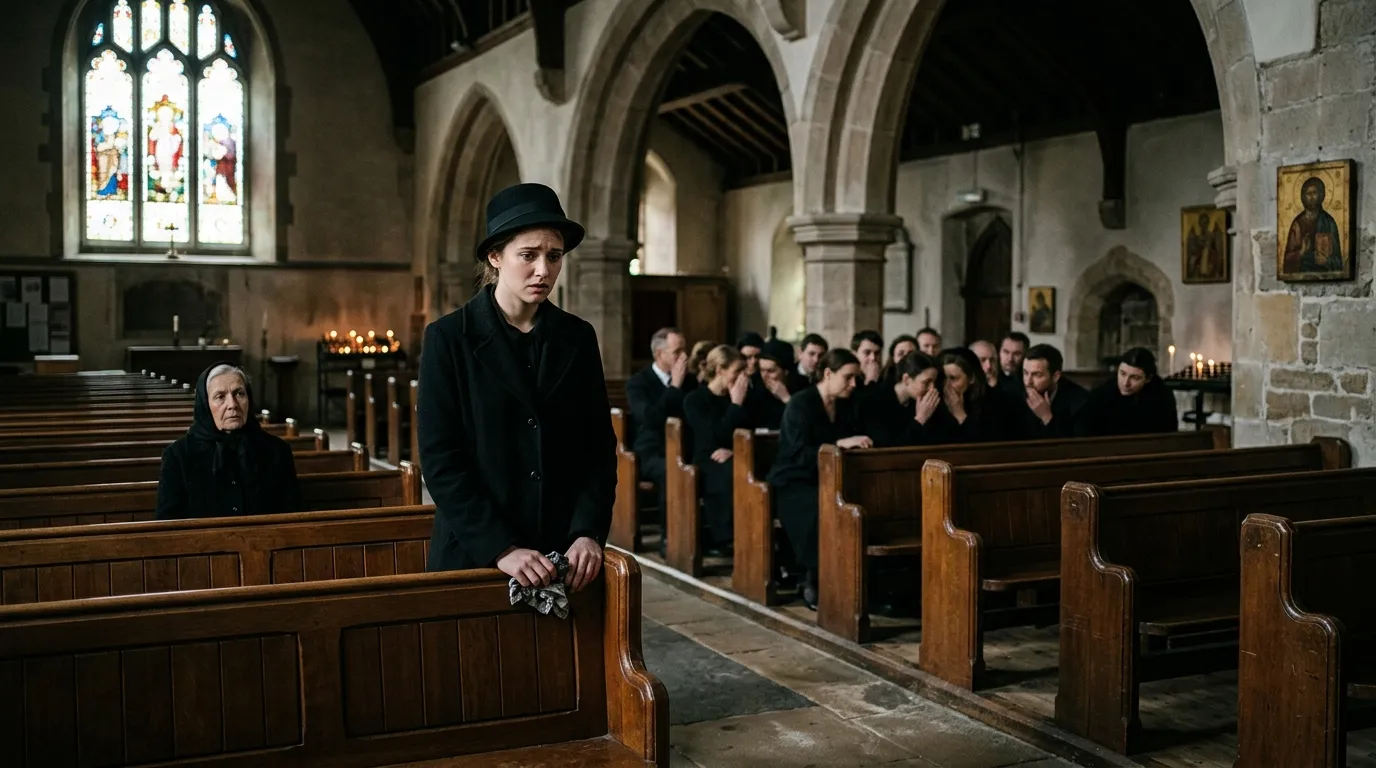
For twenty-five years, my mother sat on the outskirts of our family.
I knew there had been dark accusations about a large sum of money disappearing from my grandfather Frank’s safe, but Mom never offered much of an explanation. The family firmly believed she had stolen it, and I had grown up knowing better than to ask questions. During the funeral service, I kept glancing back toward Mom, my heart breaking for her isolation.
Then, the funeral director stepped toward Grandma’s casket, preparing to close it for the final time. Suddenly, the memory hit me like a physical blow.
The handbag.
My stomach dropped to the floor. “We forgot the bag,” I blurted out. Everyone in the front pews turned to stare at me. My mother squeezed her eyes shut in embarrassment. “Emily, sit down,” she mouthed. “The cars are waiting.”
“But Grandma made me promise,” I insisted, standing up.
Uncle Robert immediately shot to his feet. “Sweetheart, I’ll get it,” he offered smoothly. “We can put it in the casket at the cemetery.”
Something about how eagerly and quickly he volunteered made my skin prickle with discomfort. “No,” I said firmly.
He frowned, his calm facade cracking slightly. “Emily—”
“She asked me to do it.” I grabbed my car keys, ignoring his protests. “I’ll be back in fifteen minutes.”
Unlocking the Past
Grandma’s house felt eerily quiet. It still smelled faintly of cinnamon and the wool of the cardigan she wore every single Sunday. I dragged a heavy wooden dining chair into her bedroom, climbed onto it, and reached for the highest shelf. My fingers brushed the familiar leather.
When I pulled it down, it was heavier than I had expected. It wasn’t “jewelry heavy”—it was “paper heavy.”
I sat on the edge of her perfectly made bed and popped open the rusted brass clasp. Inside, neatly stacked, were twelve thick envelopes. Eleven of them had names written across the front in Grandma’s looping cursive. One for every grandchild. Emily. Megan. Jake. Ashley. Tyler. And so on.
The final envelope had no name. It bore only three capitalized words:
READ THIS LAST.
My hands began to tremble. I gathered the envelopes, shoved the twelfth one deep into my own purse, and rushed back to the church. One by one, I handed the eleven named letters to my bewildered cousins. Then, as promised, I placed Grandma’s empty vintage handbag gently into her folded hands. The funeral director closed the casket. Grandma was buried exactly as she had requested.
But that twelfth envelope remained hidden, containing a secret our family had spent a quarter of a century protecting.
The Wake and the Whispers
Out of respect, nobody opened their letters until after the burial. At the wake, while others mingled awkwardly over stale sandwiches, I slipped into a quiet, dim hallway and unfolded my personal letter. Grandma had written beautifully about tender memories I had almost forgotten. She remembered me feeding a stray cat when I was seven, and she thanked me for my relentless Sunday phone calls.
Then, the tone of the letter abruptly shifted.
“You were the only one I never had to hide anything from,” she wrote. She went on to explain that our family had become dangerously good at harboring secrets. Each of her children had, at some point, begged her to stay silent about one thing or another. Grandma had agreed, foolishly believing that silence was the glue that would hold our family together.
“I told myself I was protecting everyone. Now I know all I protected was the silence.”
When I finally walked back into the reception room, the atmosphere was suffocating. My cousins were whispering furiously in corners. Aunts were exchanging nervous, wide-eyed glances. And strangely, people who had actively ignored my mother during the funeral were suddenly staring at her with profound guilt.
Whatever Grandma had written in those eleven letters had violently ripped off the bandages of wounds nobody had discussed in decades.
The following morning, my cousin Megan called me. “Did your letter say anything about my dad?”
“No,” I replied cautiously. “Why?”
She dodged the question. Instead, she asked, “What’s in the twelfth envelope?”
My heart stalled. “How do you know about that?”
“We all watched you hand out eleven letters, Emily. You kept two.”
“I haven’t opened it yet,” I admitted.
“Well, everyone wants to know what’s inside,” she warned, and hung up.
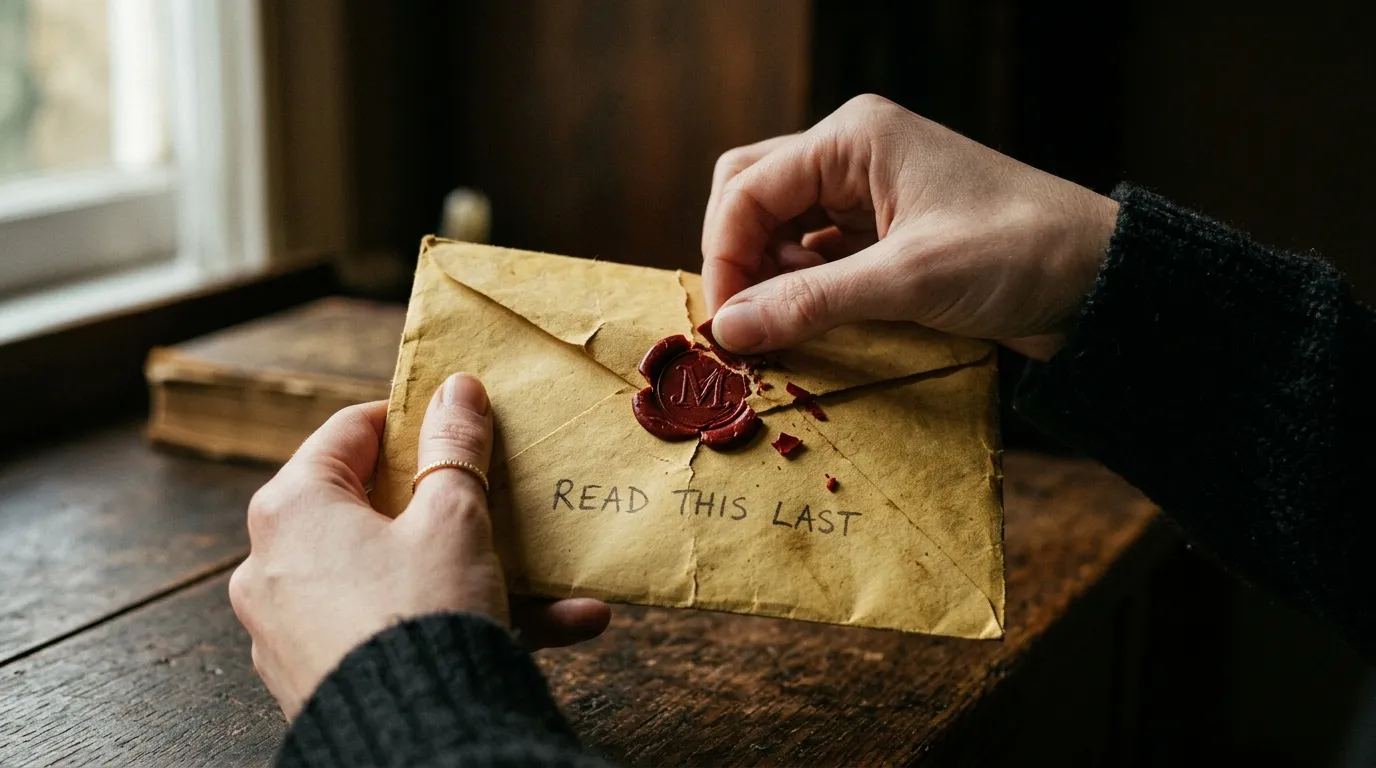
The envelope that held twenty-five years of hidden truth.
Shattering the Silence
By noon, our normally buzzing family group chat was a ghost town. That afternoon, my mother called me. She was weeping—a jarring sound, as I had almost never heard my resilient mother cry.
“Emily, what on earth did Grandma write in those letters?”
“I don’t know what everyone else got, Mom.”
There was a long, agonizing pause. Then Mom whispered, “Be careful what you believe about me.”
That haunting sentence echoed in my mind all day. Later, Aunt Susan let something slip. “Your mother didn’t take that money, Emily.”
I froze. “What money?”
Susan’s face crumpled. “Grandpa Frank’s money. From the old safe.”
“My entire life, this family told me Mom stole it!” I yelled, unable to contain my shock.
“That’s what we allowed people to believe,” Susan admitted, looking deeply ashamed. “I knew enough to know we should have asked more questions.”
I drove straight to my mother’s house. I sat her down on the faded living room couch and refused to leave until she told me the truth. Finally, broken and exhausted, she admitted it. Someone else in the family had stolen the money. Mom knew exactly who it was, but that person had young children. Fearing the severe legal consequences that would destroy her sibling’s life, Mom thought she could take the blame temporarily until Grandpa cooled down.
Instead, the family turned on her permanently. She and I were pushed out into the cold.
“You sacrificed twenty-five years of your life for someone else?” I asked, stunned by her misplaced loyalty.
Before I could press her for a name, Uncle Robert called my cell. “Sweetheart, Susan told me you’re terribly upset,” he cooed, playing the role of the comforting patriarch.
“There’s another letter, Robert,” I said coldly.
Dead silence on the line. Then, “Emily, don’t read it. Look what those first letters have already done. Your mother is hurting again. Let Nancy die with her secrets.”
For a brief second, I almost listened. Robert had always been the uncle I trusted. He taught me how to ride a bike, fixed my car, slipped me cash in college. But the sheer panic vibrating beneath his smooth tone gave him away.
That night, sitting alone in my apartment, I broke the seal of the twelfth envelope.
The Final Confession
The letter began with a desperate apology. “Emily, if you’re reading this, then I owe you the absolute truth.”
Grandma explained that a few years ago, the guilt of what had happened to my mother became too heavy. She planned to gather the family and clear Carol’s name once and for all. But before she did, she warned the true culprit.
He begged her not to. When begging didn’t work, his tone turned vicious. “You tell them, and you’re out of this house.”
My blood ran cold. Grandma had transferred the deed of her home to one of her children years ago to simplify her estate. At seventy-two, with no savings, she was terrified of becoming homeless. So, she chose her roof over her daughter’s reputation. She lived with that self-hatred every single day.
Then came the sentence that rearranged my entire reality:
“The man who threatened me was Robert. He was the one who took the money from your grandfather’s safe.”
Robert. The man who played the hero. He let his sister lose her family. He watched her raise me entirely alone while relatives whispered vile rumors. He let everyone treat her silence as an admission of guilt. And when his own mother tried to fix it, he threatened to throw her out on the street.
The next morning, I summoned Mom, Aunt Susan, and Aunt Linda to Grandma’s empty house. Standing in the living room, I read the twelfth letter aloud. My mother began to sob—not quiet, reserved tears, but the heavy, gasping tears of a woman who had waited a quarter of a century for someone to finally say: She was telling the truth.
My phone lit up. Robert. I ignored it. He called again. And again.
That evening, he boldly showed up at Grandma’s front door holding two coffees, wearing that same sickeningly calm expression. I opened the door but blocked the frame.
“Emily, sweetheart, let me explain—”
“You stole Grandpa’s money,” I said, my voice eerily calm. His fake smile vanished. “You let my mother take the blame. You watched her lose everything. And when Grandma wanted to tell the truth, you threatened an old woman with her own house.”
“Emily, you don’t understand—”
“All these years, you played the saint,” I interrupted, stepping forward. “Don’t you ever contact us again.”
I slammed the door in his face. Through the frosted glass, I watched the great Uncle Robert stand frozen for a long time before he finally turned and walked away into the dark.

For the first time in twenty-five years, my mother was finally home.
Later that night, I brought my mother into Grandma’s kitchen. I brewed a fresh pot of coffee and we sat at the old wooden table. Mom looked around slowly, soaking in the space she had been banished from for so long.
Grandma’s letters could never give back the decades my mother had lost. They couldn’t magically replace the missed birthdays, the lonely holidays, or the stolen memories. But they did give her the one thing she had long stopped hoping for.
She got her name back. She got her truth. And most importantly, she got her rightful place in the family back.
As we sat in the warm glow of the kitchen light, nobody asked her to leave. Nobody looked at her like she was a thief. And from that day forward, Carol would never have to carry the crushing weight of someone else’s secret ever again.
Note:This work is inspired by real events and people, but it has been fictionalized for creative purposes. Names, characters, and details have been changed to protect privacy and enhance the narrative. Any resemblance to actual persons, living or dead, or actual events is purely coincidental and not intended by the author.
All images used in this article are AI-generated and intended for illustrative purposes only.