
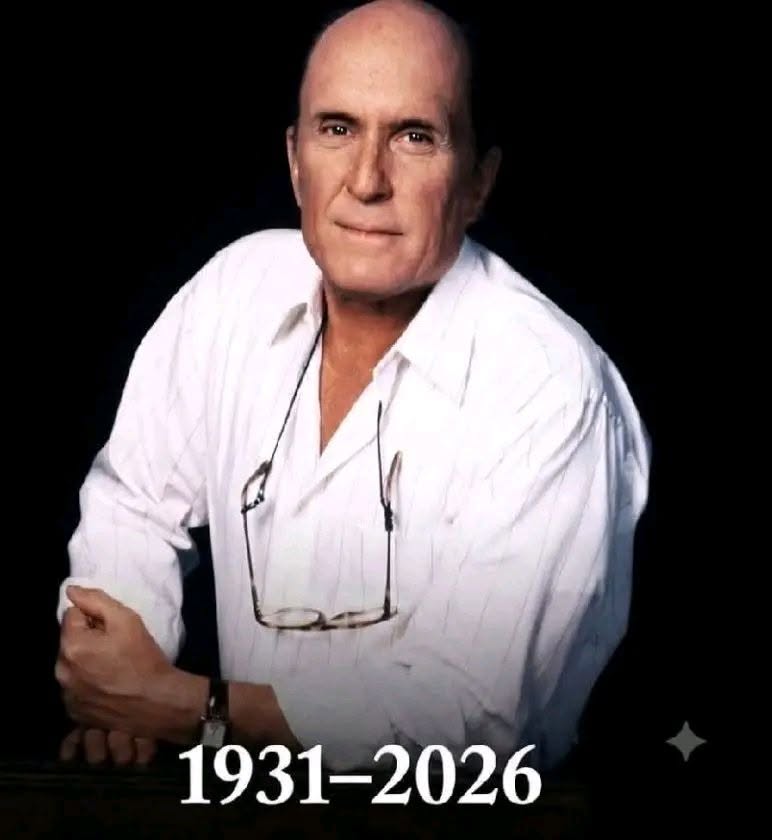
The world of entertainment is mourning the loss of Robert Duvall, one of the most respected and versatile actors in American cinema. Known for unforgettable performances in films such as The Godfather, Apocalypse Now, Tender Mercies, and Lonesome Dove, Duvall built a career that stretched across more than six decades.
Duvall died peacefully at his home in Middleburg, Virginia, on February 15, 2026, at the age of 95, surrounded by love and comfort. His wife, Luciana Pedraza, announced his passing. His death marks the end of an extraordinary chapter in Hollywood history, but his work and influence will continue to live on through the films and characters that made him a household name.

A Passion for Acting Began Early
Robert Selden Duvall was born on January 5, 1931, in San Diego, California. From an early age, he developed an interest in performing and eventually decided to pursue acting as a career.
After serving in the United States Army, Duvall studied acting in New York at the Neighborhood Playhouse School of the Theatre. During those years, he crossed paths with several future Hollywood stars, including Dustin Hoffman and Gene Hackman. His training helped shape the disciplined and natural acting style that would later become one of his trademarks.
Rather than becoming an overnight celebrity, Duvall built his reputation gradually. He worked in theater and television before making his film debut as Arthur “Boo” Radley in the 1962 classic To Kill a Mockingbird. That early performance gave audiences a glimpse of the quiet intensity that would define much of his career.
The Roles That Made Robert Duvall a Hollywood Legend
Duvall’s career changed dramatically as he began taking on larger and more demanding roles. One of his most famous performances came in Francis Ford Coppola’s The Godfather, where he played Tom Hagen, the calm and intelligent consigliere of the Corleone family.
He returned as Hagen in The Godfather Part II, further establishing himself as one of the most memorable supporting actors of his generation. His performance was powerful without being overly dramatic, demonstrating how much emotion could be communicated through a quiet voice, a facial expression, or a carefully chosen pause.
Then came Apocalypse Now, another landmark film in Duvall’s career. As Lieutenant Colonel Bill Kilgore, he delivered one of the movie’s most unforgettable performances. The character’s unusual combination of confidence, authority, and intensity became a defining moment in American cinema.
But Duvall was never an actor who wanted to be remembered for only one character. Throughout his career, he continued taking on roles that were completely different from one another, proving again and again that his range was extraordinary.

An Oscar-Winning Performance in Tender Mercies
One of the greatest achievements of Duvall’s career came with the 1983 film Tender Mercies. In the movie, he portrayed Mac Sledge, a troubled country singer attempting to rebuild his life after years of personal struggles.
The performance was deeply emotional but never felt forced. Duvall brought a quiet realism to the character, allowing the audience to understand his pain, regrets, and hope without relying on exaggerated emotion.
That performance earned Duvall the Academy Award for Best Actor in 1984. Over the course of his career, he received seven Academy Award nominations, winning once for Tender Mercies. He also received recognition from the Golden Globes, Emmys, and other major organizations for his work in film and television.
More Than Just Awards
While awards helped recognize Duvall’s talent, they were only one part of his remarkable legacy. What made him special was his ability to make even complicated characters feel believable and human.
Whether he was playing a lawyer, soldier, musician, police officer, cowboy, businessman, or troubled father, Duvall approached his roles with extraordinary attention to detail. He understood that great acting was not always about being the loudest person in a scene. Sometimes, the smallest gesture or quietest moment could have the greatest impact.
That approach earned him tremendous respect from fellow actors, directors, and audiences. His performances often felt less like someone pretending to be a character and more like a real person living through a particular moment.
A Career That Spanned Generations
Duvall remained active in the entertainment industry for many decades. His filmography included an impressive range of projects, from major Hollywood productions to independent dramas and television classics.
Among his best-known works were Lonesome Dove, The Apostle, Open Range, Network, The Great Santini, The Natural, and many others. His role as Augustus “Gus” McCrae in Lonesome Dove became especially beloved, with the Television Academy noting it as his favorite role.
What made his career remarkable was not simply its length, but its consistency. Duvall continued finding interesting characters and challenging himself long after many performers of his generation had stepped away from the spotlight.
A Quiet but Powerful Acting Style
Robert Duvall never needed to rely on flashy performances to capture an audience’s attention. His greatest strength was his authenticity.
He had a rare ability to communicate complicated emotions without explaining everything to the audience. A look, a pause, or a change in his voice could reveal what a character was thinking or feeling.
This subtle style made his performances especially memorable. Even when he appeared alongside major stars, Duvall had a way of making his presence felt. He could enter a scene quietly and still leave a lasting impression.
Tributes From Hollywood and Fans
Following news of Duvall’s death, tributes came from across the entertainment world. Fellow actors, directors, film historians, and fans remembered him as an extraordinary performer whose work had influenced generations of filmmakers and actors.
Francis Ford Coppola, who directed Duvall in several important films, including The Godfather and Apocalypse Now, also paid tribute to the actor. Many of the tributes reflected the same qualities that audiences had admired for decades: his dedication to his craft, his remarkable range, and his ability to bring truth to every character he played.
For movie lovers, his passing is more than the loss of a celebrated actor. It is the farewell to a performer whose work became part of the fabric of American cinema.

A Legacy That Will Not Fade
Robert Duvall’s career is a reminder that great acting does not depend on fame alone. It depends on dedication, patience, preparation, and a genuine understanding of human nature.
For more than sixty years, he gave audiences characters they could believe in, remember, and sometimes even see themselves in. From Tom Hagen’s controlled presence in The Godfather to the emotional struggles of Mac Sledge in Tender Mercies, Duvall continually demonstrated why he was considered one of America’s finest actors.
Although Robert Duvall is no longer with us, his work remains very much alive. His films will continue to introduce new generations to his talent, while longtime fans will return to familiar performances and discover something new each time.
Robert Duvall leaves behind more than an impressive list of movies and awards. He leaves behind a body of work that helped shape modern cinema. His voice, his characters, and his unforgettable performances will remain part of Hollywood history for generations to come.
And perhaps the greatest way to remember him is simple: watch one of his films, experience one of his performances, and allow the work of a truly remarkable actor to speak for itself.
Note: All images used in this article are AI-generated and intended for illustrative purposes only.