
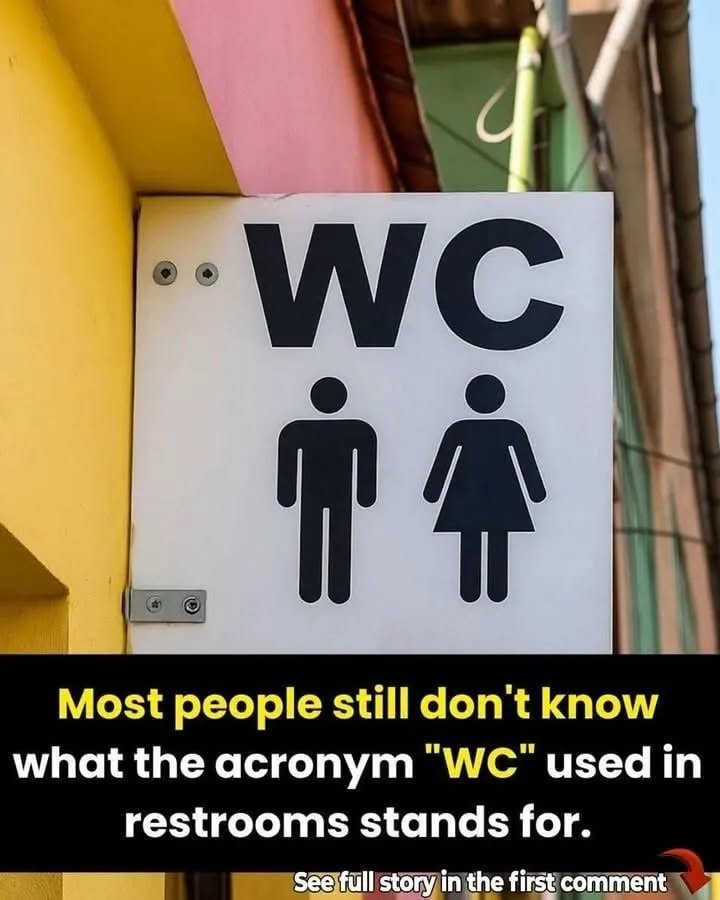
Most of us move through our daily routines on autopilot, rarely pausing to think about the small signs and symbols that dictate our paths. A red octagonal stop sign, an illuminated green fire exit, a glaring speed limit—these are universal markers we process instantly without a second thought. But there is one particular sign that appears in train stations, airport terminals, grand hotel lobbies, and cozy restaurants across dozens of countries, yet the vast majority of people who walk past it have absolutely no idea what it actually says.
Two simple letters. Enormously common. And almost entirely unexplained.
Those letters are WC.
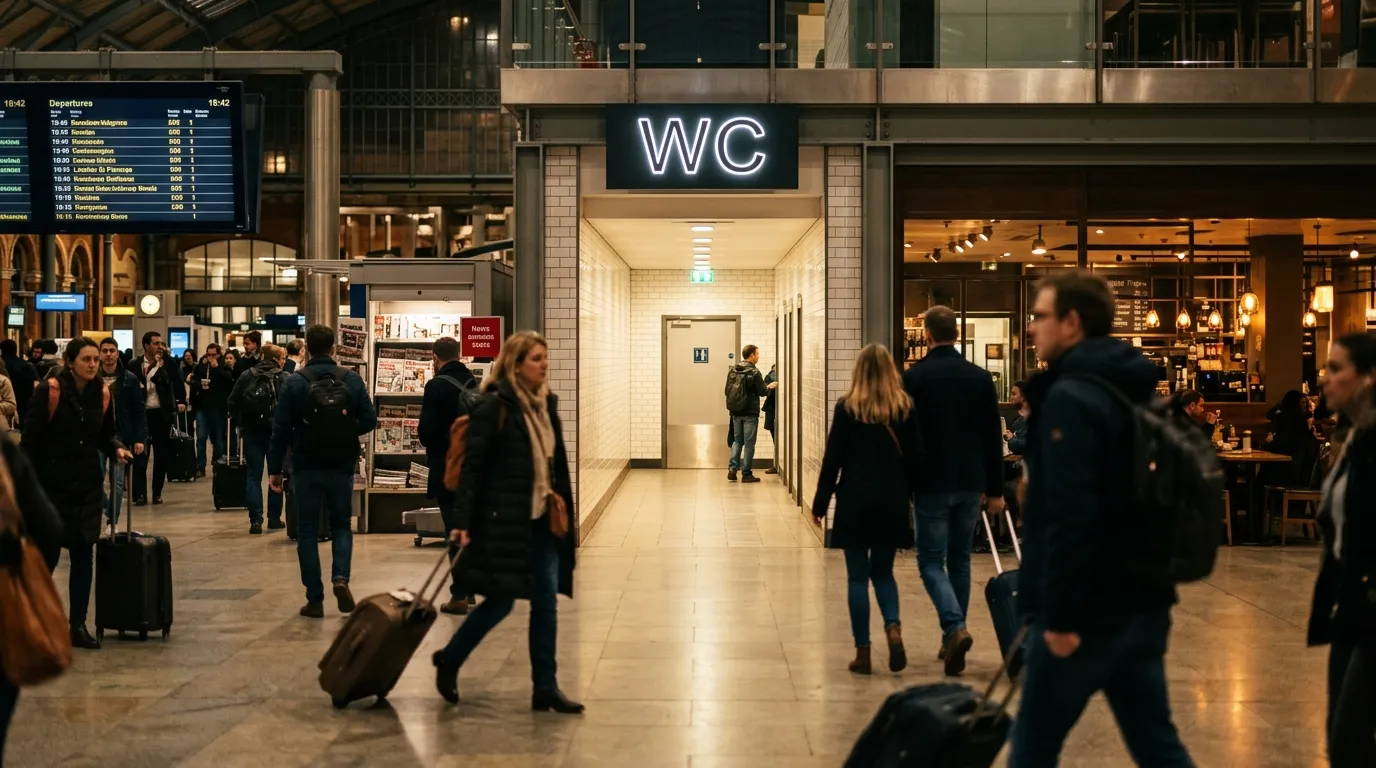
Despite being seen by millions daily, the letters ‘WC’ remain a mystery to many travelers.
If you were to ask ten random people on the street what WC stands for, you would be treated to a fascinating mix of awkward silence, wild guesses, and incredibly confident but entirely wrong answers. In fact, a recent 2026 discussion documented by British Brief found that social media users across the UK expressed genuine shock when they finally learned the truth. Countless people admitted they had assumed for years that it meant “wheelchair.” One person revealed they had lived their entire adult life believing it indicated a wheelchair-accessible room, while others expressed deep surprise at having coexisted with WC signs for decades without once questioning their actual meaning.
The real answer is surprisingly simpler than most people expect, but the deep, twisting story behind it is considerably more fascinating.
What WC Actually Stands For
Let’s solve the mystery right away: WC stands for “Water Closet.”
The term is exactly what it sounds like. It refers to a small, enclosed room fitted with a flushing toilet that uses water to carry waste away. These compact, highly specific spaces became known as “water closets” because they were literally that—tiny closets containing water-operated toilets. It helps to remember that at the time of their invention, bathing areas were completely separate from sanitation spaces. The modern concept of a combined “bathroom”—where the toilet, sink, and bathtub all share the same tiled floor—had not yet fully developed.
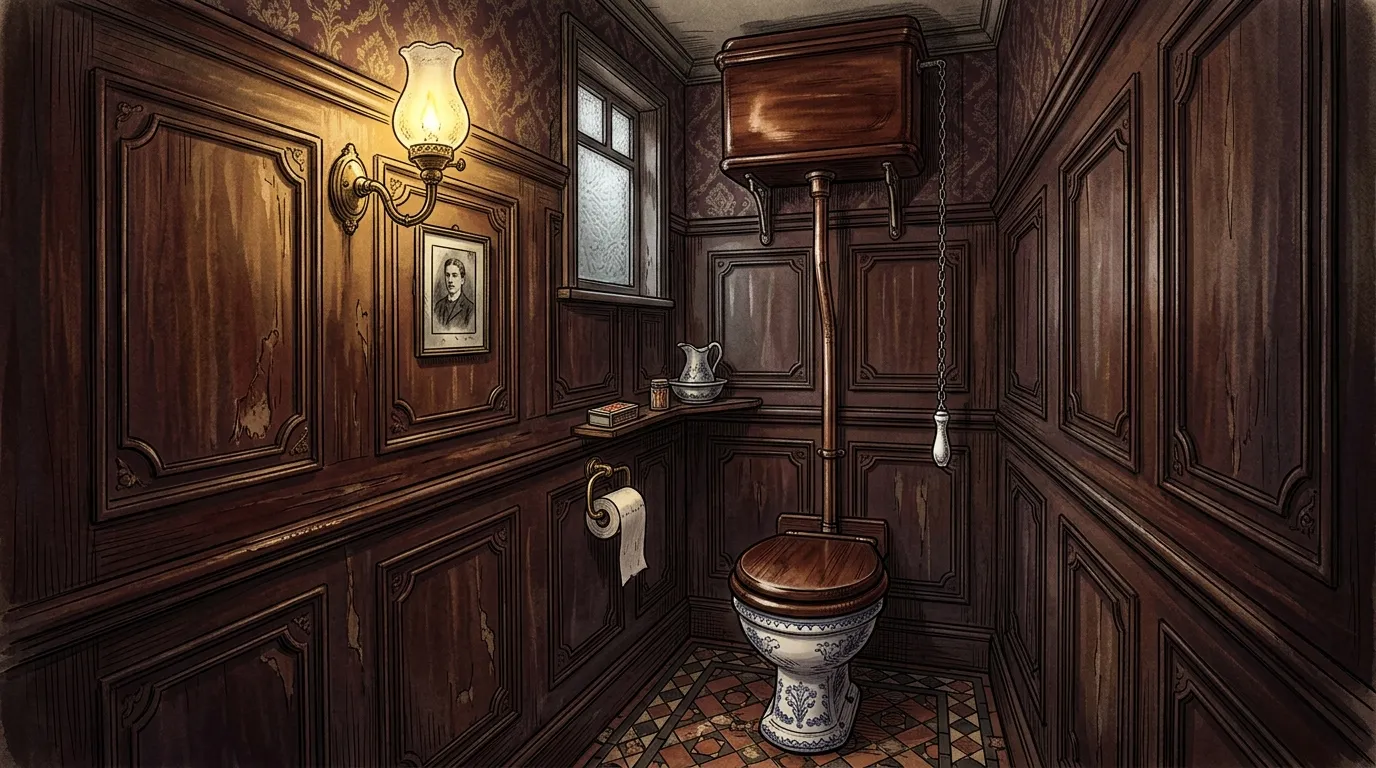
Early water closets were literally tiny closets retrofitted with indoor plumbing.
History enthusiasts are quick to point out that the term “water closet” was a linguistic invention born out of the Victorian era. It was specifically crafted to avoid social embarrassment when discussing bodily functions and toilet facilities in polite company. Originally, the contraption was known as the rather blunt “wash-down closet,” but everyday usage gradually softened and transformed it into the “water closet.” Eventually, even that was deemed a bit too descriptive, and it was shortened to the brilliantly vague abbreviation we know today: WC.
But why call it a “closet” in the first place? In 19th-century English, a “closet” didn’t just mean a wardrobe or a place to hang your winter coats. It referred to any small, private room. When indoor flush toilets were first installed in affluent homes, they couldn’t just be placed out in the open. They typically occupied their own tiny, separate room tucked away under a staircase or at the end of a hall. Add a tank of water to that small private room, and you had yourself a water closet. The abbreviation followed naturally as a matter of pure social convenience.
The Surprisingly Deep History Behind Those Two Letters
While the abbreviation might be Victorian, the story of the WC begins much earlier. It actually starts with a poet who happened to be the cheeky godson of Queen Elizabeth I.
The very first modern flush toilet was described way back in 1596 by Sir John Harington, an English courtier. Harington was a brilliant thinker who invented a wash-down system featuring a special valve at the bottom of a water tank. He was incredibly proud of his creation, and Queen Elizabeth even reportedly had one installed in her palace. However, the invention flopped and was not widely adopted. Why? Because there was no reliable supply of running indoor water to flush it. Worse, Harington’s clever contraption still drained directly into an open cesspit below the floorboards. The resulting smell was so horrific that it largely defeated the purpose of having the toilet indoors.
Because of this fatal flaw, the invention sat largely dormant for nearly two centuries. The world kept using chamber pots until 1775, when a Scottish watchmaker named Alexander Cumming solved the problem that had been holding indoor plumbing back for generations.
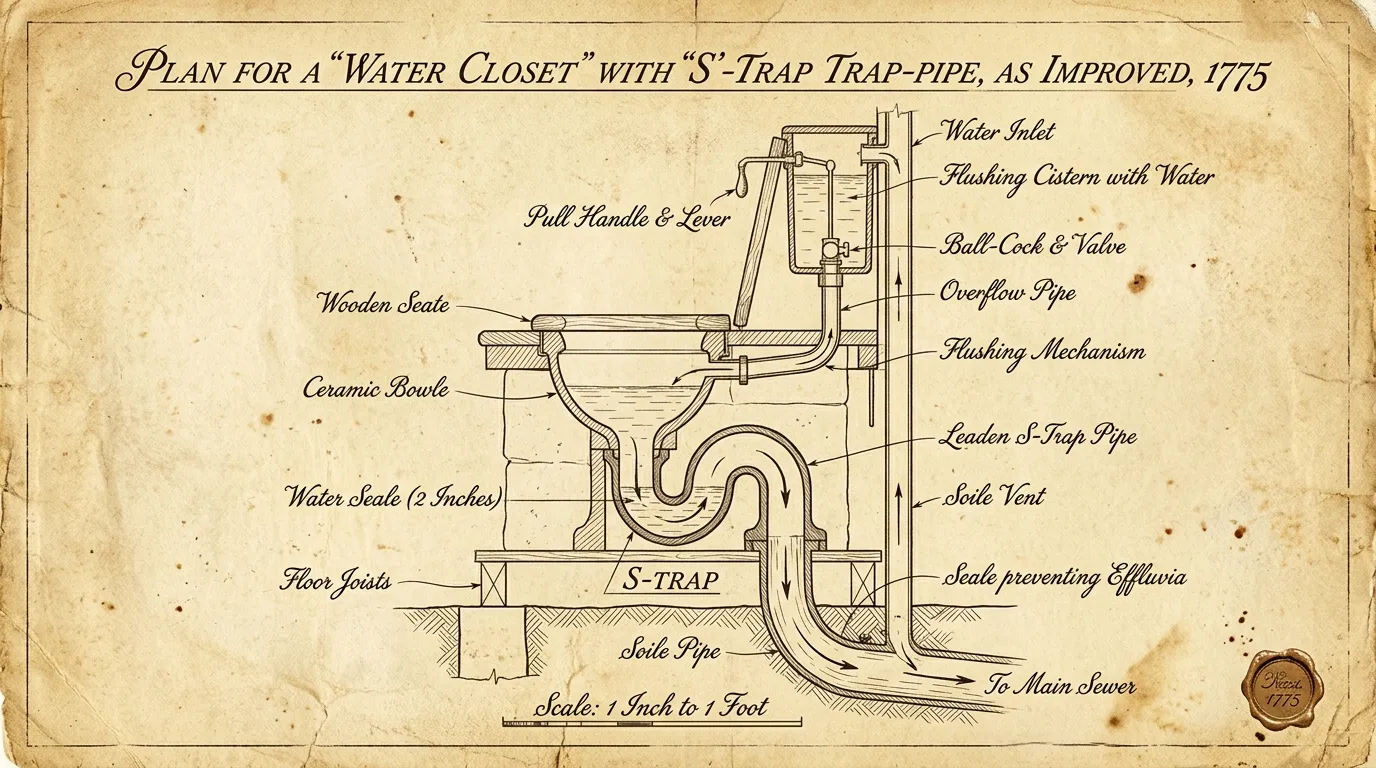
Alexander Cumming’s brilliant S-trap design trapped water to block foul odors.
Cumming applied a watchmaker’s precision to plumbing. He became the first person to patent a new design for the flush toilet. Alongside improving the flush mechanism itself, he introduced an ingenious addition: the S-trap. This was a curved section of pipe that permanently retained a small pool of water within the waste pipe after every flush. That tiny barrier of water effectively sealed the pipe, preventing noxious sewer gases from creeping back up into the building. It’s a design feature so perfect that it is still found in almost every modern flush toilet today.
That S-trap is the exact reason your modern bathroom doesn’t smell like a 16th-century sewer. It made indoor toilets genuinely livable for the very first time. (In fact, you can check yours right now by looking at the visible curve of the pipe below or behind your toilet bowl.)
Fast forward to the Victorian era. As urban populations exploded during the Industrial Revolution, the critical importance of sanitation gained worldwide recognition. Engineers and inventors raced to develop new ways to manage human waste safely. At first, these newly perfected “water closets” were exclusive to wealthy families and grand luxury hotels. They were status symbols that signaled wealth, hygiene, and sophistication.
However, the gradual spread of indoor plumbing collided with a very particular societal hurdle: Victorian prudishness. People needed a way to talk about this amazing new fixture without causing embarrassment in the parlor room. Uttering the word “water closet” sounded much more refined than referencing a toilet. The abbreviation WC was even better. It was two steps removed from the bodily function it referred to—acceptably vague, highly discreet, and completely detached from its actual purpose. It allowed people to excuse themselves without making anyone uncomfortable.
How WC Conquered the World
Once the discreet term took hold in Britain, it moved incredibly fast. The abbreviation gained massive popularity through the explosive growth of public facilities. Train stations, grand hotels, and massive new department stores needed clear, polite signage to guide the masses. WC became the standard marker on doors across the country, and the label persisted even as toilet designs and plumbing systems evolved into the modern bathrooms we know today.
But how did it leave Britain? In continental Europe—particularly in Germany, the Netherlands, and Scandinavian countries—the English abbreviation was widely adopted. It eventually became a universally recognized identifier far beyond the British Isles. From Europe, it spread even further. In many Asian countries, the exact same abbreviation has been adopted in public spaces to accommodate international travelers and create a sense of familiarity for tourists.
The real secret to why WC crossed so many language barriers so effortlessly is that it doesn’t try to mean anything in most local languages. It’s just two neutral, abstract letters. Travelers from anywhere in the world could recognize the visual symbol of those two letters, regardless of what native word they personally used for toilet facilities. That universal, blank-slate quality is precisely why WC became the undisputed go-to label in hotels, airports, rail stations, and public buildings from Tokyo to Berlin.
This matters much more than it might seem on the surface. Imagine someone visiting a foreign country for the very first time. They might search desperately for a “bathroom” sign, completely unaware that the building only labels its facilities as “toilets,” “lavatories,” or “WC.” Knowing exactly what those two letters mean can save a tired traveler a lot of frantic, panicked scanning in a crowded foreign airport.
Why Americans Don’t Know It (And Why That Makes Sense)
If you grew up in the United States, there is a very high probability you have never seen a WC sign on a door in your hometown. In the U.S., words like “bathroom” and “restroom” are overwhelmingly preferred, even though many public restrooms don’t actually contain a bath, and you certainly aren’t going in there to rest.
The word “toilet,” though technically the most accurate descriptor, is often avoided in polite American conversation due to deep-seated cultural sensitivities around discussing bodily functions. The American preference for the word “restroom” has its own fascinating history. Born in the U.S. around the early 20th century, the term “restroom” was originally used in upscale theaters and high-end establishments. Just like the invention of the WC, “restroom” was a polite fiction—a linguistic sleight-of-hand designed to describe the space without being too direct about the realities of human biology.
Meanwhile, in the United Kingdom and across many Commonwealth countries, WC remains firmly embedded in public signage and everyday conversation. You’ll routinely spot it on doors in bustling train stations, sprawling shopping centers, and public parks. Because of this geographic divide, Americans traveling abroad frequently encounter the WC sign for the first time in European airports. It sits there on the door as a small but confident label, requiring absolutely no translation for most of the world, while leaving American tourists momentarily scratching their heads.
The Many Names the World Uses Instead
Of course, WC is only one entry in a very long, very entertaining list of words humans have invented to avoid saying what they actually mean. The creativity involved in dodging the topic of toilets is genuinely impressive.
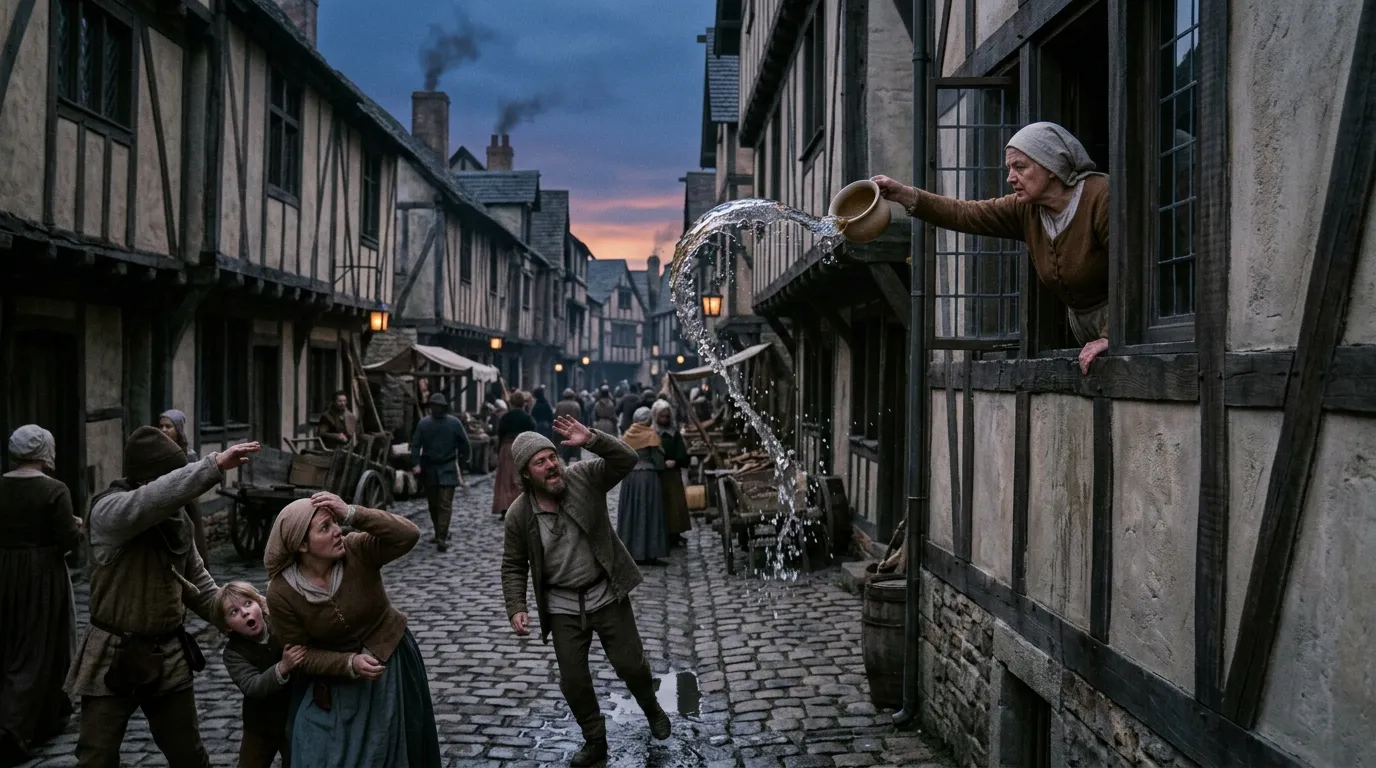
The British ‘loo’ likely comes from the terrifying medieval French warning to watch out for falling water.
Britain alone accounts for a remarkable number of linguistic alternatives. “Loo” is arguably the most widely used informal term across the UK today. Despite sounding quintessentially British, “loo” actually has a rather terrifying French origin. It is believed to be derived from the French phrase “guardez l’eau,” which translates to “watch out for the water.” This phrase gained massive popularity due to the frankly gross habits of medieval Europeans, who would shout it out of their bedroom windows right before emptying their chamber pots directly into the streets below. The British soon adopted this warning, but as it crossed the English Channel, the frantic shout of “guardez l’eau” morphed into “gardy-loo.” Over time, it was shortened simply to “loo” and was applied directly to the toilet itself.
“Lavatory” takes a much more scholarly and ancient route. The word comes from the Latin term “lavare,” meaning to wash. During the Medieval period, it evolved into “lavatorium” (which referred to a communal washbasin), before finally arriving at the modern English “lavatory” sometime in the 14th century.
Australia, true to form, takes a much more colorful and direct approach. Down under, people often use the cheerful slang “dunny” for their toilets. The word dates back to the 19th century during Australia’s colonial period. It most likely evolved from the old British word “dunnekin,” meaning “cesspit” or “toilet.” In the rugged early days of rural Australia, toilets were basic wooden structures located far outside the main house, often dramatically referred to as “outhouses” or “thunderboxes.” Even though almost all modern Australian homes have sparkling indoor flush toilets today, the warm, friendly term “dunny” remains a beloved staple of everyday conversation.
Each of these unique terms reveals something profound about the culture that invented it: the Victorian English impulse toward absolute discretion, the medieval French habit of screaming a warning before throwing waste into the street, and the Australian fondness for unpretentious, direct language dressed up in just enough slang to keep everyone smiling.
The Bigger Picture Behind a Small Sign
While it is fun to trace the linguistic quirks of the bathroom, the global spread of the WC as a physical concept was tied directly to one of the most significant public health advances in human history. Indoor plumbing is not just about convenience; it is a matter of life and death.
Poor sanitation is inextricably linked to the transmission of deadly diarrhoeal diseases such as cholera and dysentery, as well as typhoid, intestinal worm infections, and polio. Victorian-era Britain understood this painful reality all too well, having lived through devastating cholera outbreaks that were eventually traced directly back to contaminated public water supplies. The water closet was the ultimate weapon against these invisible killers.
However, the global reach of safe, reliable sanitation remains profoundly unfinished work. According to a sobering 2025 joint report from the WHO and UNICEF, the data from 2024 shows that a staggering 3.4 billion people still lack safely managed sanitation services. Furthermore, 1.9 billion have only basic services, 560 million have limited services, 555 million use completely unimproved facilities, and 354 million people continue to practice open defecation due to a total lack of infrastructure.
When viewed through this lens, the humble WC sign represents much more than an antiquated Victorian plumbing abbreviation. It is a symbol of a fundamental level of health, dignity, and infrastructural access that much of the world is still desperately working toward.
What This Means for You
The next time you find yourself wandering through a foreign airport, checking into a historic European hotel, or exploring an old municipal building in a new city, and you see that glowing WC on a door, you’ll know exactly what you’re looking at. It is a water closet—a term that started as a clever piece of Victorian social etiquette designed to let people ask for the toilet without blushing, and ultimately ended up as one of the most universally recognized architectural symbols on the planet.
The most practical takeaway for any modern traveler is simply this: WC is the magic label you need to look for when you’re navigating most parts of Europe, large swaths of Asia, and anywhere else in the world that caters heavily to international visitors. If you see it and you find yourself wondering whether the room includes a sink or a mirror, remember that it usually doesn’t. That serves as a fascinating historical echo of the fact that the original “water closet” was deliberately designed to be completely separate from a bathing room.
And if the sight of that sign still brings a smile to your face, just remember that those two little letters carry nearly 430 years of human history. They bridge the gap from a poet’s eccentric, smelly invention in Elizabethan England, to a Scottish watchmaker’s quiet but brilliant pipe modification, all the way to a universal global symbol that billions of people recognize every day without ever learning what it actually stands for.
That is an awful lot of incredible story packed into two little letters on a door.
If you found this article interesting, please SHARE it with your friends and family!
Note: All images used in this article are AI-generated and intended for illustrative purposes only.