
I was fifty-eight, living by myself.
A framed photograph of my daughter, Rachel, rested face-down on the mantel.
It had stayed that way for the past three years.
I had just switched off the lights and settled into bed when a sharp knock echoed from the front door.
It was nearly midnight.
I sat upright, my pulse quickening.
Another knock sounded from outside.
Who would come to my house at that hour, in weather like that?
I slipped into my robe and walked to the entrance.
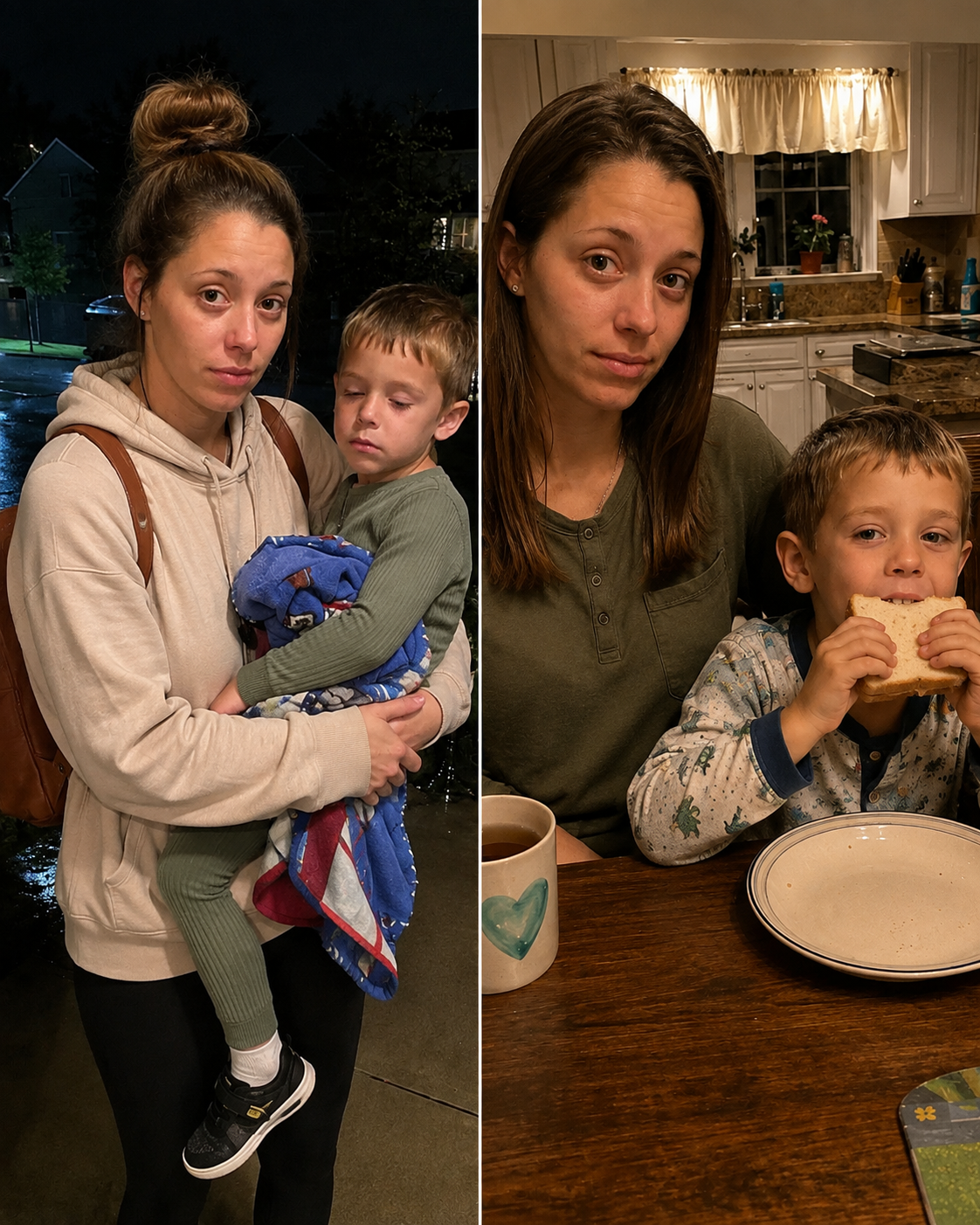
Standing on my porch was a young woman carrying a little boy who couldn’t have been older than four.
He had only one sneaker on.
She looked drained, with nowhere left to turn.
“I know this is a strange question,” she said quietly, “but could my son and I sleep in your guest room? Just for tonight. We’ll be gone before you wake up.”
Who would come to my house at that hour, in weather like that?
“I don’t even know your name,” I replied.
“Elena,” she said. “Elena. And this is my boy.”
The little boy’s head rested heavily against her shoulder.
He was struggling to keep his eyes open.
I watched him for a long moment, wondering whether I was about to make the biggest mistake of my life.
Then I moved aside.
I was making the biggest mistake of my life.
“Come in. You’ll catch your death out there.”
She paused, almost as if she’d never expected me to agree.
“Thank you,” she whispered. “You have no idea what this means to me.”
I filled the kettle and made peanut butter sandwiches while she bathed her son.
My hands moved automatically, remembering years gone by.
“There’s a towel on the rack,” I called down the hallway. “Clean ones are in the cabinet.”
“Come in. You’ll catch your death out there.”
“I found them,” she answered. “Thank you, Mrs. Ellison.”
I froze.
She must have seen my name on the mail sitting on the table.
It was the only explanation that fit.
I searched the closet and found a tiny pair of pajamas that had once belonged to my grandson.
I had bought them for a visit that never really happened.
She must have seen my name on the mail sitting on the table.
I hardly knew that little boy.
His name was Owen.
I could count on one hand the number of times I’d held him.
Elena carried her son into the guest room, and within minutes he was fast asleep.
“He hasn’t slept in a real bed in a while,” she said softly from the doorway. “I couldn’t give up. Not with him depending on me.”
I hardly knew that little boy.
“How old is he?”
“He turns five in the spring.”
I gave a small nod and looked away.
Rachel had once slept exactly like that, tiny and trusting.
Certain her mother could keep the world away.
The weight of those silent years pressed against my chest.
I gave a small nod and looked away.
“Get some rest,” I said. “The door locks from the inside if that makes you feel better.”
“I won’t need to lock it,” she replied. “Thank you for not being afraid of me.”
I returned to my bedroom, but sleep never truly came.
I lay awake listening to the rain, thinking about my daughter.
The final words we’d exchanged replayed again and again.
Most of all, I remembered her calling me unkind and cold-hearted.
“Thank you for not being afraid of me.”
Before dawn, they were gone.
The bed had been neatly made, the towels folded, and the borrowed pajamas placed carefully on the pillow.
A single folded note rested on the kitchen counter.
“You gave us hope. I’ll never forget your kindness.”
I read it twice.
Then I slipped it into my kitchen drawer beneath takeout menus and rubber bands.
A single folded note rested on the kitchen counter.
I convinced myself it had simply been one unusual night, already becoming a memory.
I believed I would never cross paths with that young woman or her little boy again.
I had no idea I had just set something much larger in motion.
The following morning, my sister Diane walked in as she always did.
We settled down with coffee.
Without giving it much thought, I told her about the woman and her son.
I had just set something much larger in motion.
She placed her mug down so hard it clattered.
“You let a stranger sleep in your house? At your age? Alone?”
“They needed somewhere to stay, Diane.”
“They could have been anyone. You don’t do things like this.”
“Maybe that’s the problem.”
Diane looked at me carefully.
“This isn’t about the boy,” she said gently. “This is about Rachel.”
“You let a stranger sleep in your house?”
I stood up and carried a perfectly clean plate to the sink.
“Rachel made her choices.”
“So did you.”
I kept my back turned toward her.
“I was trying to protect her. That’s what a mother does.”
“You called Marcus a mistake to her face,” Diane said quietly. “You said things a mother probably shouldn’t say.”
“Rachel made her choices.”
“He was unreliable.”
“He’s her husband. He’s the father of your grandson.”
“She stopped answering my calls, Diane. Three years. Not one call. Whose fault is that?”
Diane never looked away.
She had never been intimidated by me the way everyone else seemed to be.
“I’m not saying it’s all yours,” she replied. “I’m saying it isn’t all hers, either. You’ve spent three years keeping score. Has it made you less lonely?”
She had never been intimidated by me the way everyone else seemed to be.
I couldn’t answer her.
She left before noon, and the house became silent once more.
That was what my home had become.
The silence had its own shape, the shape of a girl who used to leave shoes in the hallway, slam doors, and call me at midnight just to tell me about her day.
Over the next two weeks, Elena’s note stayed tucked inside my kitchen drawer.
The house became silent once more.
I found myself opening that drawer again and again.
Each time, I reread the note.
Kindness.
A stranger had seen kindness in me during the middle of the night, something my own daughter no longer believed I possessed.
Each time, I reread the note.
One afternoon I sat at the kitchen table with a pen and a blank sheet of paper.
I wrote, “Dear Rachel.”
I reached the words, “I have been thinking about the last time we spoke, and I want you to know…”
Then I stopped.
Because the next truthful sentence was, “I was wrong.”
And I couldn’t bring myself to write it.
The next truthful sentence was, “I was wrong.”
I remained there for a long time.
Then I tore the paper in half, and then into halves again.
I dropped the pieces into the trash.
“She’s the one who left,” I told the empty kitchen.
The empty kitchen didn’t challenge me the way Diane would have.
Somehow, that made it even worse.
I tore the paper in half, and then into halves again.
That evening I called Diane.
“Do you think she’d even answer if I tried?”
“I think you’ll never know until you stop waiting for her to go first.”
“What if I apologize and she throws it back at me?”
“Then at least you’ll have said the true thing,” Diane replied. “You’ve been protecting yourself, but unless you take a risk and tell her you’re sorry, you’ll never know how she’ll take it.”
“What if I apologize and she throws it back at me?”
I ended the call feeling angry.
I stayed angry through washing the dishes and watching the evening news.
But I was beginning to realize anger was simply the coat pride wears when it gets cold.
By Saturday, the rain had returned.
I stood at my kitchen window holding Elena’s note.
Anger, I was beginning to realize, was simply the coat pride wears when it gets cold.
It occurred to me that showing kindness to a stranger was easy because a stranger never asked anything of my pride.
My daughter had asked everything of it.
Then headlights swept across the rain-soaked driveway.
A police cruiser pulled up to the curb.
My stomach tightened.
A police cruiser pulled up to the curb.
Two uniformed officers stepped out first.
Then the rear door opened.
Elena climbed onto the sidewalk.
She looked nothing like the frightened woman who had stood on my porch two weeks earlier.
Her clothes were neat and clean, her hair was tied back, and the burden she’d carried no longer showed in her posture.
The three of them walked toward my front door.
Two uniformed officers stepped out first.
I slipped the note into my pocket.
Then I opened the door.
One of the officers smiled politely.
“Mrs. Ellison?”
I nodded, unable to speak.
I opened the door.
“Don’t worry,” he said gently. “You’re not in any trouble.”
Elena offered a nervous smile.
Before I could ask what was happening, Elena spoke.
“This wasn’t my idea. Someone thought it might be better if we didn’t come alone… just in case.”
I frowned.
“Just in case what?”
“Someone thought it might be better if we didn’t come alone.”
A voice answered from behind the officers.
“Just in case this goes badly when you see me here.”
My heart stopped.
I knew that voice.
One of the officers stepped aside.
A woman I hadn’t noticed before was standing behind him.
I knew that voice.
She slowly raised her face.
Rachel.
My only child.
I couldn’t force a single word past my lips.
“Hello, Mom,” Rachel said.
Elena was the first to speak because neither of us could.
I couldn’t force a single word past my lips.
“I’m sorry to surprise you like this,” she said. “But I owed you an explanation, and I owed both of you something bigger.”
I held tightly to the doorframe.
“After that night,” Elena continued, “I caught a bus to a shelter I’d heard about. The Ellison Community Housing Program. They placed me in transitional housing. They also helped me find a job.”
“Ellison,” I whispered.
“I owed you an explanation.”
“That’s exactly what I told them.” Elena’s voice remained calm. “I told the director about the woman who welcomed me in on a rainy evening. I described the house. I said the name on the mail was Ellison.”
Rachel let her gaze drift around my small living room before looking back at me.
“I need to tell you something,” she said quietly. “The shelter Elena stayed at… I founded it.”
I stared at her.
“I need to tell you something,”
“After we stopped speaking, I couldn’t carry that anger any longer. So I poured it into helping women who had nowhere else to turn.”
I swallowed hard.
“I named it the Ellison Community Housing Program. I could have used my married surname, but I chose not to. There’s a reason for that.”
I was almost too afraid to ask.
“There’s a reason for that.”
“After everything that happened between us, ‘Ellison’ became the name I hated most. Every time I heard it, I thought about losing my mother while she was still alive.”
She lowered her eyes to her hands before meeting mine again.
“So I decided that if I was going to keep that name alive anywhere, it wouldn’t represent pride or pain anymore. It would represent kindness. Second chances. Mothers and children who simply needed someone to open a door.”
“I thought about losing my mother while she was still alive.”
Her voice grew gentler.
“I couldn’t change what the name meant to me growing up… but I could change what it meant to everyone else.”
She looked over at Elena.
“Then she came through the door and told me about a woman named Ellison who welcomed her when everyone else turned her away.”
Elena smiled.
“I could change what it meant to everyone else.”
One of the officers cleared his throat.
“It looks like you ladies have some catching up to do,” he said with a warm smile.
His partner tipped his hat.
“We’ll leave you to it.”
The front door clicked shut behind them.
For a long while, none of us said a word.
Then I turned toward my daughter.
The front door closed behind them.
“I’m sorry. I said terrible things to you,” I told my daughter. “Things a mother should never say. I’ve known it for three years, Rachel. I was too proud to say it out loud.”
Rachel looked at me as though she were waiting for more, for the excuse, for the twist that always came afterward.
It never came.
“That’s all,” I said. “That’s the whole truth. I was wrong, and I let three years pass instead of admitting it.”
“I was too proud to say it out loud.”
For a moment, no one moved.
Then Rachel pulled out one of the kitchen chairs and slowly, carefully, sat down at my table.
In that moment, I realized my daughter had decided to stay just a little longer than she’d intended.
“I’m not moving back into your life,” she said. “Trust takes time. I’m only cracking the door.”
“I know,” I replied. “I won’t push.”
She nodded, then reached into her handbag and removed a small envelope.
“Trust takes time. I’m only cracking the door.”
“I brought something.”
Inside were six photographs.
One showed a little boy in a soccer uniform, smiling at the camera with his front teeth missing.
Another captured him holding a birthday cake topped with seven candles.
The final photograph made me freeze.
“I brought something.”
Owen stood beside Elena’s son outside the shelter, both boys laughing together.
“They’re best friends now,” Elena said softly.
My eyes blurred with tears.
“The night you opened your door…” she said, “our boys found each other because of it.”
Rachel looked at me.
“Owen knows who you are.”
I blinked through tears.
“He does?”
“I’ve told him about his grandmother.”
I couldn’t find my voice.
“He asked me last week if he’d ever get to meet you.”
The room fell into a beautiful, aching silence.
“I told him…” Rachel said, her voice catching, “…that I hoped so.”
I couldn’t speak.
Before I could try, Elena spoke, her voice gentle but steady.
“Can I tell you something?” she asked. “About that night.”
I nodded because I couldn’t trust my own voice.
“I almost didn’t knock on your door,” Elena said. “I’d already been turned away by four other houses. Four. One man told me to keep walking. One woman shut the door before I even finished speaking.”
She looked directly at me.
“Can I tell you something?”
“I chose your door because of the porch light,” she said. “It was soft, not harsh. And there was a wind chime by the step. My mother had one just like it. She passed two winters ago.”
My breathing caught.
“I walked toward the light that felt like home,” Elena finished.
Rachel turned toward me, her eyes shining with tears.
“If you had turned her away, I would never have known you were capable of this kindness.”
“I walked toward the light that felt like home,”
And then I understood.
Elena knocking on my door had been the single accident that broke open everything I had allowed to grow hard inside me.
“I can’t give those years back,” I said. “I won’t pretend I can.”
“No,” Rachel agreed. “You can’t.”
But before they left, she stood, paused for a moment, and wrapped me in a hug.
The one accident in the world that could crack open everything
I held her only for as long as she let me.
Elena slipped a small card into my hand.
It was the shelter’s address.
“There’s a volunteer meeting Thursday,” she said. “If you want.”
That Thursday, I drove to the shelter without knowing whether Rachel would be there.
Without knowing whether Owen would ever call me Grandma.
“There’s a volunteer meeting Thursday,”
Even so, I went.
I took the same step I had once asked Elena to trust me enough to take.
A step across a doorway, with no promise that I would be welcomed.