
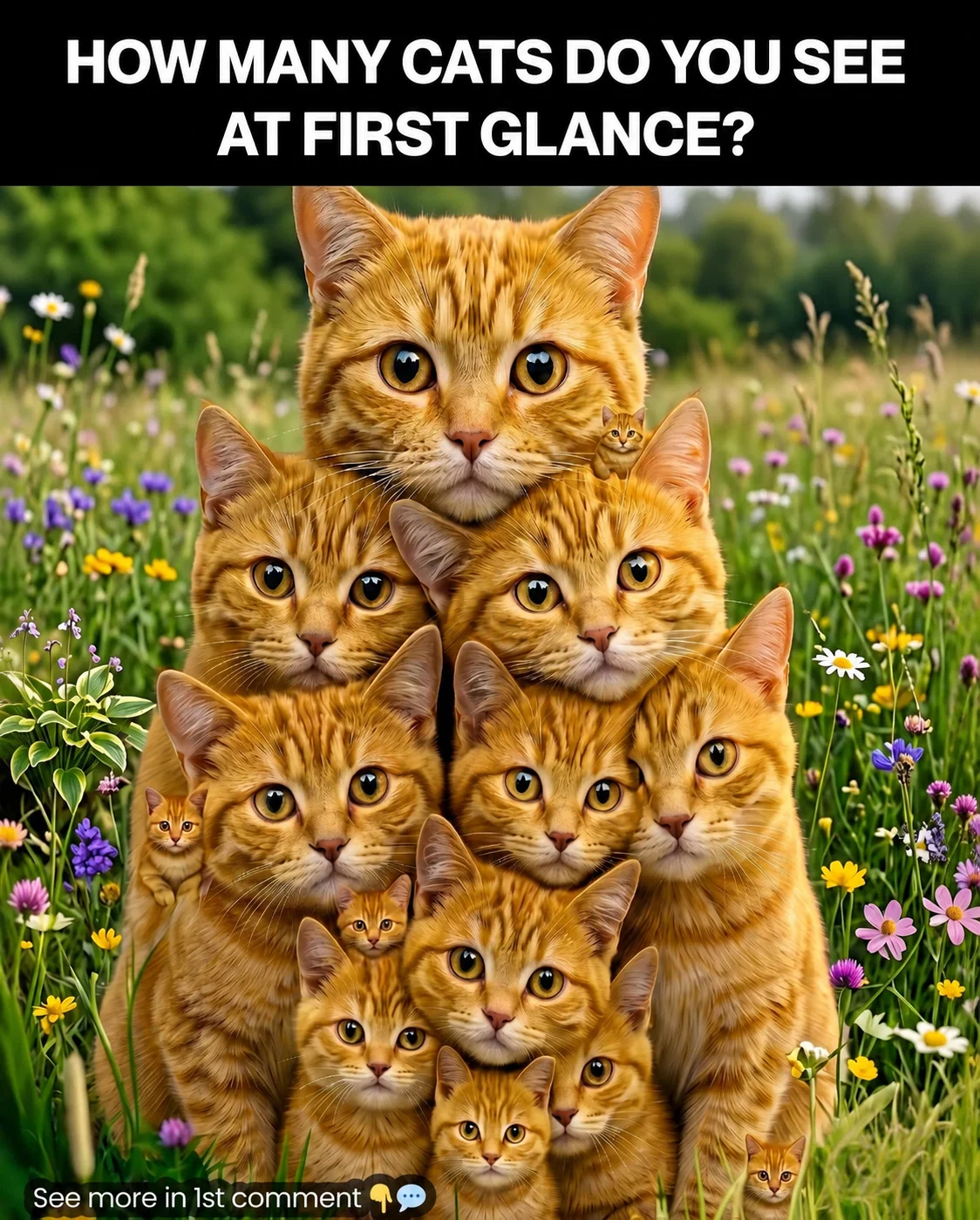
How Many Cats Are Hidden? The Viral Optical Illusion That Has Everyone Guessing
At first glance, the illustration looks completely ordinary: a sweet drawing of a fluffy orange cat family gathered together in a bright spring meadow.
Cute, cozy, and perfectly harmless.
But don’t let the gentle expressions and soft orange fur fool you. The image is actually a cleverly designed visual puzzle that has confused thousands of viewers.
The challenge sounds easy:
How many cats can you find in the picture?
Most people immediately answer:
- 5
- 7
- 9
However, according to the puzzle, the real number is much higher.
So why is this image so difficult? And why does the brain keep missing cats that are hiding in plain sight?
Let’s examine it more closely.
Why Your Brain Gets Fooled So Easily
When you first look at the picture, your brain naturally notices the largest and most obvious shapes.
This happens because our brains usually understand the overall scene before paying attention to smaller details.
Psychologists often describe this as global processing. It means the brain quickly searches for recognizable patterns so it can interpret what it is seeing as efficiently as possible.
In this puzzle, your attention is immediately pulled toward:
The giant cat at the top
The larger cats in the center
The clearly visible faces near the bottom
Once your brain thinks it has recognized the pattern, it often stops searching carefully.
That is exactly what makes this illusion so effective.
The Secret to Finding Every Cat
To discover the correct number, you need to stop viewing the picture as a single group.
Instead, inspect it slowly, almost like scanning every square of a grid.
Pay close attention to:
Small openings
Corners
Overlapping fur
Hidden outlines
Spaces between the larger cats
The tiny kittens are carefully blended into the artwork through:
Matching colors
Similar facial features
Strategic placement
Because of this, they are very easy to overlook during your first look.
The Hidden Total: 14 Cats
According to the explanation, the picture actually contains 14 hidden cats.
Here is where they are believed to appear.
Top Section – 2 Cats
The large cat at the very top is obvious.
But beside its cheek is a much smaller kitten face that blends naturally into the surrounding fur.
Second Row – 2 Cats
Just below the top cat are two medium-sized cats facing forward.
Most people notice both of them fairly quickly.
Middle Section – 4 Cats
Three larger cats are easy to spot in the middle of the image.
However, another tiny kitten face is concealed near the far-left side among the orange fur and leaves, making it easy to miss.
Hidden Gap Cat – 1 Cat
A small cat face is tucked into the empty space between two larger cats.
This one is especially difficult because the brain often treats that area as part of the background.
Bottom Area – 4 Cats
The lower portion of the picture contains several overlapping cats.
Most viewers immediately see two or three, but a tiny hidden kitten beneath the central cat’s chin is commonly overlooked.
Final Hidden Cat – 1 Cat
The last cat is believed to be concealed near the lower-right corner, carefully blending into the grass.
For many people, it is one of the most difficult cats to notice.
What Your Answer Could Reveal About Your Personality
Some people also enjoy linking this puzzle to personality traits based on the number of cats they spotted during their first attempt.
If you counted 5 to 7 cats, you may naturally focus on the most obvious details first. You are practical, think quickly, and prefer straightforward information instead of examining every tiny clue.
If you found 8 to 11 cats, you probably have strong observation skills. You tend to notice more than most people and are curious, patient, and willing to look beyond what first appears.
If you spotted 12 to 14 cats, you may have an exceptional eye for detail. You are likely analytical, careful, and highly skilled at recognizing small patterns that others often overlook.
Of course, this is simply for entertainment rather than a real psychological assessment. Still, it adds another enjoyable element to the puzzle and encourages people to compare their results.
Why Optical Illusions Like This Capture So Much Attention
Visual brain teasers become popular because they demonstrate how the mind processes what we see.
Although your eyes may capture every detail, your brain filters information to avoid becoming overloaded.
This relates to a phenomenon called inattentional blindness, where visible objects are missed because attention is focused elsewhere.
This puzzle becomes even more challenging because:
Every cat shares the same orange coloring
Their facial features are extremely similar
They appear in very different sizes
Many of their shapes overlap
Together, these characteristics force the brain to repeatedly adjust its focus, depth perception, and pattern recognition.
Were You Able to Find All 14?
If you discovered every hidden cat without any assistance, congratulations. You probably have excellent attention to visual detail.
If you missed several, don’t worry.
Most people fail to notice a number of the hidden faces on their first attempt because the image is intentionally designed to confuse pattern recognition.
That is exactly what makes optical illusions so captivating.
They encourage us to slow down, observe more carefully, and question what we believe we are seeing.
Sometimes, the hardest things to notice are the ones hiding right in front of us.