
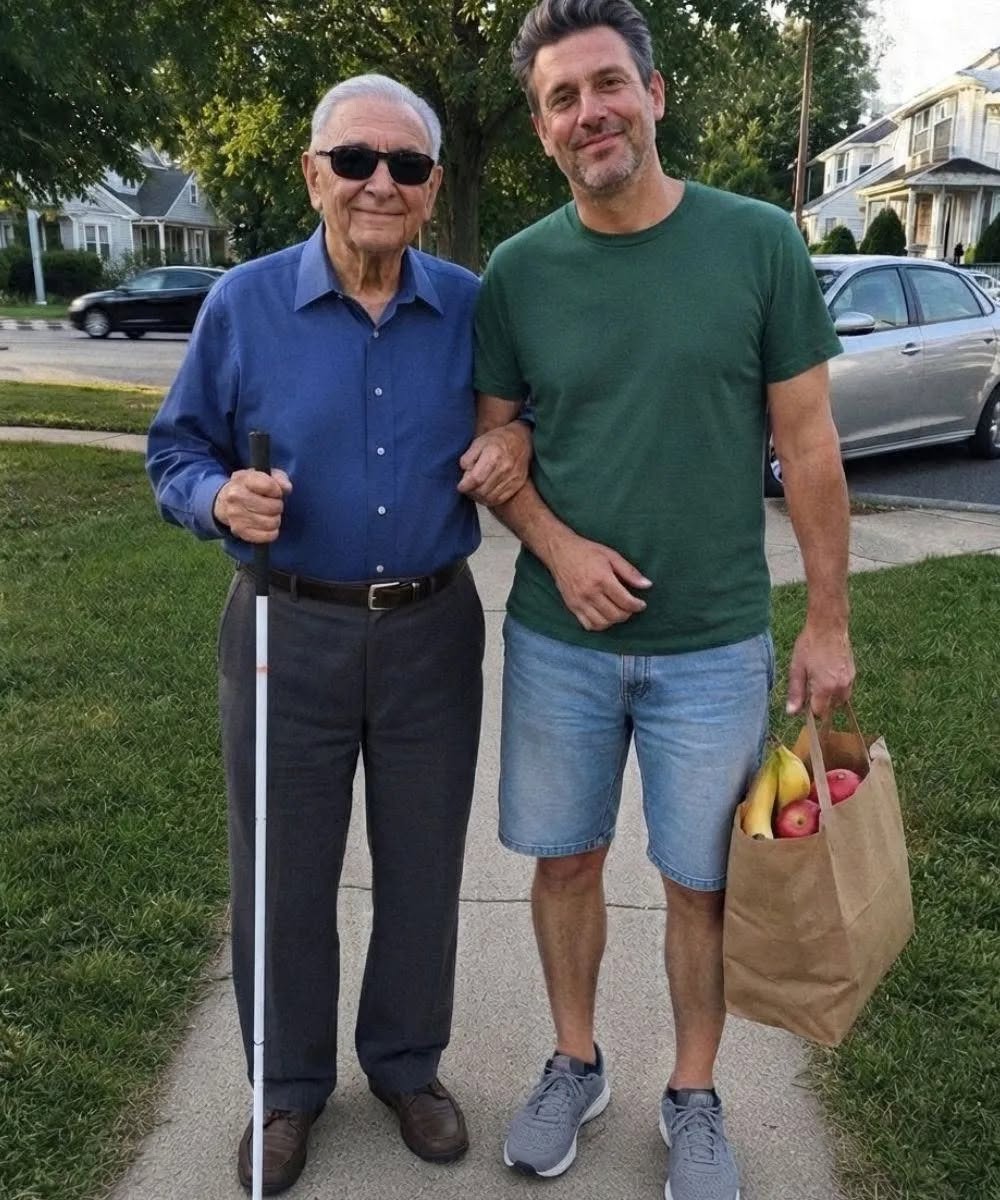
For eight long years, I found comfort in a simple routine: I believed my father spent every Thursday afternoon attending medical checkups, stocking up on groceries, and sharing a quiet lunch with our longtime neighbour, Ben.
I was completely wrong.
A decade earlier, Dad had received a devastating glaucoma diagnosis. By the time the doctors caught it, the optic nerve damage was severe. Within two years, his vibrant world had faded into little more than moving shadows and grey shapes. Yet, despite his failing vision, he flatly refused to leave the old family home where he had lived with my mother.
“The hallway wall still has the dent from when you crashed your bicycle inside the house,” he would tell me, his voice softening with memory. “Leaving this place would feel like losing forty years with her all over again.”
I lived nearly a thousand miles away, constantly juggling two children, a demanding corporate career, and a busy marriage. Dad was stubbornly independent and managed most routines by touch and memory, but he genuinely needed safe transportation for his clinic checkups, prescription pickups, and weekly errands.
That was when Ben—his retired neighbour and closest friend—stepped in to help.
Every Thursday, I paid Ben to drive Dad wherever he needed to go. It wasn’t about charity; it was an arrangement that gave me profound peace of mind from across the country.
Dad and I spoke on the phone every single evening. He would tell me stories about meals he had cooked entirely by touch, complain about terrible narrators on his audiobooks, and chuckle over checkers games that Ben had supposedly thrown on purpose just to boost his spirits.
Sometimes, our calls overlapped with Ben’s arrival, and I could hear the familiar banter through the receiver.
“Your royal carriage awaits!” Ben would announce from the front hallway.
Dad never missed a beat: “It smells like old coffee and poor decisions!”
Their shared laughter always drifted through the line, making the thousand-mile distance between us feel just a little bit smaller.
And then, without warning, Dad died peacefully in his sleep.
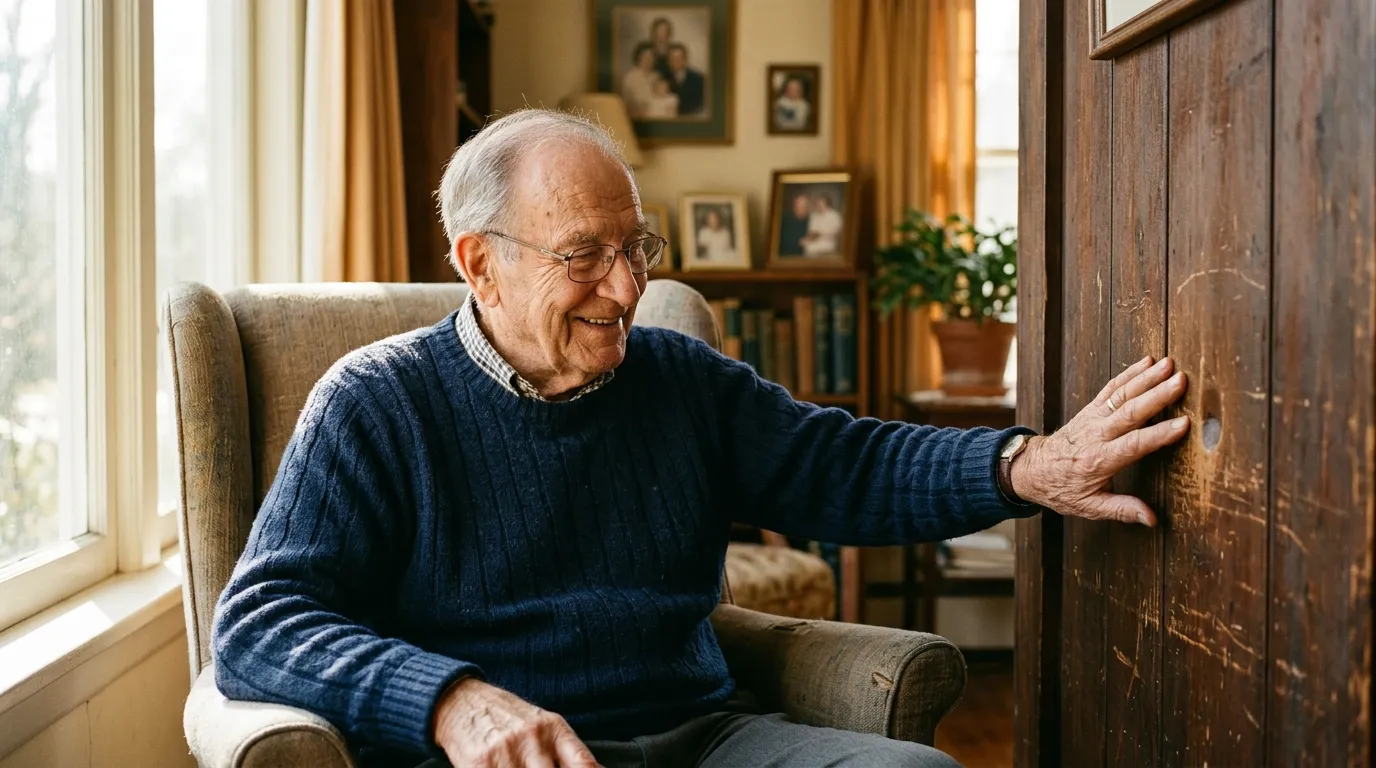 Even as the shadows closed in, the memories held in the walls kept him grounded.
The funeral passed in a surreal, exhausting blur. Well-meaning people brought casseroles, shook my hand, and repeated how deeply proud he had always been of me.
Yet, through the haze of grief, my mind kept circling back to our very last phone call.
“Thursday was productive,” he had said, an unusual lilt in his voice.
When I pressed him on what that meant, he just laughed his raspy laugh and told me not to interrogate an old man. I promised I would call him back the following day to pry the secret out of him.
There was no following day.
After the burial concluded and the crowd dispersed, I lingered beside the freshly turned earth while a light rain began to fall. That was when Ben walked over to me, holding a thick, sealed envelope across his chest. My name was scribbled across the front in Dad’s familiar, uneven handwriting.
Ben’s hands trembled visibly as he extended it toward me.
“Your father made me swear a promise,” Ben said, his voice thick with grief. “He told me that once he was gone, I had to tell you where we really went on Thursdays.”
I smiled faintly, assuming he meant trips to riverboat casinos, hidden hole-in-the-wall diners, or some harmless escapade Dad had kept under wraps because he knew I worried too much.
Ben shook his head slowly.
“I wasn’t just driving him around to pass the time. The destinations mattered, sure—but what we were actually doing during those hours mattered so much more.”
Then, standing in the drizzle, he told me about Claire.
Claire was Ben’s only daughter. They hadn’t spoken properly in years; according to Ben, every attempt at conversation over the past decade had disintegrated into a bitter argument.
Dad, sharp as ever despite his eyes, had noticed how Ben always grew quiet and withdrawn whenever I mentioned my own children during our chats.
One Thursday, while sitting in the passenger seat, Dad finally demanded to know what had broken between them.
At first, Ben blamed Claire entirely. He called her stubborn, complained that she never made time to visit, and insisted she had built a modern life that deliberately excluded him.
Dad refused to let him hide behind excuses.
Pressed by Dad’s quiet persistence, Ben eventually confessed the darker truth: for years, he had showered Claire with critical, unsolicited remarks about her career choices, her marriage, and the way she was raising her children. He defended it by claiming he only acted out because he missed her desperately and didn’t know how to bridge the gap.
Dad’s response was typically blunt and uncompromising.
“You miss a lot of things, Ben,” Dad had told him. “You miss your daughter, and right now, you’re missing your chance to make peace with her before it’s too late.”
That very same morning, Dad ordered Ben to turn the car around and drive straight to the public library.
Part 2: Dad’s Secret Project
At the library, Dad sat quietly at a nearby table while a remarkably patient staff member taught Ben the basics of digital communication—how to attach photographs, record short voice messages, and phrase texts without sounding defensive or judgmental.
Whenever Ben grumbled about the technology, Dad would remind him that Claire had spent her entire childhood learning hard things just to make her father proud. Learning a few buttons on a screen was the least he could do for her.
The following Thursday, their itinerary shifted to a local bakery, where they bought fresh ingredients for cinnamon rolls—the exact childhood treat Ben used to bake for Claire on special weekends.
They took the groceries back to Dad’s house and practiced in his kitchen.
The first batch came out charred and black.
The second batch looked fine on the outside but remained doughy and raw in the middle.
Ben immediately blamed Dad’s aging oven.
Dad countered by blaming the stubborn baker who had forgotten to set the timer.
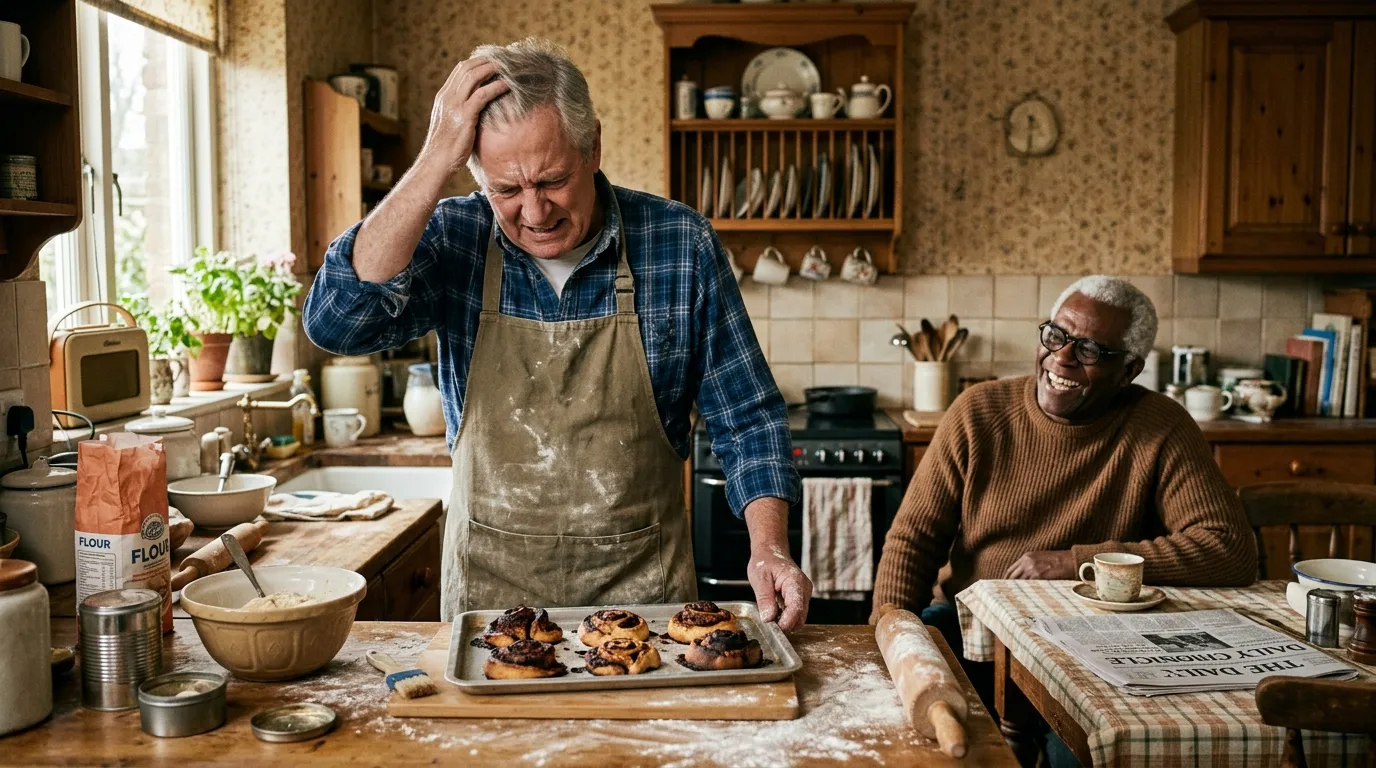 Between burnt sugar and raw dough, two old friends worked on a recipe for forgiveness.
Once the baking was underway, the lessons turned to apologies.
Ben tried recording a spoken apology in the car. Dad listened to it and made him delete it. He tried drafting another version over lunch. Dad rejected that one too.
Exasperated, Ben finally demanded to know what on earth Dad expected him to say.
“Stop defending yourself,” Dad told him plainly. “Stop explaining your side. Just tell her why she matters to you.”
The thick envelope Ben had just handed me at the cemetery contained multiple drafts of those handwritten letters. Over their Thursday sessions, Ben had read every single attempt aloud. Dad had listened intently, pointing out which sentences sounded hollow, which lines were veiled excuses, and which rare words finally revealed a father’s genuine remorse.
The last letter in the stack bore no corrections.
Dad had declared it ready.
Yet, even with the perfect letter in hand, Ben’s courage had faltered. He couldn’t bring himself to deliver it.
That was when Dad gave him one final, solemn instruction: if anything happened to him, I was to be told the truth, and I was supposed to make sure Ben finished the journey they had started.
A sudden wave of anger surged through my chest.
I had buried my father less than an hour ago. My heart was raw, and now Ben was piling another heavy emotional responsibility onto my shoulders.
I pushed the envelope back toward him. “I cannot do this for you today, Ben.”
Ben nodded humbly, not offended by my resistance.
“There is another note inside,” he said softly. “That one is just for you.”
My resolve broke. I couldn’t walk away from one final message written by my father.
I pulled out the smaller sheet of paper. On it, Dad explained that Ben had given him the gift of true freedom every Thursday without ever making him feel like a helpless burden.
He wrote how Ben would casually describe kerbs, doorway steps, menu items, and passing faces so Dad always understood his surroundings without asking. Ben waited patiently during endless medical appointments, but he always stepped back so Dad could answer the doctors himself. He offered his arm without ever making Dad feel small.
Helping Ben repair his broken relationship with Claire, Dad wrote, was simply his way of returning that profound dignity.
Then my eyes hit the two lines that completely broke my heart:
You may believe I was hiding something from you. I was.
I was hiding how useful I still felt.
I read those words three times through blurred eyes.
Those Thursday afternoons hadn’t just been about transportation or errands. They had given my father purpose at a time when his body was taking his independence away.
He was still a mentor, an advisor, and a protector. Even as the visual world faded from him, he had found a meaningful way to reshape another family’s future.
I folded the note, took a deep breath, and looked up at Ben.
“I will go with you,” I said, my voice steadying. “But I will not speak for you. I will only stand beside you—the exact way you stood beside Dad.”
The very next morning, we drove three hours north to Claire’s home.
During the drive, Ben rehearsed his speech over and over. But every spoken draft started with a half-hearted regret and quickly devolved into an explanation of why the estrangement wasn’t entirely his fault.
Each time he drifted into excuses, I intervened.
“That part is an excuse, Ben. Strip it out.”
By our fourth correction, he looked ready to grab the letter and toss it out the passenger window onto the highway. To keep him honest, I took the envelope and locked it safely inside the glove compartment.
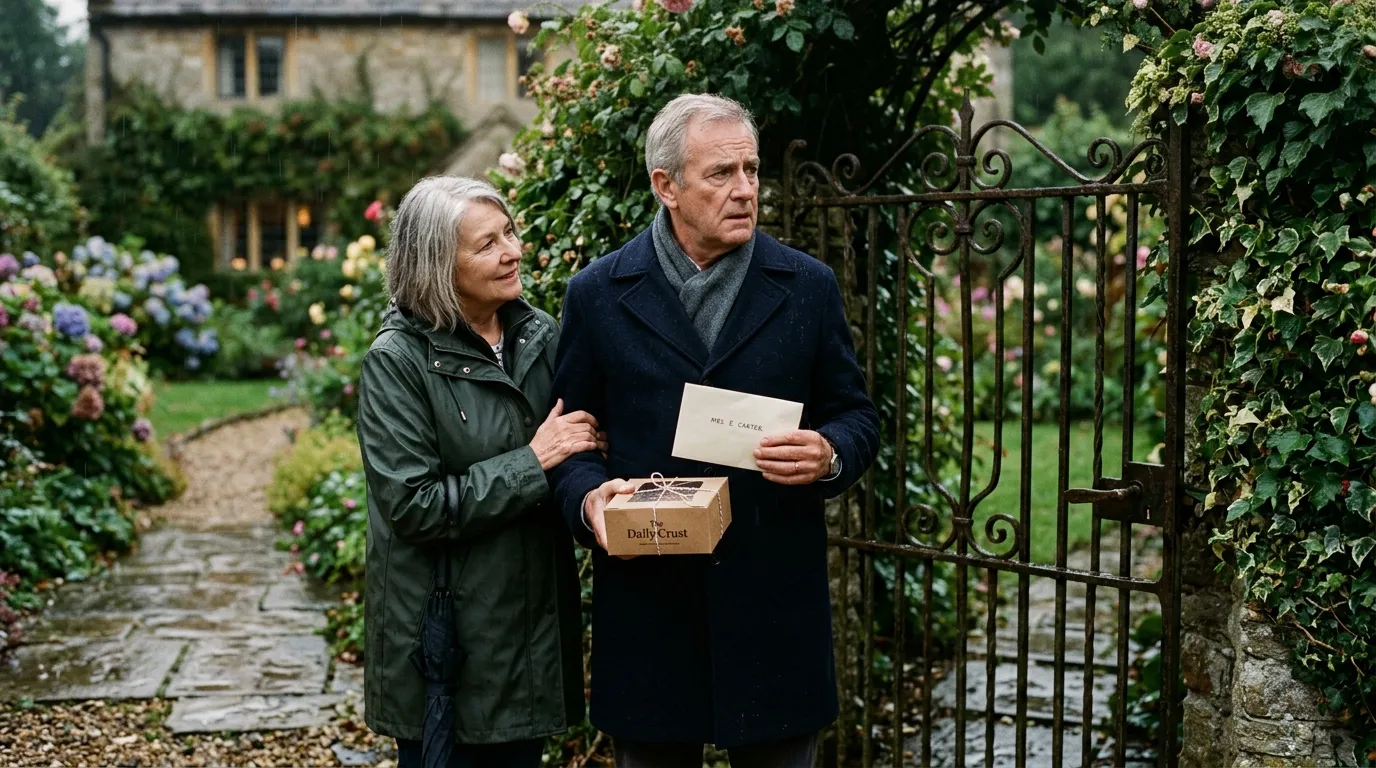 Three hours of driving led to the hardest few steps Ben had ever taken.
When we finally pulled up to Claire’s house, she was working in her front yard, wearing stained gardening gloves. As she stood up to face us, I saw immediately that she had Ben’s eyes and the exact same stubborn set to her jaw.
“You should have called first,” she said, her voice icy and guarded.
Ben’s shoulders dropped; his instinct to retreat was undeniable.
I stepped up close beside him and murmured Dad’s final rule: “Tell her why she matters.”
Part 3: One Thursday Call
Ben took a steadying breath and extended the envelope along with a warm box of cinnamon rolls.
“I spent years protecting my own pride, Claire,” he said, his voice raw. “I waited around for you to come back to me because admitting that I hurt you meant I had to admit I was wrong.”
He swallowed hard, holding her gaze.
“I was wrong. And far worse than that—I made you feel as though you did not matter to me.”
Claire didn’t rush forward to embrace him. She didn’t offer instant forgiveness.
For several agonizing seconds, she stood motionless, looking as though she might turn around and walk back inside.
Then her eyes dropped to the pastry box. She popped the cardboard tab and let the scent of fresh cinnamon and sugar drift out.
“They might taste terrible,” Ben admitted quickly. “His father refused to even finish one of them.”
Claire’s head snapped up, looking at me.
“Your dad helped him do this?”
I nodded silently.
A faint, knowing smile touched the corners of her mouth. “That makes sense,” she murmured. “This old badger would never apologize on his own.”
She unlatched the garden gate and motioned for us to come up to the porch.
We sat together on her wooden deck for nearly two hours. Ben laid everything out—the trips to the library, the messy baking trials, the deleted audio recordings, and the long afternoons spent dissecting his own pride at Dad’s kitchen table.
In turn, I shared stories about my daily phone calls with Dad, his terrible jokes, and the quiet ache of the empty armchair sitting in his living room. Speaking his name aloud to people who understood his warmth helped soften the sharpest edges of my grief.
Halfway through our conversation, Claire went inside and returned with a small wooden keepsake box. She opened it to reveal a handful of unsigned postcards she had received in the mail over the past several months.
She handed the first one to Ben. It read:
Your father remembers more than he knows how to say.
The second card read:
He still makes cinnamon rolls badly.
The third simply said:
Pride takes its toll. I think he is growing tired of it.
Ben stared at the familiar script in utter disbelief. He hadn’t written or mailed a single one of them.
Dad had.
While helping Ben craft his apologies, my father had been quietly preparing Claire’s heart from afar, laying down the tracks for both sides of the reconciliation.
Claire pressed her father’s unread letter against her chest, her eyes bright with tears.
“I cannot pretend that everything is instantly repaired between us,” she told Ben honestly. “I don’t fully trust you yet.”
Ben nodded without hesitation. “You don’t have to.”
She considered him for a long, quiet moment.
“One phone call every Thursday,” she said finally. “We start there.”
“I will,” Ben promised.
During the three-hour drive home, Ben apologized for continuing to take my weekly payment checks even after their Thursday outings had transformed from medical trips into a personal reconciliation project. He admitted that Dad had strictly forbidden him from refusing the money, arguing that I would immediately become suspicious if the financial arrangement changed.
Even at the very end, Dad had been quietly managing us both.
The following Thursday morning, I was still at Dad’s house, packing up old tools and sorting through shirts that still held his comforting scent.
Right at nine o’clock, I heard tires crunching on the gravel outside. Ben’s car was idling in the driveway—he had driven over out of pure, ingrained habit.
I walked out onto the front porch carrying two travel mugs of coffee.
“I assume the royal carriage still operates on Thursdays?” I asked.
Ben glanced up at Dad’s empty front window, a wistful smile touching his face. “The carriage feels rather empty today.”
We decided to take a drive anyway.
He steered us through the familiar streets, passing the public library, the bakery with its morning crowd, and the eye clinic Dad had visited for years.
Suddenly, the car’s Bluetooth system chimed. A name lit up across the dashboard display: Claire.
It was Thursday. Exactly as promised.
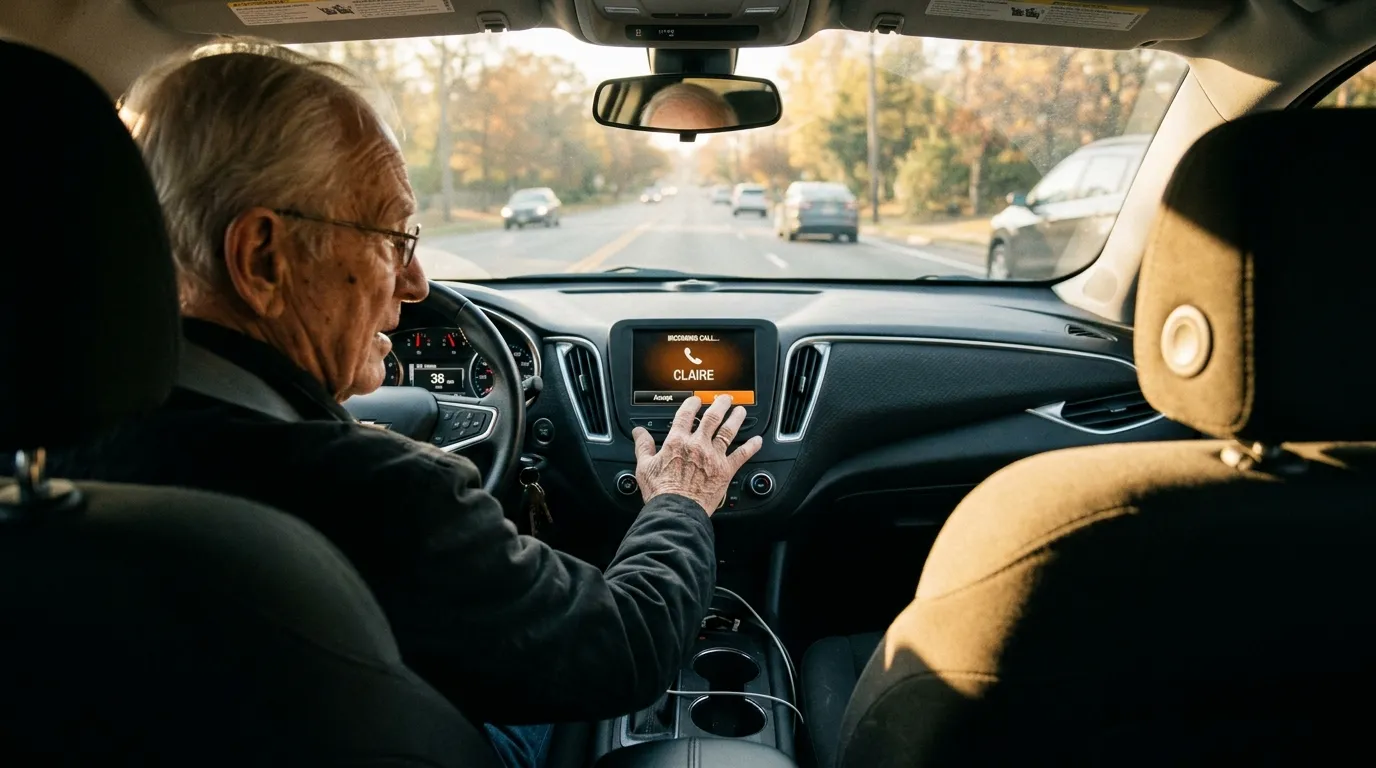 A simple name on a dashboard screen, marking the start of a brand-new routine.
Ben’s hand hovered over the receive button, his face tightening as he paused to mentally rehearse an opening line.
I reached across and gently touched his wrist.
“No rehearsal,” I reminded him.
He nodded, pressed the button, and spoke toward the microphone.
“Hello, Claire.”
His voice shook with nervous emotion. For a lingering second, the quiet interior of the car felt painfully heavy and still.
Then the speakers crackled warmly, and Claire’s voice filled the cabin:
“Hello, Dad.”
Ben let out a long, trembling breath—the sigh of a man who had been holding his breath for a decade.
I turned my head to look at the empty passenger seat where my father should have been sitting. In my coat pocket, my fingers brushed against the folded creases of his final note.
He had spent the last years of his life proving that losing his sight never meant losing his power to make a difference. Every single Thursday, he had guided a stubborn father along the difficult road back to his daughter.
And in doing so, he had left behind one final lesson: showing me how to keep helping others long after he was gone.
Note:This work is inspired by real events and people, but it has been fictionalized for creative purposes. Names, characters, and details have been changed to protect privacy and enhance the narrative. Any resemblance to actual persons, living or dead, or actual events is purely coincidental and not intended by the author.
All images used in this article are AI-generated and intended for illustrative purposes only.