
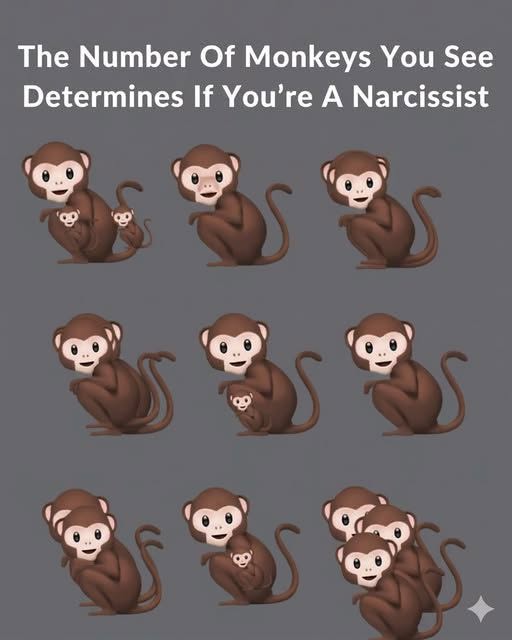
At first glance, this image looks like nothing more than a fun cartoon puzzle filled with rows of smiling monkeys. But then you notice the bold statement that goes along with it: “The number of monkeys you see determines if you’re a narcissist.” It’s an attention-grabbing claim that instantly sparks curiosity and makes you want to take a closer look.
Without even realizing it, most people immediately begin counting the monkeys. Some reach a number almost instantly, while others pause, look again, and discover shapes or hidden monkeys they didn’t notice the first time. What seemed like a simple picture suddenly becomes much more interesting.

Your Brain Sees More Than Just a Picture
Although the puzzle appears to be about counting monkeys, it’s actually a fascinating example of how the human brain processes visual information. Our eyes collect the image, but it’s our brain that decides what stands out, what blends into the background, and what deserves our attention.
Every person processes visual information a little differently. Some people naturally focus on the overall image first, while others immediately notice small details. This is why two people can look at the exact same picture and come up with different answers without either of them being wrong.

Your previous experiences, attention span, focus, and even the way your brain recognizes patterns all influence what you notice first. Optical puzzles like this remind us that seeing isn’t always as simple as it seems.
Does the Puzzle Really Measure Narcissism?
The short answer is no.
Despite what the headline suggests, there is no scientific evidence that the number of monkeys you count can determine whether someone is a narcissist. Claims like this are commonly used on social media because they encourage people to stop scrolling, test themselves, and share the image with friends.
While these statements make the puzzle more entertaining, they shouldn’t be taken as real personality assessments or psychological tests.
What the Puzzle Can Actually Tell You
Even though it can’t diagnose personality traits, this visual challenge can still reveal something interesting about how you observe the world.
- If you quickly settle on a number, you may naturally trust your first impression and focus on the overall picture.
- If you keep searching and find additional monkeys, you may enjoy examining details and looking for hidden patterns before reaching a conclusion.
- If you change your answer after taking another look, it simply shows that your brain continues to gather and process new information.
None of these responses is better than another. They simply reflect different ways that people naturally observe and interpret visual information.
Why Optical Illusions Are So Popular
Optical illusions and visual puzzles continue to fascinate millions of people because they challenge our expectations. They remind us that our brains don’t simply copy what our eyes see—they actively interpret every image we look at.

Sometimes our minds fill in missing details. Other times they overlook something that’s hiding in plain sight. That’s what makes these puzzles so enjoyable and why people often compare their answers with friends and family.
The fun isn’t necessarily about finding the “correct” number. It’s about discovering how differently each person experiences the very same image.
The Takeaway
Whether you spotted only a few monkeys or found many more after taking a second look, the result doesn’t determine your personality or reveal whether you’re a narcissist.
Instead, puzzles like this celebrate the incredible way our brains process information. They encourage us to slow down, look more carefully, and realize that there’s often more to see than what first meets the eye.
So the next time an image challenges your perception, don’t rush to an answer. Take another look—you might be surprised by what your brain discovers the second time around.
Note: All images used in this article are AI-generated and intended for illustrative purposes only.