
My husband, Dean, planted our apple tree twelve years ago, just a few short months before he passed away. Looking back, the memory is both profoundly beautiful and heartbreakingly fragile.
Dean had already been battling his illness for quite some time, though neither of us liked admitting out loud just how serious things had become. The disease was stealing his strength day by day. Even carrying a small bag of potting soil left him breathless and pale, leaning against the shed for support. Yet, he remained absolutely determined to plant that young apple sapling with his own two hands.
“This is the best place,” he said, pointing a trembling finger toward a warm, sunny corner of our backyard.
I gently reminded him that his doctor had strictly forbidden any heavy lifting or strenuous activity.
“It’s a tree, Sloane,” he replied, flashing that familiar, crooked grin I loved so much. “Not a weightlifting competition.”
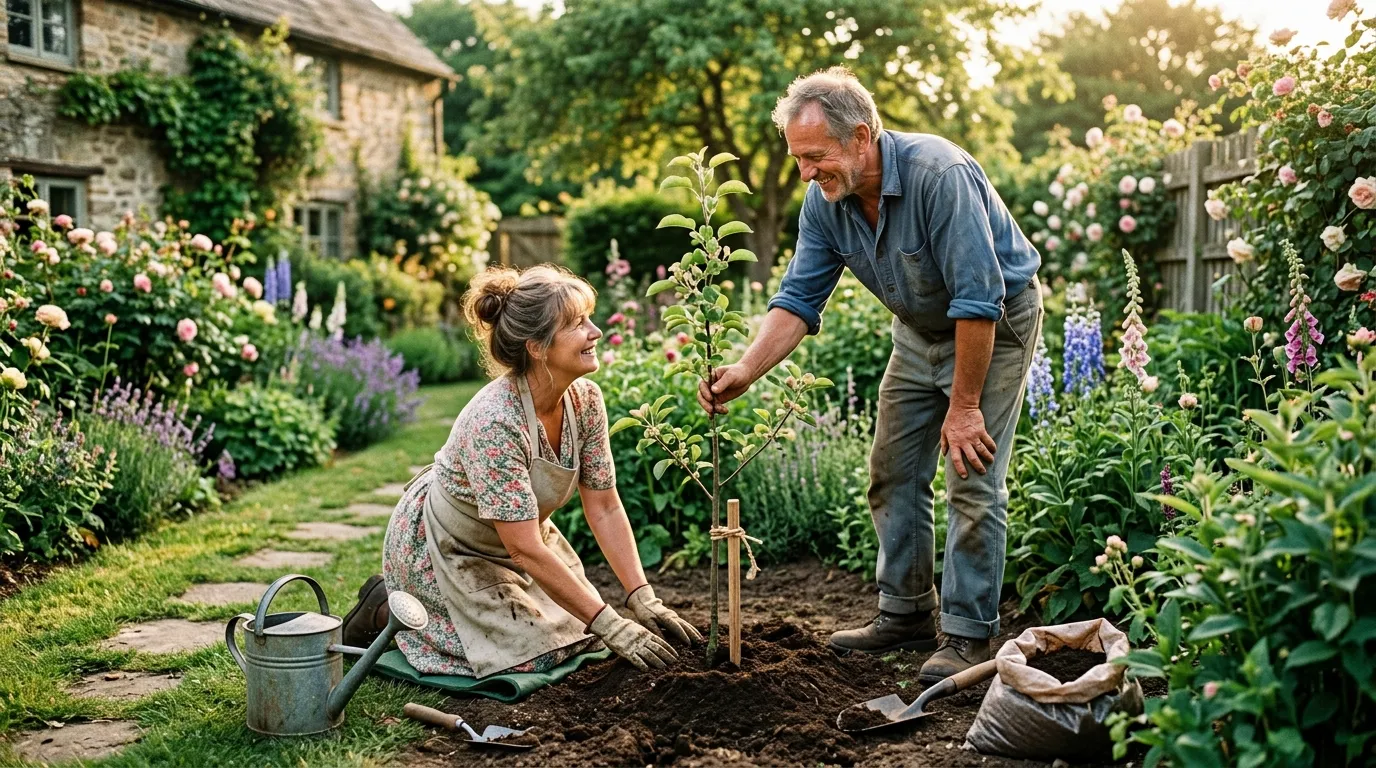 Dean insisted on planting the tree himself, despite his failing health.
We planted it together. In truth, I did most of the heavy digging while Dean sat nearby on a garden chair, acting as the foreman and offering cheerful instructions. When the hole was dug and the roots were settled, he walked over and placed one hand gently against the incredibly thin trunk.
“Give it time,” he whispered, almost to the tree itself. “It’ll surprise you.”
Dean passed away four months later, leaving a quiet void in my life that felt impossible to fill.
The Silent Years and the Sudden Bloom
For two agonizingly long years, the tree produced absolutely nothing. It just stood there, a stark, barren stick in the corner of my yard. I honestly nearly had it removed several times, because looking out my kitchen window and seeing it brought back a wave of grief so heavy I could barely breathe.
Then, one crisp spring morning, it finally bloomed. The branches were suddenly covered in delicate white and pink flowers.
The following autumn, that little tree produced exactly twelve apples. I know this for a fact because I went out and counted every single one of them.
As the years passed, the tree grew taller, its roots digging deeper and its branches stretching wider. It grew stronger, just as I was slowly learning to do. Soon, it produced enough fruit for pies, warm cider, homemade applesauce, and extra for the neighbors and children who came knocking to politely ask if they could pick one. I always said yes.
The tree had become a beloved fixture of the neighborhood, but to me, it was infinitely more precious. It remained one of the last living things Dean had touched. It was a breathing monument to his optimism.
Then, Ryan moved into the house next door.
The New Neighbor
Within mere weeks of his arrival, Ryan stripped away every ounce of charm from his property. He replaced his charming old mailbox with a stark metal one, ripped out every colorful flower from his front garden, and covered the bare earth with a sterile blanket of white landscaping stones.
One sunny afternoon, he knocked briskly on my front door. The moment I opened it, he pointed a stern finger toward my backyard.
“We need to discuss your tree,” he announced, skipping any form of friendly introduction.
“The apple tree?” I asked, slightly taken aback. “It’s beautiful, isn’t it?”
“It’s messy,” he snapped back. “Its branches cross the property line over the fence, and the fruit falls into my pristine garden.”
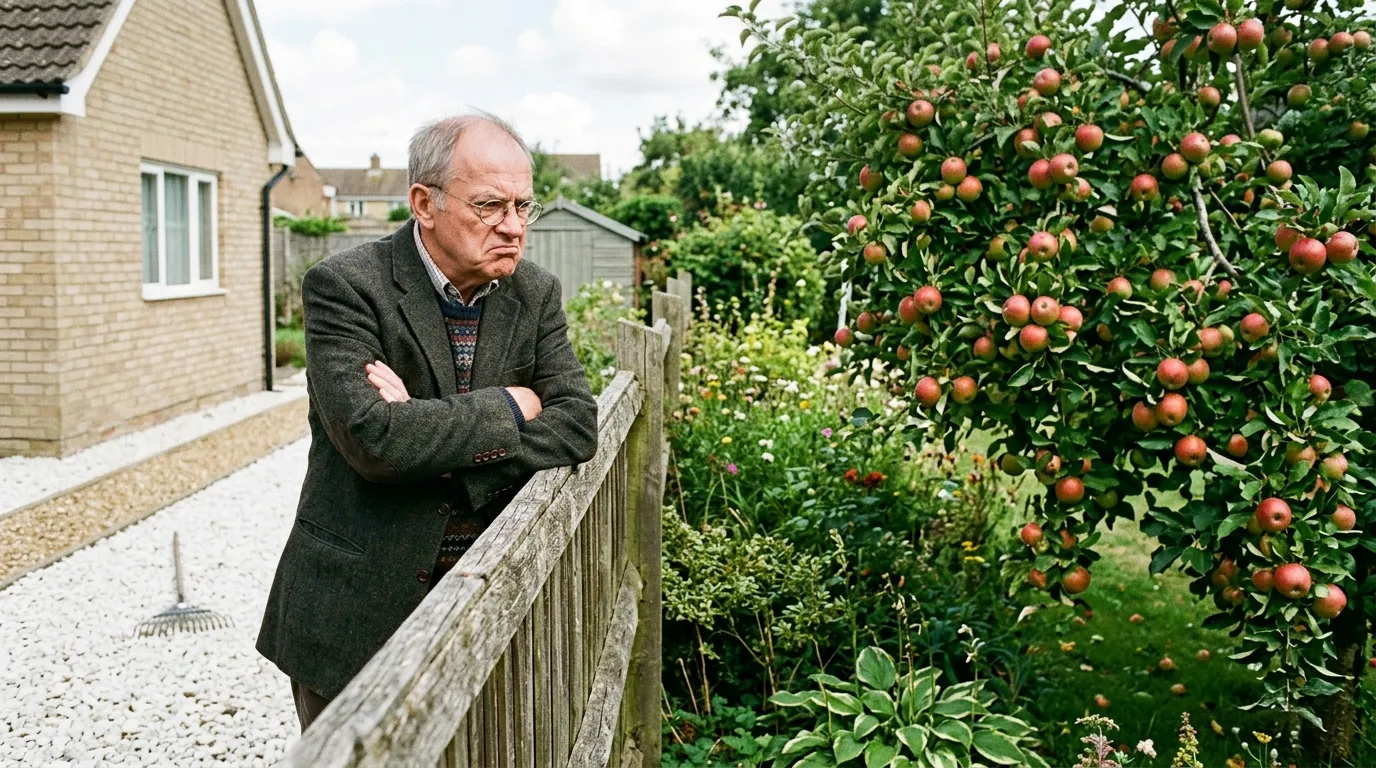 Ryan made it clear from day one that he despised the beautiful apple tree.
Wanting to keep the peace, I immediately offered a compromise. I told him I would gladly hire someone to trim the overhanging branches and personally collect any stray apples that happened to drop onto his property.
Ryan shook his head emphatically.
“I don’t want it trimmed,” he declared. “I want it removed entirely.”
“That is not happening,” I said, my voice steady but firm.
He puffed up his chest and began lecturing me in a condescending tone about property values, hypothetical insect infestations, and neighborhood aesthetics. I calmly reminded him that the trunk of the tree stood entirely on my land.
His expression hardened into a scowl. “You may not like what happens next,” he threatened.
The very next morning, I hired a professional to cut back absolutely every branch that dared to cross the fence line. Nothing from Dean’s tree would ever fall into Ryan’s sterile rock garden again. That reasonable action should have been the end of the disagreement.
Instead, Ryan’s complaints only escalated.
He claimed the roots were maliciously tunneling toward his foundation to destroy it. He said the mere presence of apples attracted swarms of rodents. Eventually, when his intimidation tactics failed, he filed a formal, lengthy complaint with our homeowners’ association.
Mira, our no-nonsense HOA representative, came out to inspect the situation. She found zero violations.
“The tree is firmly on Sloane’s property,” she firmly explained to Ryan. “You are not allowed to damage it, touch it, or demand its removal.”
After that humiliating defeat, Ryan stopped speaking to me altogether. But he did not stop watching. Whenever I was outside watering the hydrangeas or weeding the flowerbeds, I could feel the heavy weight of his eyes tracking my every move from behind his kitchen blinds.
His lingering hostility unsettled me. That was exactly why I quietly ordered a trail camera online and installed it deeply hidden inside a thick hedge, angled perfectly to capture the tree and my garden gate. I prayed I would never actually need to check the footage.
The Night of the “Strong Wind”
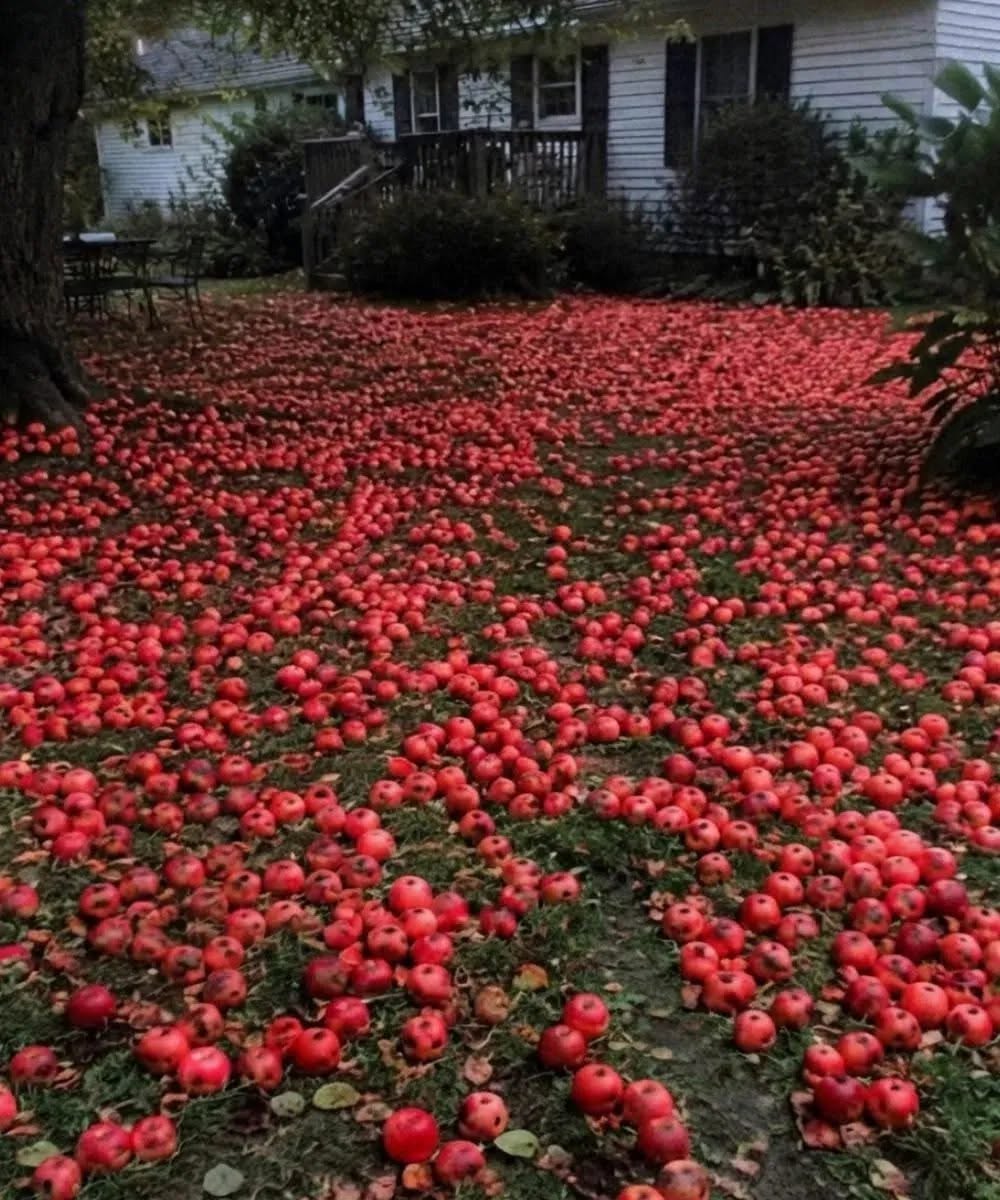
Three weeks later, I woke up to a horrific sight. Hundreds of unripe and ripe apples were violently scattered across my back lawn.
Nearly every piece of fruit had been aggressively ripped from the tree’s canopy. Several of the smaller, more fragile branches were splintered and broken, dangling pathetically. The soft soil beneath the tree had been torn apart by heavy, stomping boots.
I stood on my porch, clenching my jaw. I was not crying over lost apples. I was furious because someone had deliberately trespassed onto my safe haven and intentionally injured the living legacy Dean had left behind.
Right on cue, Ryan strolled out onto his back porch, casually sipping from a mug of coffee.
“Did you do this?” I asked, my voice dangerously quiet.
He looked at the devastated fruit, looked back at me, and smirked. “Must have been a strong wind last night.”
There had not been a breeze all night.
He stood there, visibly waiting for me to break down—to shout, to cry, or to lose my temper so he could call me hysterical. Instead, I took a deep breath, channeled Dean’s unshakeable calm, and smiled brightly right back at him.
“It must have been,” I agreed pleasantly.
Then I turned around, walked inside my house, locked the door, and immediately pulled up the trail-camera app on my iPad.
The Footage Doesn’t Lie
The digital recording captured absolutely everything in stunning night-vision clarity.
At precisely 12:47 AM, the video showed Ryan awkwardly swinging his legs over my wooden fence. He was carrying a long metal fruit picker and two large plastic buckets. He maliciously stripped the apples from the branches, violently shook the smaller limbs, and even clumsily climbed into the lower boughs of the tree when some stubborn fruit wouldn’t drop. I watched in anger as several branches audibly snapped beneath his weight.
Once his buckets were full, he carried the apples around to my garden and began spitefully dumping them across the grass. He made a total of six trips back and forth.
During his final trip, exhausted by his own vandalism, he stopped directly in front of the hedge where my camera was hidden to catch his breath. He looked right into the lens. His smug, sweating face was perfectly visible.
I watched the video twice to ensure it was saved and backed up to the cloud. Then, I brewed a fresh pot of coffee and began planning my response.
A Meticulous Delivery
I went out into the yard and carefully collected every single apple that remained whole, leaving the broken branches exactly as they were for evidence. At two in the morning, under the pale moonlight, I hauled a stack of paper shipping tags, a ball of twine, gardening gloves, my trusty wheelbarrow, and a large piece of poster board out into the yard.
For the next three hours, I sat in the cool night air and engaged in a repetitive, almost meditative task. I attached a numbered tag to each and every usable apple.
Every single tag read the exact same thing:
“Removed from Sloane’s tree without permission.”
When I was finished, I counted them. There were exactly 245 apples.
I loaded them into the wheelbarrow, quietly rolled it over to Ryan’s property, and began arranging them on his beloved expanse of sterile white stones. I arranged them in mathematically perfect, immaculate rows. I did not throw a single one, I did not step on his minimal landscaping, and I did not touch his house.
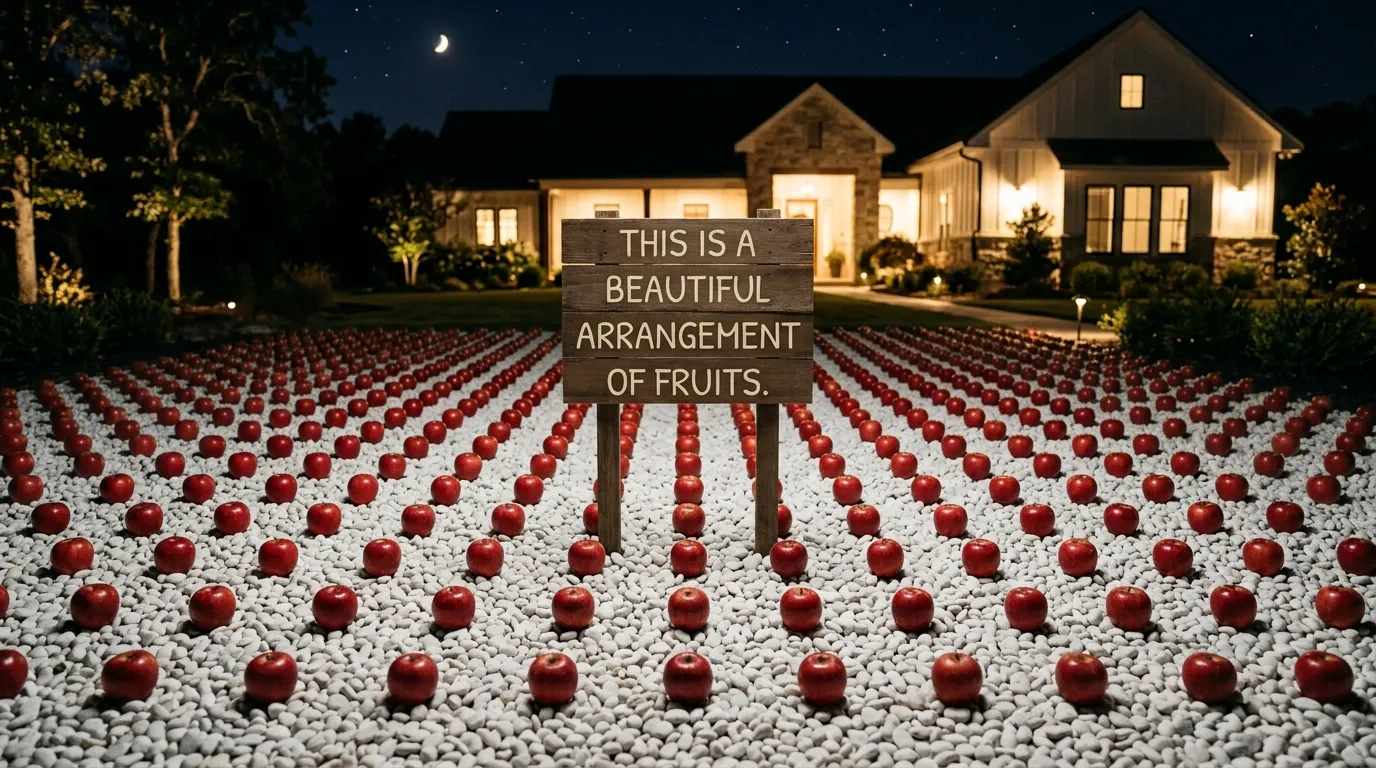 The 245 apples were laid out with meticulous precision.
In the dead center of this ruby-red display, I staked the large sign I had made:
“Strong wind appears to blow both ways.”
Satisfied with my handiwork, I returned home, washed my hands, and waited for the sun to rise.
The Trap is Sprung
Ryan discovered the architectural apple grid at sunrise, and his reaction did not disappoint. His enraged shouting echoed down the block, waking up half the street.
“What is this?!” he yelled, furiously gesturing at his yard.
I calmly stepped onto my front porch, holding a fresh mug of tea.
“The wind must have been especially strong last night,” I noted, mimicking his tone from the day before.
“You did this!” he screamed, his face turning an impressive shade of purple.
“I have absolutely no idea what you mean, Ryan.”
“I’m reporting you to the homeowners’ association immediately!”
I took a sip of tea. “Go ahead.”
He had marched blindly right into the trap.
Mira arrived twenty minutes later, looking exasperated. Ryan immediately rushed toward her car, waving his arms and frantically claiming that I had maliciously covered his expensive landscaping with rotting rubbish.
Mira walked over, examined the perfectly numbered rows, and read the sign out loud. She then turned to me. “Sloane, did you place these here?”
“Yes, Mira, I did,” I answered clearly. “I also have high-definition video showing exactly how they were violently removed from my tree and scattered across my garden in the middle of the night.”
All the angry, flushed color instantly drained from Ryan’s face.
Mira turned her sharp gaze toward him. “Did you enter her property, Ryan?”
“No!” he lied, panicking.
I didn’t say another word. I simply held up my phone, turned the brightness all the way up, and pressed play.
The video clearly showed Ryan climbing the fence, filling the buckets, breaking the branches, and dumping the fruit. When the recording ended, the usually bustling street was dead silent.
Ryan sputtered, trying to pivot. He claimed the branches had crossed onto his property. But the footage clearly showed him deep inside my yard. Then, in a desperate leap of logic, he loudly accused me of editing the video with artificial intelligence.
Mira’s expression turned to stone. “You had absolutely no right to enter her garden, damage her tree, or remove that fruit.”
Ryan pointed a shaking finger toward the apples on his lawn. “And she had the right to do this to my yard?!”
“Placing items on another person’s property is not advisable,” Mira said diplomatically, though I could see the corner of her mouth twitching.
“I’ll happily remove them,” I replied.
“After they have been thoroughly documented,” she added.
By then, a small crowd of curious neighbors had gathered on the sidewalks. Mrs. Patel, the sweet elderly woman from across the road, stared at Ryan in utter disgust.
“You climbed into a widow’s garden in the middle of the night to attack a tree?” she asked loudly.
Ryan pointedly ignored her. Meanwhile, Mira pulled out her smartphone and began dialing.
“What are you doing?” he demanded, his voice cracking.
“I am calling the police.”
His remaining confidence evaporated into thin air. “That really isn’t necessary, we can work this out—”
“You trespassed and maliciously damaged private property,” Mira stated.
“It was only a tree!”
“It was not your tree.”
When the police officers arrived, Ryan was a mess. He changed his story three separate times. First, he claimed the apples had fallen naturally in a storm. Then, he said he had generously entered my garden to clean them up for me. Finally, when backed into a corner, he insisted I had given him verbal permission to prune the tree.
My timestamped trail-camera video effortlessly disproved every single version of his lies.
Later that afternoon, I had an arborist inspect the tree. Two major branches had suffered serious trauma and had to be amputated, but thankfully, the tree’s core was healthy. It would survive.
The legal fallout for Ryan was swift. He was heavily fined for trespassing and vandalism, ordered by the court to pay my arborist and repair costs, and assigned fifty hours of community service.
The local judge overseeing the case appeared to possess a fantastic sense of irony: Ryan was assigned to help maintain the public orchard in the town park.
For several consecutive Saturdays, he was forced to wear a bright orange vest, pick apples, rake wet leaves, and remove rotting fallen fruit from the public pathways. The first time I happened to drive past the park and saw him miserably hauling a massive basket of apples, I laughed so hard I had to pull my car over to the shoulder.
The Tree Surprised Me
After the great apple incident, the dynamic of our neighborhood shifted dramatically. People who had previously just offered polite waves began stopping by to check on me more frequently. During one of these visits, Mira asked whether I would consider organizing a “Community Apple Day” in my backyard the following autumn.
At first, my instinct was to fiercely protect it and refuse. Although I had always happily shared the fruit, the tree itself still felt deeply, painfully personal. It was a private sanctuary; it belonged exclusively to the memories Dean and I had created together in our final months.
But then, I closed my eyes and remembered him standing beside that incredibly fragile, tiny sapling, exhausted but glowing with hope.
“Give it time,” he had said. “It’ll surprise you.”
So, I took a leap of faith and agreed.
The following spring, the tree bloomed more vibrantly than ever before. Not every damaged branch recovered—the empty spaces where Ryan had broken them served as permanent scars—but the healthy limbs compensated, filling with a dense cloud of white and pink flowers. By September, heavy, crisp red apples hung from the boughs once more.
On the day of the gathering, Mira helped me set up long folding tables across my back garden. Families from all down the street arrived carrying empty mason jars, glass pie dishes, wooden cutting boards, and even an antique cider press.
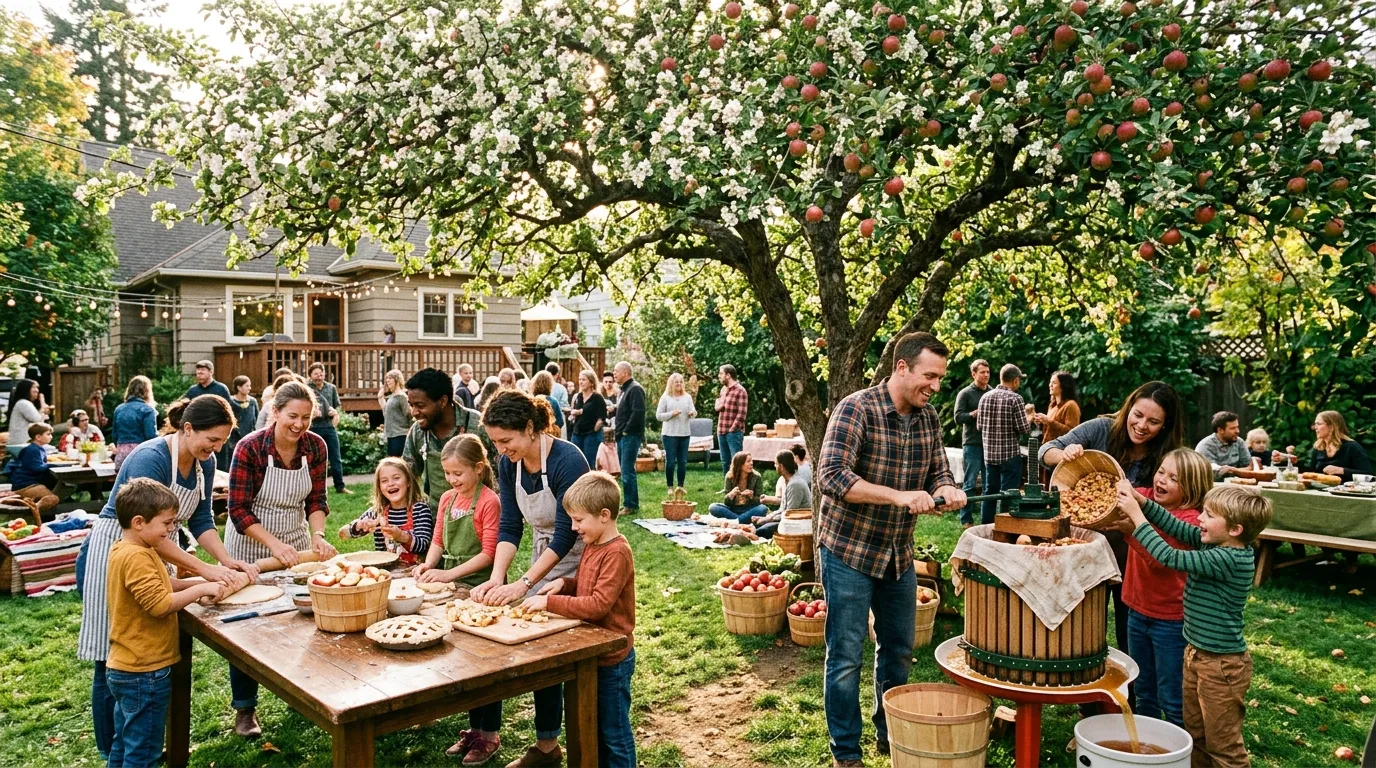 The tree that was once a private memorial became the heart of our community.
Children squealed with delight as they picked apples under their parents’ supervision. Mrs. Patel set up a station and taught several teenagers the secret to making her famous, slow-cooked apple butter. It was joyful chaos—someone burned the crust of the very first pie, while someone else accidentally dumped far too much cinnamon into the boiling cider pot.
The entire street smelled sweet, spicy, and alive.
Standing back and watching the laughter, I realized something profound. For the first time since Dean’s passing, his tree no longer felt like a fragile relic that I needed to fiercely protect all alone. It had successfully grown into something much larger than just the two of us.
Next door, Ryan remained shut inside his house for most of the afternoon. I had not invited him, of course, but I also hadn’t asked anyone to explicitly exclude him or make him feel unwelcome.
Near the very end of the celebration, as the sun was beginning to set, two of the neighborhood children carried a paper plate up to his front door. A massive, warm slice of apple pie rested on it, right beside a steaming cup of fresh cider.
Ryan opened the door, looking bewildered. He stared down at the children, and then his eyes drifted across the street to meet mine.
For a long, tense moment, neither of us moved.
Finally, his shoulders slumped just a fraction, and he reached out to accept the plate from the kids.
“Thank you,” he said softly.
It was not a formal apology. We did not suddenly become best friends, and we certainly didn’t start chatting over the fence. But Ryan never complained about the tree ever again. He kept a respectful distance, honored the property line, and left me and my garden in absolute peace.
That was more than enough.
Today, Dean’s tree still reminds me of his incredible patience, his warm sense of humor, and his unwavering belief that beautiful, good things can continue to grow long after a terrible loss. But now, it reminds me of something else, too.
When Ryan trespassed and violently stripped the tree bare, I truly believed he had permanently damaged one of the final physical connections I had to my late husband. Instead, his cruelty forced me to stand up and defend it. He inadvertently taught me that remaining kind and polite did not mean I had to allow someone to walk all over me.
And somehow, through the chaos of it all, a tree that had once represented only my solitary grief blossomed into the beating heart of an entire community.
Dean had been right from the very beginning. All I ever needed to do was give it a little time.
The tree truly did surprise me.
Note:This work is inspired by real events and people, but it has been fictionalized for creative purposes. Names, characters, and details have been changed to protect privacy and enhance the narrative. Any resemblance to actual persons, living or dead, or actual events is purely coincidental and not intended by the author.
All images used in this article are AI-generated and intended for illustrative purposes only.