
At seventy-two, Edward Hale had achieved everything society calls success. He owned companies across three continents, lived in penthouses, and traveled wherever he pleased. Yet on that quiet morning, as his black luxury sedan crawled down a narrow, overgrown dirt road, none of that mattered.
It had been forty-seven years since he had last driven this way.
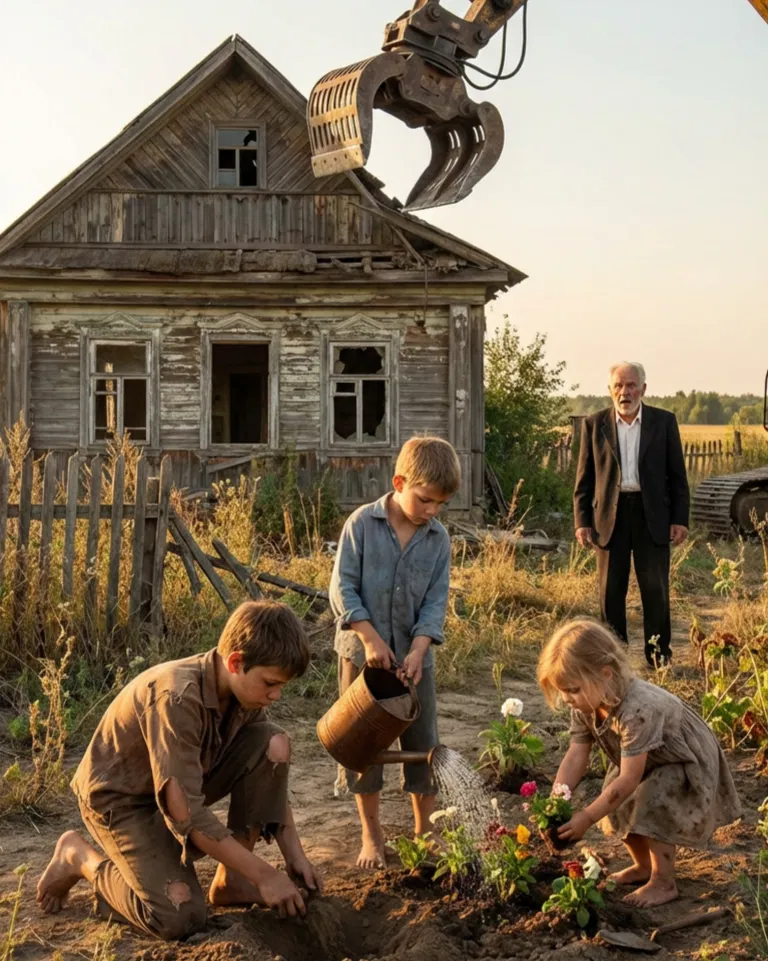
The old house emerged slowly from behind wild grass and tangled vines. Once white, its paint now peeled in long, tired strips. Several windows were cracked or missing entirely, and the front porch sagged under the weight of time. It looked forgotten—left behind by the world.
Edward stopped the car.
On the passenger seat lay a thick manila folder. Inside were permits, signatures, and finalized plans. The demolition crew was scheduled to arrive the following week. The land would be cleared, divided, and sold. Practical. Clean. Final.
As he stepped out, his polished shoes sank slightly into the soft earth. That was when he noticed something unexpected.
Flowers.
Near the foundation of the house, bright roses bloomed—red, yellow, and pink—carefully planted, lovingly tended. Completely out of place against the decay.
Edward frowned and walked closer.
Then he heard voices.
Children’s voices.
Coming from behind the house.
He moved cautiously, rounding the side of the structure—and froze.
Three children stood in what had once been his mother’s vegetable garden.
The oldest was a boy of about twelve, tall and serious, dirt smudged across his hands. Beside him, a younger boy—maybe nine—carefully arranged flowers into a small basket. And near them stood a little girl, no older than six, wearing a faded blue dress and holding blooms almost bigger than her hands.
“Easy with the roots,” the oldest boy said gently. “Mama said if you’re rough, they won’t grow back next year.”
Edward cleared his throat. “Excuse me.”
All three spun around. The little girl instinctively stepped closer to her brothers.
The oldest boy straightened. “Can we help you, sir? This is private property.”
Edward blinked. “What are you doing here?”
“We live here,” the boy said simply. “Not inside—it’s not safe. But we take care of the place.”
Edward’s chest tightened. “Where are your parents?”
The children exchanged glances. The little girl’s eyes filled with tears.
“It’s just us,” the boy said quietly. “Has been for a while.”
“How long?” Edward asked.
“Eight months. After our mom died, they were going to separate us. Different foster homes.” He swallowed. “I’m Aaron. This is Lucas, and our sister Nia. We stay together.”
“So you ran away,” Edward said softly.
Aaron lifted his chin. “We found a home.”
Edward looked again at the garden. Straight rows. Healthy soil. Care. Love.
“Why the flowers?” he asked.
Nia spoke, her voice small but steady. “Because homes should have flowers. Mama said they mean someone cares.”
Edward turned away, pretending to inspect the house, though his eyes burned.
He had grown up here—the only son of Margaret Hale, a woman who believed gardens mattered even when money didn’t. She had planted roses every spring. Red, yellow, pink.
He was seventeen when the argument shattered everything. His father had found the college acceptance letter—full scholarship, far away. Harsh words were said. Ultimatums made.
Edward left.
And never came back.
Not when his father died.
Not when his mother passed.
Not once in forty-seven years.
“I own this house,” Edward finally said.
The children’s faces fell.
Aaron nodded. “We’ll leave. Just… could we have a day?”
Lucas frowned. “If it’s yours… why didn’t you take care of it?”
Aaron hissed at him, but Edward raised a hand.
“That’s a fair question,” he said quietly. “I stayed away because it was easier than facing what I lost.”
Nia stepped forward and held out a pink rose. “Then you should have one.”
Edward accepted it with trembling fingers.
“How have you survived?” he asked.
“There’s a working well,” Aaron explained. “We grow food. I take small jobs in town.”
“I can read big books now,” Nia added proudly. “Aaron teaches us.”
Edward swallowed hard.
“I came today to finalize the demolition,” he admitted.
The children stiffened.
“No,” he said quickly. “You won’t leave.”
They stared at him.
“I abandoned this place chasing success,” Edward continued. “But you reminded me what I forgot. Home isn’t walls. It’s care.”
He pulled out his phone. “I’m canceling the demolition. I’m restoring this house.”
Aaron’s voice shook. “We can stay?”
“I’m asking if you’ll help me bring it back to life,” Edward said. “And if you’ll let me be part of yours.”
Tears welled in Aaron’s eyes.
Nia ran forward and hugged Edward tightly. He froze—then wrapped his arms around her, sobbing openly.
That evening, as the sun painted the house gold, Aaron brought Edward a small wooden box found upstairs. Inside were old photographs—and a letter.
Written by his mother.
If you ever come home, it read, remember—it’s never too late.
Edward held the children close.
They hadn’t just saved a house.
They had brought him home.