
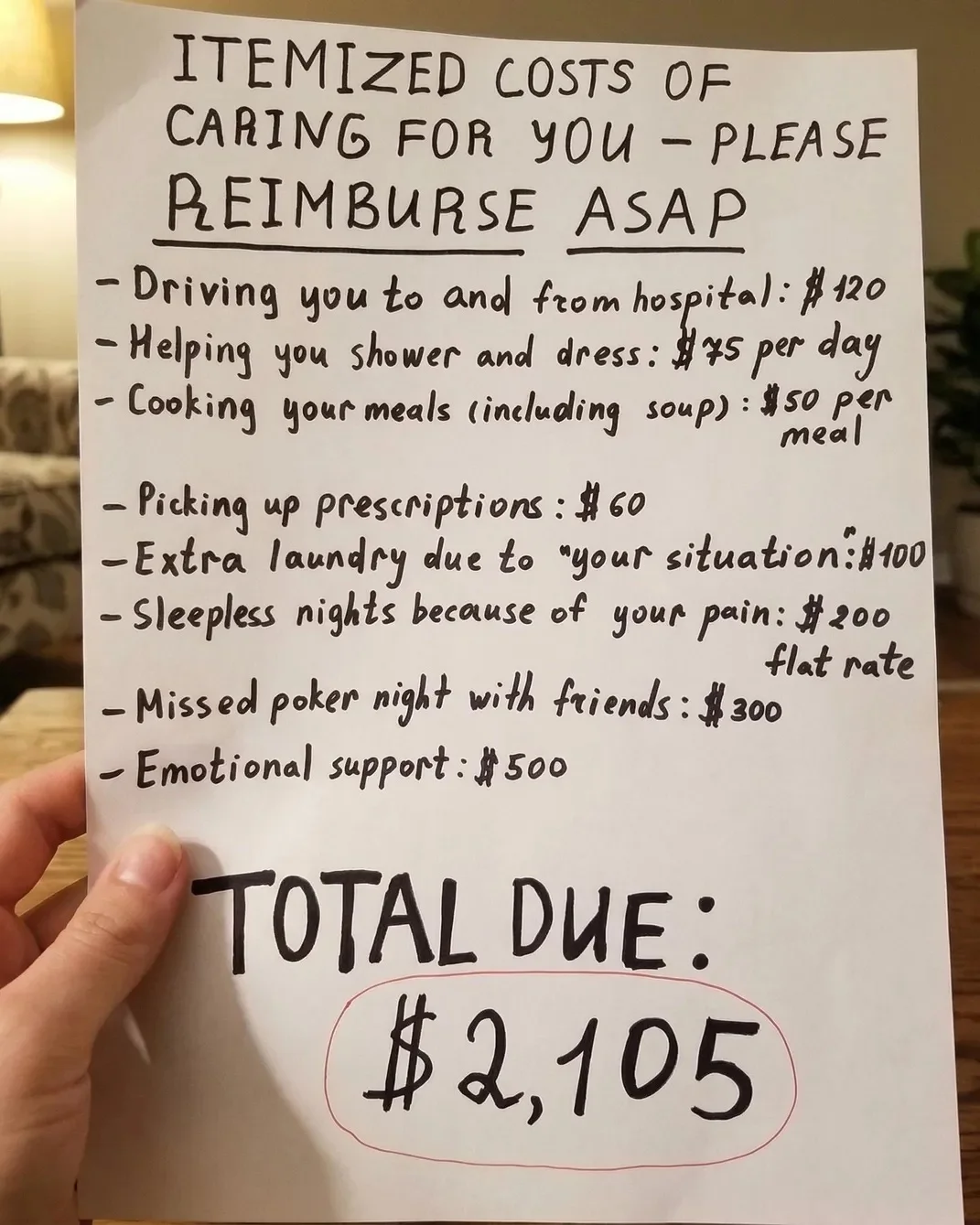
There is a unique vulnerability that comes after surgery, a state where you are wholly dependent. It was in that state that I encountered a piece of paper that would redefine my seven-year marriage. Taped to our refrigerator, amidst magnets from our travels, was a note from my husband. But it wasn’t a wish for my health or a sweet nothing. It was an itemized bill. Every act of care I had received in my convalescence—the rides, the meals, the lost wages—had a dollar value neatly written beside it. The man who had vowed to cherish me had, in my deepest need, chosen to act as my accountant.
Before that moment, I would have described our relationship as equitably loving. We worked hard, shared chores, and faced life’s small storms together. The surgery was our first major crisis, and I had felt so grateful for his steady presence. He told me not to worry, that we were in this together. His words were the blanket I wrapped around my fears. To find that list was to have that blanket ripped away, exposing me to a chilling truth: in his heart, his compassion had conditions, and my recovery was accruing interest.
The hurt was paralyzing at first, but it soon fermented into a powerful clarity. I began to mentally catalogue my own contributions to our life, the endless stream of tasks and emotional support I provided simply because I loved him and our shared life. I realized I had been running a silent, uncredited service for years. So, I did the one thing I knew would make him understand. I sat at the same table where he’d written his list and composed my own. I assigned fair value to my labor as a homemaker, planner, and emotional anchor. The final sum was a quiet, devastating revelation of all I gave that had never been seen as “work.”
Presenting my list to him was one of the hardest things I’ve ever done. He stared at the numbers, his face crumbling not from anger, but from shame and realization. He saw the monumental, unacknowledged economy of my love laid bare. He admitted that anxiety had turned him into someone he didn’t recognize, someone who kept score when he should have been offering solace. We both saw the grotesque picture a transactional relationship paints.
That exchange, though born of pain, became our path to salvage. We acknowledged that love cannot be a series of debits and credits without dying. We sought professional guidance to help us communicate from a place of generosity, not calculation. The refrigerator note is long gone, but its shadow lingers as a permanent reminder. It taught us that the deepest love is measured not in what is counted, but in what is given freely, without the expectation of ever being paid back.