
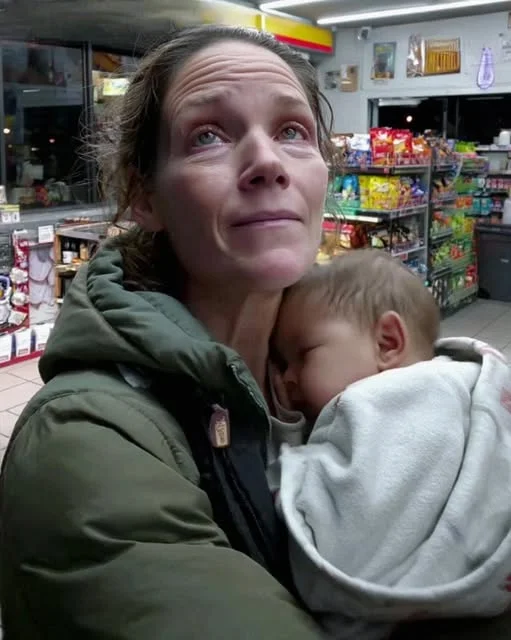
The world looks different at midnight from behind the counter of a gas station. You meet people in their raw, unguarded moments. I’m Ross, and after a lifetime of factory work, this is where I found myself. It’s a job that teaches you to appreciate the quiet and notice the small details. One detail that stood out was a young mother, her face etched with a fatigue I recognized, holding a sleeping child. She moved quietly, placing a carton of milk, a loaf of bread, and a box of diapers on the counter. When I told her the total, her face fell. She was four dollars short. The defeat in her whisper as she asked to put the diapers back was a sound I knew all too well—the sound of life being just a little too hard.
I didn’t hesitate. I pulled four singles from the wallet in my back pocket—money I’d earned—and placed it in the register. “It’s okay,” I said. “Just get home safe.” The relief that washed over her was immediate and profound. She didn’t cry, but her eyes shone with the threat of tears as she gathered her groceries and her son and hurried out. I went back to my shift, the moment fading into the backdrop of another long night. I had my own family, my own financial worries that kept me up during the day, but this was a need I could meet. It was a small anchor of stability in a sea of uncertainty, both for her and, though I didn’t know it yet, for me.
The following week, my manager handed me a plain white envelope. Inside was a check for five thousand dollars and a note that turned my understanding of that night upside down. The note was from the parents of the woman I’d helped, a woman named Emily. They explained that she had been fleeing a difficult situation to return to them, and my small act of kindness had been a critical point of hope on her journey. They invited me to their home. I drove there on a Sunday, my old car feeling out of place in their neighborhood. Robert and Margaret welcomed me not as a stranger, but as a friend. Over lunch, they painted a picture of their daughter’s life that made my own struggles seem manageable. She had felt trapped and worthless, and my simple, dignified help had reminded her that she mattered.
I left their house that day with more than just the check. I carried with me a new story about myself. For years, I had defined myself by what I had lost—my secure job, my financial comfort. I saw myself as a man who had been left behind. But through Robert and Margaret’s eyes, I was a hero. Not for the amount, but for the action. Not for the money, but for the mercy. Margaret told me that the most powerful kindnesses are the ones we don’t think about, the ones that come from our core. That four dollars wasn’t a calculation; it was a reflex of my character.
Back in my own small, noisy, and wonderfully full house, I held my wife a little tighter. We used the money to solve problems that had loomed large, and the relief was tangible. But the true wealth was the shift in my perspective. I no longer see my gas station job as just a way to pay the bills. It’s a front-row seat to the human experience. I am more aware now, more open to the subtle signs that someone might need a little help. The greatest discovery I made wasn’t in an envelope; it was the realization that even when you feel you have very little, you always have enough to be someone’s miracle. And sometimes, that miracle has a way of circling back to you.